Directional Antenna 3-Way

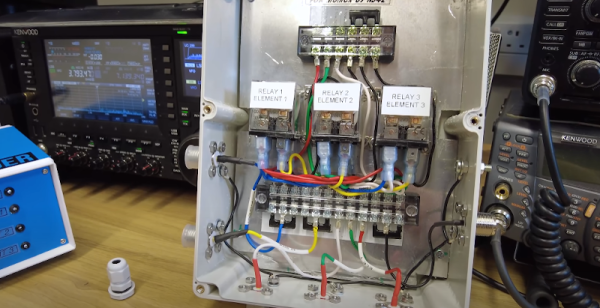
If you read old antenna books, you’ll probably see the idea of phased vertical antennas. These use certain lengths of coax to control the phase of a signal going to three verticals in a triangular configuration. Depending on the phasing, you can cause the array of antennas to be directional in one of three directions. [DX Commander] designed a very modern version of this antenna and shows the theory behind it in a recent video that you can see below.

It seems another ham built the antenna and a control box for it which he’s sent to [DX Commander] although he hasn’t set it up yet to create an 80 meter directional antenna. We’ll be interested in seeing how it works in practice.

Continue reading “Directional Antenna 3-Way”

Affordable HF Loop Antenna Reviewed

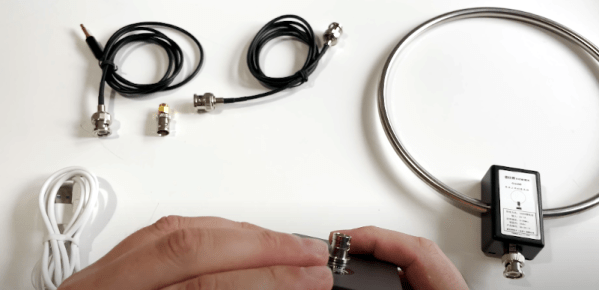
Modern ham radio operators often face restrictions on antennas. This has made small antennas more popular, despite some limitations. [Tech Minds] reviews the GA-450 indoor active HF loop antenna and finds it better than expected. You can see the video review below.

You can’t expect a little antenna to perform as well as giant skyhook. However, for such a small loop covering 3 to 30 MHz, the antenna seems to perform very well. We like that the active part of it has a rechargeable battery. Obviously, you will only want to use this antenna for receiving, but it would be a great pairing for an HF-capable software defined radio (SDR). Even just in the window sill with half gain, it was able to pick up quite a bit of signal on the 40 meter and 20 meter ham bands. According to the video, performance below 7 MHz was lackluster, but it worked nicely at higher frequencies.

The loop is directional and you can rotate the loop on the base to zero in on a particular signal. Of course, if the antenna were up in the air, it might be harder to rotate unless you work out something with a motor. If all you want to do is receive and you have a budget of under $100, this looks like it would be a nice portable option.

You can build your own loop and loop-like antennas, of course. Some of them can be quite portable.

Continue reading “Affordable HF Loop Antenna Reviewed”

3D Printing Copper

People really want to 3D print metal, but while true metal printers exist, they still are expensive and out of reach of most hackers. However, even if you can afford an exotic printer or use metal-impregnated polymer, you don’t often see copper as a print material. Copper has high electrical and thermal conductivity which makes it very useful. But that thermal conductivity also makes it very difficult to print using any process that involves heating up the material and copper reflects common lasers used in the 3D printing process. However, a German company, Infinite Flex, is claiming a breakthrough that will allow printers that use a standard IR laser to produce copper parts. The material, Infinite Powder CU 01 is suitable for selective laser sintering and several other laser-based techniques.

The powder has 99.5% copper and particle sizes of between 10 and 45 microns. There are some copper alloys that reduce thermal conductivity to allow printing, but often the reason you want a copper part is for its thermal properties. A kilogram of the powder will set you back nearly $100, so it isn’t dirt cheap, but it isn’t astronomical, either.

Continue reading “3D Printing Copper”

All About Mecanum

If you’ve dealt with robots or other wheeled projects, you’ve probably heard of mecanum wheels. These seemingly magic wheels have the ability to move in any direction. If you’ve ever seen one, it is pretty obvious how it works. They look more or less like ordinary wheels, but they also have rollers that rotate off-axis by 45 degrees from the normal movement axis. This causes the wheel’s driving force to move at a 45 degree angle. However, there are a lot of details that aren’t apparent from a quick glance. Why are the rollers tapered? How do you control a vehicle using these wheels? [Lesics] has a good explanation of how the wheels work in a recent video that you can see below.

With four wheels, you can have a pair of wheels — one at the front right and one at the back left — that have a net force vector of +45 degrees. Then the other pair of wheels can be built differently to have a net force vector of -45 degrees. The video shows how moving some or all wheels in different directions can move the vehicle in many different directions.

Continue reading “All About Mecanum”

Arduino Meets Quantum Computer

Quantum computers aren’t quite ready for the home lab, but since there are ways to connect to some over the Internet, you can experiment with them more easily than you might think. [Norbert] decided to interface a giant quantum computer to an ordinary Arduino. Why? Well, that isn’t necessarily clear, but then again, why not? He explains basic quantum computing and shows his setup in the video below.

Using the IBM quantum computer and the open source Qiskit makes it relatively easy, with the Python code he’s using on the PC acting as a link between the Arduino and the IBM computer. Of course, you can also use simulation instead of using the real hardware, and for such a simple project it probably doesn’t matter.

Granted, the demo is pretty trivial, lighting an LED with the state of qubit. But the technique might be useful if you wanted to, say, gather information from the real world into a quantum computer. You have to start somewhere.

We’ve looked at quantum computers before. They tell us it is the next big thing, so we want to be prepared. Qiskit is one of several options available today to make it easier.

Continue reading “Arduino Meets Quantum Computer”

AI Camera Knows Its S**t

[Caleb] shares a problem with most dog owners. Dogs leave their… byproducts…all over your yard. Some people pick it up right away and some just leave it. But what if your dog has run of the yard? How do you know where these piles are hiding? A security camera and AI image detection is the answer, but probably not the way that you think.

You might think as we did that you could train the system to recognize the–um–piles. But instead, [Caleb] elected to have the AI do animal pose estimation to detect the dog’s posture while producing the target. This is probably easier than recognizing a nondescript pile and then it doesn’t matter if it is, say, covered with snow.

Continue reading “AI Camera Knows Its S**t”

Hack The Web Without A Browser

It is a classic problem. You want data for use in your program but it is on a webpage. Some websites have an API, of course, but usually, you are on your own. You can load the whole page via HTTP and parse it. Or you can use some tools to “scrape” the site. One interesting way to do this is woob — web outside of browsers.

The system uses a series of backends tailored at particular sites. There’s a collection of official backends, and you can also create your own. Once you have a backend, you can configure it and use it from Python. Here’s an example of finding a bank account balance:

>>> from woob.core import Woob
>>> from woob.capabilities.bank import CapBank
>>> w = Woob()
>>> w.load_backends(CapBank)
{'societegenerale': <Backend 'societegenerale'>, 'creditmutuel': <Backend 'creditmutuel'>}
>>> pprint(list(w.iter_accounts()))
[<Account id='7418529638527412' label=u'Compte de ch\xe8ques'>,
<Account id='9876543216549871' label=u'Livret A'>,
<Account id='123456789123456789123EUR' label=u'C/C Eurocompte Confort M Roger Philibert'>]
>>> acc = next(iter(w.iter_accounts()))
>>> acc.balance
Decimal('87.32')

The list of available backends is impressive, but eventually, you’ll want to create your own modules. Thankfully, there’s plenty of documentation about how to do that. The framework allows you to post data to the website and easily read the results. Each backend also has a test which can detect if a change in the website breaks the code, which is a common problem with such schemes.

We didn’t see a Hackaday backend. Too bad. There are, however, many application examples, both console-based and using QT. For example, you can search for movies, manage recipes, or dating sites.

Of course, there are many approaches possible to this problem. Maybe you need to find out when the next train is leaving.