All Band Radio Uses Arduino And Si4730

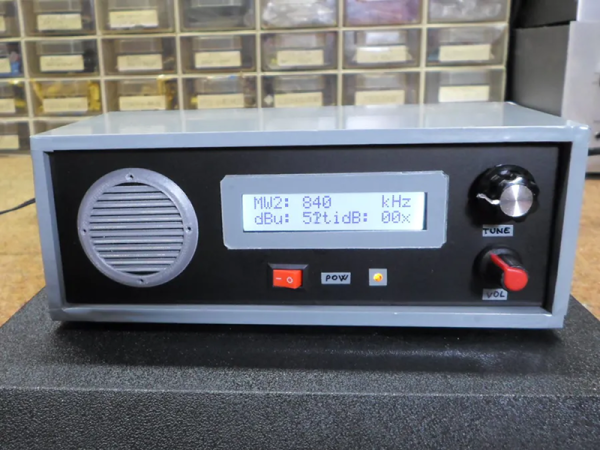
It is getting harder and harder to tell homemade projects from commercial ones. A good case in point is [Mirko’s] all band radio which you can see in the video below the break. On the outside, it has a good looking case. On the inside, it uses a Si4730 radio which has excellent performance that would be hard to get with discrete components.

The chip contains two RF strips with AGC, built-in converters to go from analog to digital and back and also has a DSP onboard. The chip will do FM 64 to 108 MHz and can demodulate AM signals ranging from 153 kHz to 279 kHz, 520 kHz to 1.71 MHz, and 2.3 MHz to 26.1 MHz. It can even read RDS and RBDS for station information. The output can be digital (in several formats) or analog.

Continue reading “All Band Radio Uses Arduino And Si4730”

Welcome To McDonald’s; Would You Like 3D Printing Resin With That?

University of Toronto researchers have succeeded in converting used cooking oil — from McDonald’s, no less — into high-resolution 3D printing resin. Your first response might be: “Why?”, but thinking about it there are several advantages. For one thing, waste oil is a real problem for the food industry, and thus it can be acquired rather cheaply. An even bigger benefit is that the plastic that originates from this oil is biodegradable. Their 3d-printed butterfly, of course, is made from the recycled resin.

We aren’t chemists, but apparently 3D resin has a lot in common with cooking oil already. The team used a one-step chemical process to convert one liter of McDonald’s greasiest into a little more than 400 milliliters of resin.

Continue reading “Welcome To McDonald’s; Would You Like 3D Printing Resin With That?”

Hacking Multiplication: Binary Multiply On Paper

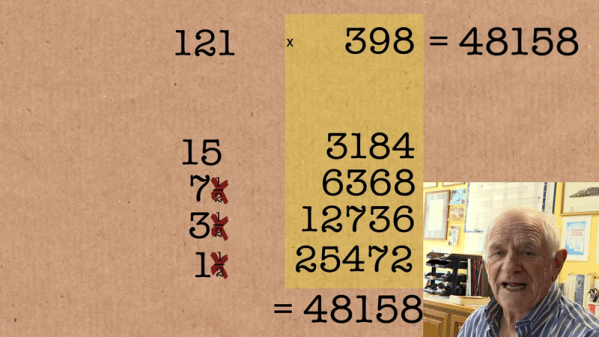
We’ve often noted that whether had ancient man known binary, we could all count to 1023 on our fingers. We thought about that while watching [Numberphile’s] latest video about “Russian” multiplication (see below). Apparently, the method dates back quite a way, sometimes known as Ethiopian or peasant multiplication. Even the ancient Egyptians did a form of it.

If you’ve ever written long multiplication code for a microcontroller, you can probably tell how this works. Each halving of the number amounts to a right shift. Each doubling is a left shift. Throwing out the even numbers means you only take the values when the least-significant bit is zero. Booth’s algorithm is more efficient, but the “Russian” method is simple to do on paper.

Continue reading “Hacking Multiplication: Binary Multiply On Paper”

Turning A Problem Around: The Whitney Cotton Gin

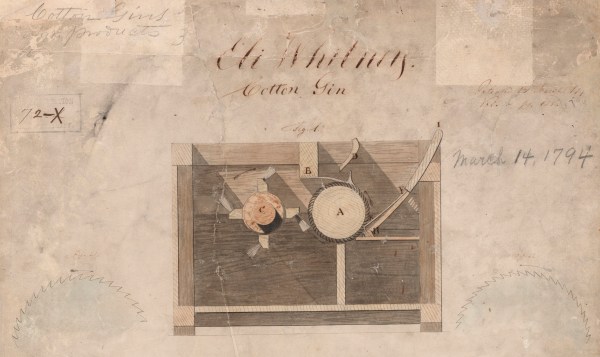
If you went to elementary school in the United States, you no doubt learned about Eli Whitney’s cotton gin as an example of how the industrial revolution took previously manual processes and replaced the low-efficiency of human labor with machines. The development of the cotton gin — patented in 1794 — involves an interesting lesson about solving engineering problems.

Farmers in the southern United States had a big problem. Tobacco was a cash crop, but it eventually left your fields barren and how to solve that problem wasn’t understood yet. Indigo was valuable for dye, but the British were eating away that market with indigo created in its colonies. Rice requires a lot of water and swamp, so it was only suitable for certain areas.

There was one thing that grew very readily in much of the land: cotton. Unfortunately, the cotton had little seeds you had to remove. A single person could clean — maybe — a pound of cotton a day. In the late 1700s, plantation owner Catharine Littlefield Greene introduced Whitney to a group of farmers were trying to decide if there was a way to make cotton a more profitable crop.

Continue reading “Turning A Problem Around: The Whitney Cotton Gin”

Laser Etches Solar Absorbing Material

Having a laser cutter these days isn’t a big deal. But [Chunlei Guo], a professor at the University of Rochester, has a powerful femto-second pulse laser and used it to create what might be the perfect solar absorber. You can see a video about the work, below.

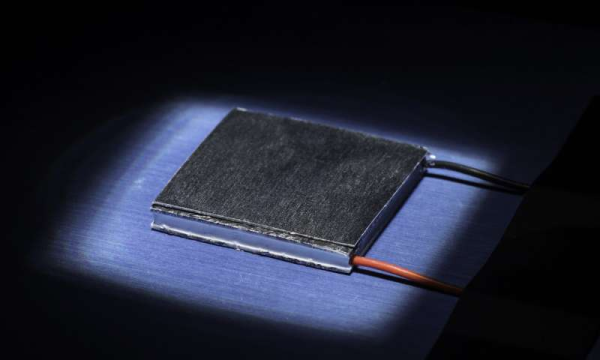
It stands to reason that white materials reflect most light and therefore absorb less energy than black materials — this is part of what makes a radiometer work. Tungsten, in particular, is a good metal for absorbing solar power, but this new laser treatment — which builds nanostructures on the surface of the metal — increases efficiency by 130% compared to untreated tungsten.

Continue reading “Laser Etches Solar Absorbing Material”

Tool Writes Your PWM Code For You

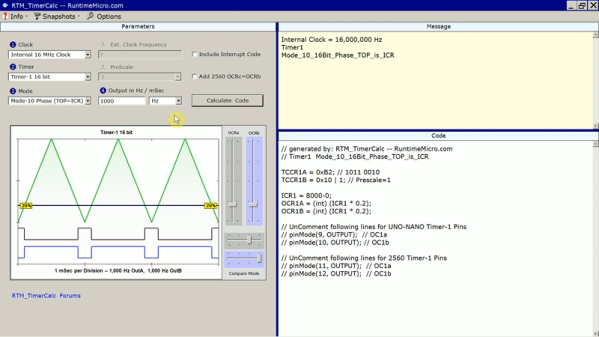
The good thing about computers is they do your work for you, right? If you are a programmer, that doesn’t always seem to be a true statement. [Runtimemicro] has the answer, at least if you are writing PWM code for the Arduino. Their free application lets you set a few parameters, visually see the results, and then generates code for you. You can see a video of the tool in operation, below.

According to their site, the tool works for timers 1 through 5 on an Arduino Nano, Uno, or Mega2560. The app appears to work on Windows, but it doesn’t look like it would have any trouble running under Wine on other platforms.

Continue reading “Tool Writes Your PWM Code For You”

Ham Antennas From MIT

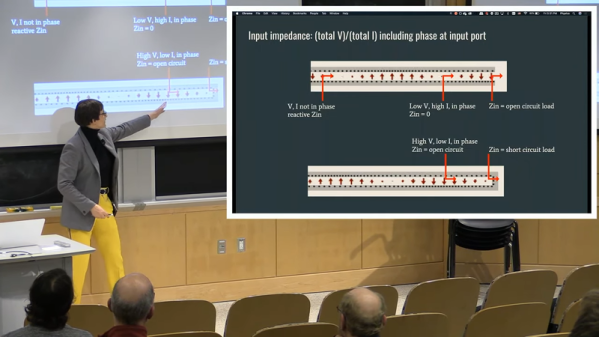
Dealing with an antenna is one of those topics we never feel like we know enough about. MIT had a live stream of [Dr. Kiersten Kerby-Patel] discussing antennas in a talk, sponsored by the ham radio club on campus. You can see the recording below.

The main assertion of the presentation is that everything is a dipole unless it is a loop. Although the professor probably deals with antennas at an extremely high theoretical level, she did a great job of keeping it aimed at ham radio operators.

Continue reading “Ham Antennas From MIT”