What The Well-Dressed Radio Hacker Is Wearing This Season

We’ve seen a lot of interest in Meshtastic, the license-free mesh network for small amounts of data over the airwaves. [Ham Radio Rookie] was disappointed with his Meshtastic node’s small and inefficient antennas. So he decided to make what we suspect is the world’s first Meshtastic necktie.

We assume the power is low enough that having it across your thorax is probably not terrible. Probably. The tie is a product of a Cricut, Faraday cloth, and tiny hardware (the Xiao ESP32S3 and the WIO SX1262 board). The biggest problem was the RF connector, which needed something smaller than the normal BNC connector.

Continue reading “What The Well-Dressed Radio Hacker Is Wearing This Season”

On The Original Punched Cards

If you mention punch cards to most people, they’ll think of voting. If you mention it to most older computer people, they’ll think of punching programs for big computers on cards. But punched cards are much older than that, and [Nichole Misako Nomura] talks about how the original use was to run looms and knitting machines and — thanks the Internet Archive — you can still find old cards to drive modern machines.

According to the post, a dedicated group of people own old commercial knitting machines, and with some work, they can use archived punch cards with patterns that predate the computerized world. The Jacquard loom was famously the first machine to use cards like this, and it is no secret that they were the inspiration for Hollerith’s use of cards in the census, which would eventually lead to the use of cards for computing.

Continue reading “On The Original Punched Cards”

DIY Microwave Crucibles

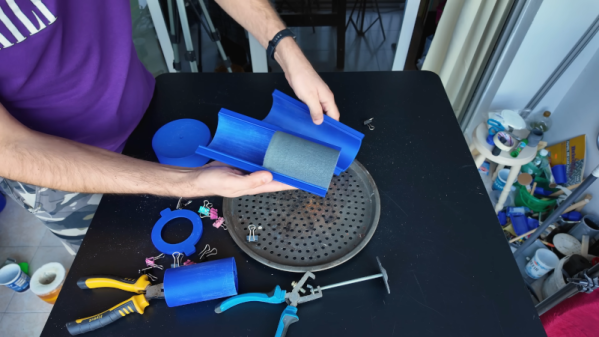
You know the problem. You are ready to melt some metal in your microwave oven, and you don’t have any crucibles. Not to worry. [Shake the Future] will show you how to make your own. All you need is some silicon carbide, some water glass (sodium silicate), and some patience.

The crucible takes the shape of a glass container. Don’t get too attached to it because the glass will break during the crucible construction. You can also use 3D-printed forms.

Continue reading “DIY Microwave Crucibles”

Your Chance To Get A Head (A Gnu Head, Specifically)

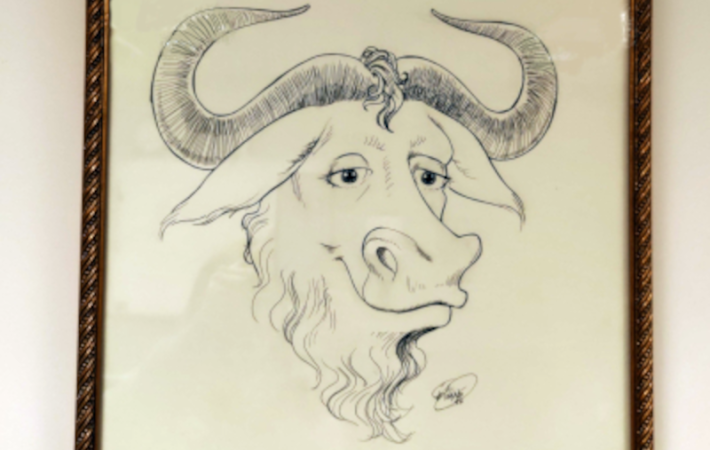
The Free Software Foundation is holding an auction to celebrate its 40th anniversary. You can bid on the original sketch of the GNU head by [Etienne Suvasa] and [Richard Stallman’s] Internet Hall of Fame medal.

There are some other awards, including the FSF’s 1999 Norbert Wiener Award. There’s even a katana that symbolizes the fight for computer user freedom.

Continue reading “Your Chance To Get A Head (A Gnu Head, Specifically)”

C++ Is 45 Years Old. [Stroustrup] Says You Still Don’t Get It!

We were surprised when we read a post from C++ creator [Bjarne Stroustrup] that reminded us that C++ is 45 years old. His premise is that C++ is robust and flexible and by following some key precepts, you can avoid problems.

We don’t disagree, but C++ is much like its progenitor, C, in that it doesn’t really force you to color inside the lines. We like that, though. But it does mean that people will go off and do things the way they want to do it, for any of a number of good and bad reasons.

Continue reading “C++ Is 45 Years Old. [Stroustrup] Says You Still Don’t Get It!”

Repairing An Old Heathkit ‘Scope

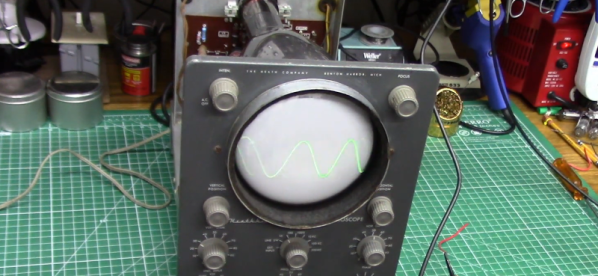
With so many cheap oscilloscopes out there, the market for old units isn’t what it used to be. But if you have a really old scope, like the Heathkit O-10 that [Ken] found in his basement, there is vintage cred to having one. [Ken’s] didn’t work, so a repair session ensued. You can see the results in the video below.

You can tell this is in an old scope — probably from the mid 1950s — because of its round tube with no graticle. Like many period scopes, the test probe input was just 5-way binding posts. The O-10 was the first Heathkit “O-series” scope that used printed circuit boards.

The device looked pretty good inside, except for a few dents. Of course, the box has tubes in it, so every power up test involves waiting for the tubes to warm up. [Ken] was very excited when he finally got a single green dot on the screen. That did, however, require a new CRT.

It wasn’t long after that he was able to put a waveform in and the scope did a good job of reproducing it. The unit would look good in an old movie, but might not be the most practical bench instrument these days.

These Heathkit scopes and their cousins were very popular in their day. The $70 price tag sounds cheap, but in the mid-1950s, that was about a month’s rent in a four-room house. While primitive by today’s standards, scopes had come a long way in 9 or 10 years.

Continue reading “Repairing An Old Heathkit ‘Scope”

Turn Your Phone Into A POV Hologram Display

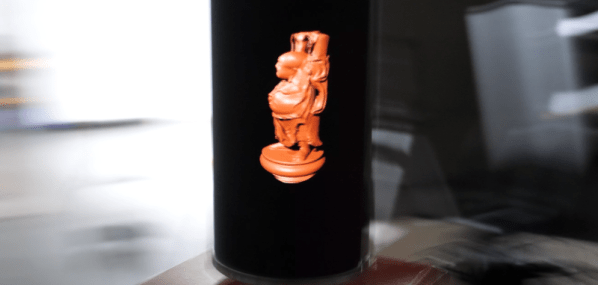
It seems obvious once you think about it, but if you can spin your cell phone and coordinate the display with the motion, you can create a 3D display. [Action Lab] had used such a setup to make a display that you could view from any angle. After he showed it, a viewer wrote him to mention that if you spin the picture at the same rate, it will appear in 3D. The results look great, as you can see in the video below.

The spinning mechanism in this case is an inexpensive pottery wheel. Whatever you use, though, you need a way to match the speed of the graphics to the speed of the phone’s rotation. For this example, there are just a few pre-spun 3D models on a website. However, creating your own viewer like this wouldn’t be that hard. Even more interesting would be to read the phone sensors and spin the image in sync with the phone’s motion.

We keep hearing about awesome commercial 3D stuff coming out “any day now.” Meanwhile, you can always settle for Pepper’s Cone.

Continue reading “Turn Your Phone Into A POV Hologram Display”