Classic Heathkit OL-1 Scope Gets Some TLC

These days, not only are oscilloscopes very common, but even a cheap instrument today would have been the envy of the world’s greatest labs not that long ago. But back in the day, the home experimenter basically had two choices: buy a surplus scope that a big company was getting rid of or build a Heathkit. [Radiotvphononut] bought an old Heathkit OL-1 scope at an estate sale and set about putting it back in service.

If you are used to a modern scope, you’ll be amazed at how simple a scope like this can be. A handful of tubes and a CRT is the bulk of it. Of course, the OL-1 is an analog scope with a 400 kHz bandwidth. It did, however, have two channels, which was a rarity at the time.

The OL-1 was sold for a few years up to 1956 and cost about $30 as a kit. There was a version with a larger screen (five whole inches) that cost an extra $40, so you can bet there were more OL-1s sold since $40 was a big ask in 1956. While they don’t seem like much today, you were probably the envy of the ham club in 1956 when you lugged this in for show and tell.

This is a long video, but it pays off at the end. Overall, this was a more capable scope than the $66 scope from 10 years earlier we looked at. Did you ever wonder how people visualized signals before the CRT? Funny, we did too.

Continue reading “Classic Heathkit OL-1 Scope Gets Some TLC”
Heathkit Signal Generator Gets An Update

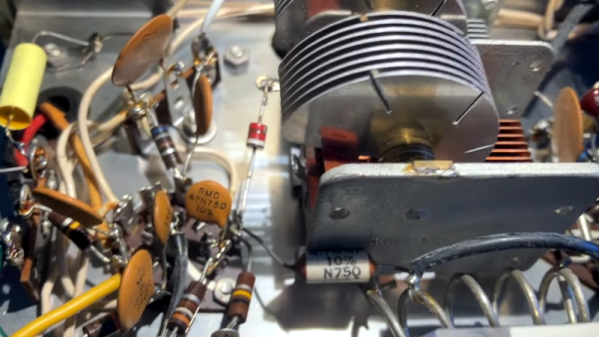
[DTSS_Smudge] correctly intuits that if you are interested in an old Heathkit signal generator, you probably already know how to solder. So, in a recent video, he focused on the components he decided to update for safety and other reasons. Meanwhile, we get treated to a nice teardown of this iconic piece of test gear.

If you didn’t grow up in the 1960s, it seems strange that the device has a polarized line cord with one end connected to the chassis. But that used to be quite common, just like kids didn’t wear helmets on bikes in those days.

A lot of TVs were “hot chassis” back then, too. We were always taught to touch the chassis with the back of your hand first. That way, if you get a shock, the associated muscle contraction will pull your hand away from the electricity. Touching it normally will make you grip the offending chassis hard, and you probably won’t be able to let go until someone kindly pulls the plug or a fuse blows.

These signal generators were very common back in the day. A lot of Heathkit gear was very serviceable and more affordable than the commercial alternatives. In 1970, these cost about $32 as a kit or $60 already built. While $32 doesn’t sound like much, it is equivalent to $260 today, so not an impulse buy.

Some of the parts are simply irreplaceable. The variable capacitor would be tough to source since it is a special type. The coils would also be tough to find replacements, although you might have luck rewinding them if it were necessary.

We are spoiled today with so many cheap quality instruments available. However, there was something satisfying about building your own gear and it certainly helped if you ever had to fix it.

There was so much Heathkit gear around that even though they’ve been gone for years, you still see quite a few units in use. Not all of their gear had tubes, but some of our favorite ones did.

Give Your SMD Components A Lift

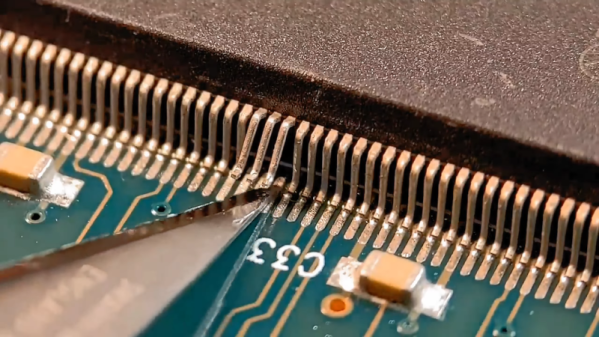
When you are troubleshooting, it is sometimes useful to disconnect a part of your circuit to see what happens. If your new PCB isn’t perfect, you might also need to add some extra wires or components — not that any of us will ever admit to doing that, of course. When ICs were in sockets, it was easy to do that. [MrSolderFix] shows his technique for lifting pins on SMD devices in the video below.

He doesn’t use anything exotic beyond a microscope. Just flux, a simple iron, and a scalpel blade. Oh, and very steady hands. The idea is to heat the joint, gently lift the pin with the blade, and wick away excess solder. If you do it right, you’ll be able to put the pin back down where it belongs later. He makes the sensible suggestion of covering the pad with a bit of tape if you want to be sure not to accidentally short it during testing. Or, you can bend the pin all the way back if you know you won’t want to restore it to its original position.

Continue reading “Give Your SMD Components A Lift”

For Desalination, Follow The Sun

It’s easy to use electricity — solar-generated or otherwise — to desalinate water. However, traditional systems require a steady source of power. Since solar panels don’t always produce electricity, these methods require some way to store or acquire power when the solar cells are in the dark or shaded. But MIT engineers have a fresh idea for solar-powered desalination plants: modify the workload to account for the amount of solar energy available.

This isn’t just a theory. They’ve tested community-sized prototypes in New Mexico for six months. The systems are made especially for desalinating brackish groundwater, which is accessible to more people than seawater. The goal is to bring potable water to areas where water supplies are challenging without requiring external power or batteries.

The process used is known as “flexible batch electrodialysis” and differs from the more common reverse osmosis method. Reverse osmosis, however, requires a steady power source as it uses pressure to pump water through a membrane. Electrodialysis is amenable to power fluctuations, and a model-based controller determines the optimal settings for the amount of energy available.

There are other ways to use the sun to remove salt from water. MIT has dabbled in that process, too, at a variety of different scales.

Nuclear Tomb Must Survive

It is hard to imagine that much we built today will be used ten years from now, much less in a hundred. It is hard to make things that last through the ages, which is why we are fascinated with things like ancient pyramids in Mexico, Egypt, and China. However, even the oldest Egyptian pyramid is only about 5,000 years old. [Mark Piesing] at the BBC visited a site that is supposed to lock up nuclear waste for 100,000 years.

This particular project is in France, but there are apparently dozens of similar projects around the world. Locating these nuclear tombs is tricky. They need to be in a geologically stable area that won’t contaminate water. They also prefer areas already depleted of resources to lessen the chance someone will be digging nearby in the far future. You also need people to agree to have these facilities in their communities, which is probably the most difficult thing to find.

Continue reading “Nuclear Tomb Must Survive”

The 1983 Clock Four Decades In The Making

In 1983, a 14-year-old [Will] saw an LED clock in The Sharper Image store. At $250, it stayed in the store. That was a lot of money back then, especially for most teenagers. But [Will] didn’t forget. After high school, he and a friend planned to build one from scratch. They worked out how they would do it and did a little prototyping, but never really finished. Well, they never really finished at the time. Because 33 years later, [Will] decided to finally put it together. Check it out in the video below.

[Will’s] learned a lot since his original design, plus we have tech today that would have seemed like magic in the late 1980s. But he wanted to stay true to the original design, so there’s no microcontroller or smart LEDs. Just binary counters and a lot of LEDs. There’s even a 555 doing duty as a reset timer.

Continue reading “The 1983 Clock Four Decades In The Making”

Strange English Teaching Computer Might Have Been Big In Japan

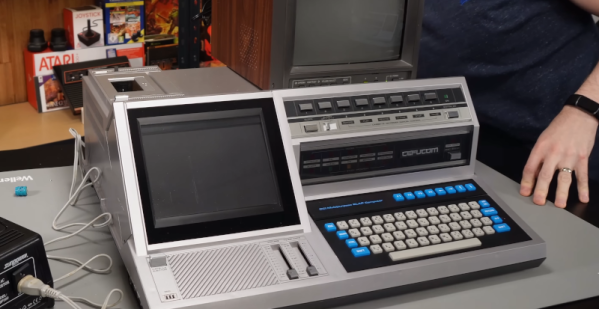
[Ctrl-Alt-Rees] bought something strange on an auction site: a Japanese Cefucom-21 from 1983. No? Didn’t ring a bell for us either. The legend on the front boldly proclaims: “CCI Multipurpose SLAP Computer,” so maybe it is some kind of computer, but it is definitely strange. For one thing, the “screen” isn’t a screen at all. [Rees] has found that it has something to do with teaching English. You can see the odd beast in the video below.

We don’t know how common these were in Japan, but they appear to be virtually unknown everywhere else. Inside is a Z80 computer based on a  Sanyo PHC-25, which is a little better known.

Continue reading “Strange English Teaching Computer Might Have Been Big In Japan”