A Simple High-Fidelity DIY Mic Pre Amp

If you’re doing any serious work with microphones, you’ll typically find yourself in want of a dedicated preamp. [ojg] needed just such a thing for acoustic measurement duties, and set about working up a cheap DIY design by the name of ThatMicPre.

The design is based around the THAT1510 preamp IC, known for its good frequency response and low harmonic distortion and noise. The design is also compatible with THAT1512, SSM2019, and INA217 chips as well. [ojg] gave the design switch-controlled gain levels, providing greater accuracy than a potentiometer adjustment, and the ability to supply phantom power for mics that require it. The PCB is designed to rely on through-hole parts and common connectors for easy assembly.

The design is open source, and has already been built by others on the DIYAudio forums. Built into a simple case, it looks like a handsome and well-built piece of audio equipment. We’ve featured quite a few unique preamps over the years, and if you’ve been building your own, we’d love to see those too!

Foot Pedal Ups Vim Productivity, Brings Ergonomic Benefits

Vim is the greatest or the worst text editor of all time, depending on the tribe you’re in. Either way, members of both camps can appreciate this build from [Chris Price], which uses a foot pedal to ease operations for the user.

The basic concept was to use a pedal to enable switching between normal and insert modes. In Vim’s predecessor, vi, switching modes was easy, with the ESC key located neatly by the Q on the keyboard of the ADM-3A terminal. On modern keyboards, though, it’s a pain, and so a foot pedal is a desirable solution. In the Vim world, it’s referred to as a “Vim clutch.”

The build used a cheap pedal switch sourced from eBay, into which a Raspberry Pi Pico was installed. The Pico was hooked up to the switch contacts, and programmed to act as a USB HID device. When the pedal is pressed down, the Pico sends an “i” keypress to enter Vim’s insert mode. Releasing the pedal has the Pico send a “ESC” keypress to return to normal mode.

Those that use Vim on a regular basis would likely appreciate the productivity improvements of such a device. Plus, there’s some ergonomic benefits to not having to strain one’s hand over to reach the ESC key. Of course, it’s an old-school solution, but there’s still something so compelling and next-level about having a foot pedal hooked up to one’s dev rig.

Motion-Activated Clock Only Lights Up On Command

While some of us can fall asleep anywhere from a noisy auditorium to a brightly lit train station, others are more fussy, requiring quiet and dark to nod off. [Craig Lindley] likes to minimize light when he’s trying to sleep, and decided to build himself a simple clock that wouldn’t disturb his rest.

The basic concept was to build a clock that would only display the time on command. In this case, that command would be a wave of a hand in front of the clock. The build is based around a Lilygo ESP32 T-Display unit, which combines the ESP32 with an LCD display and a battery management system. The ESP32’s WiFi connection provides accurate time via querying an NTP server. A passive infrared motion sensor is used to detect the motion of the user’s hand in front of the clock.

While all kinds of clocks and clock radios are available out there, few are motion activated. [Craig]’s work is a great demonstration of building your own solutions to your problems. We’ve seen some other neat motion-sensing convenience hacks before, too!

Two-Thirds Keyboard Is Inspired By The Typesetting Era

We see all kinds of custom keyboard builds around here. Most of them are intended to optimize typing to the user’s desires. This glorious build from [Attoparsec] isn’t one of those, and is instead part of the growing joke keyboard genre. The so-called Two-Thirds Keyboard is inspired by the long-gone typesetting era.

The build is based on the typecases used in the era when type was assembled by hand. Typesetters would grab “majuscule” letters from the upper case of type, and “miniscule” letters from the lower case of type, when setting a page, which would go on to influence how we refer to those letters today. Letters that came up more often, like e and s, would get larger compartments in the type cases, while rarer letters like z and q would get smaller compartments. The Two-Thirds keyboard replicates this by giving the most common letters the biggest keys, while rarer letters and upper-case majuscule letters get smaller keys. The overall layout matches that of the popular Two-Thirds California Case of type that grew popular in the US in the typesetting era.

There were some engineering issues in building the keyboard. While stabilizers are available for wide keys like Enter and Space in regular keyboard designs, stabilizing keys that are wide and high is fussy. The build relies on multiple switches to enable them to move cleanly. Nor were 2×2 and 2×3-sized custom keycaps readily available. In the end, resin printing was key to producing all the necessary components.

Typing on the keyboard is not quick, but lower speeds were probably acceptable in the typesetting era. Regardless, [Attoparsec] used it for a full week to do it justice, going from around 10  wpm to 22 wpm by the end of the test.

It’s a fun build, but by no means the slowest keyboard we’ve ever seen.

Continue reading “Two-Thirds Keyboard Is Inspired By The Typesetting Era”

Building A Chain Drive Differential From Junkyard Parts

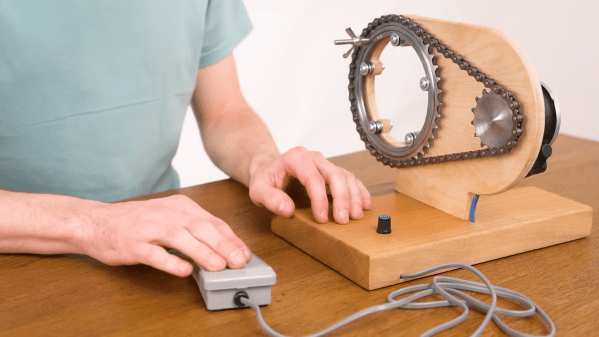
A differential is a very useful thing for a vehicle. It allows two driven wheels to rotate at different speeds, such as when going around a corner. [Workshop From Scratch] needed a chain driven differential, so set about building one from a salvaged automotive unit.

The differential itself was taken from a BMW E46 3-Series, specifically a 2.0-liter diesel model. The work began by removing the differential’s center gears from its big, hefty iron housing. Disassembly then ensued, with the spider gears removed from their carrier and the other components discarded. The differential gears themselves were installed instead in a new compact housing, fabricated with much welding and lathery. The housing was fitted with a large chain sprocket to deliver drive, in place of the original differential’s ring gear and pinion.

The video’s description states it would be an ideal differential for a go-kart, buggy, or other such small vehicle. Given the differential gears were originally built to handle a full-sized car, they should be more than capable of dealing with such applications.

If you’re a little unfamiliar with how differentials work, check out this primer from the early 20th century. It’s widely considered to be the best education on the topic. Video after the break.

Continue reading “Building A Chain Drive Differential From Junkyard Parts”

3D Printed Gadgets Make Lab Work Easier

If you’ve worked in a bio or chem lab, you’ve probably found yourself handling all manner of plastic. Test tubes, fixtures, clamps — there’s a cavalcade of this stuff that fattens up the order books of lab suppliers every quarter. Sometimes, though, the commercial solutions aren’t quite what you need. For [AtomicVirology], the solution was to 3D print custom lab accessories to make work easier.

The tube adapter allows the collection of 60 small samples without having to unload the fraction collector halfway through. That’s a big quality-of-life improvement for staffers using the equipment.

Some of the devices are straightforward, like simple holders for upright storage of centrifuge tubes. Others are fun twists on the theme, like the Millennium Falcon tube holder or one shaped like the Imperial Star Destroyer. Meanwhile, a resuable plastic tube cover serves as a way to protect tubes from light without the fuss of covering them in aluminium foil. It’s less wasteful, too!

Our favorite, though, is a simple adapter for holding fraction tubes in a AKTA fraction collection device. Stock, the AKTA device will hold 30 small tubes in the inside ring, and 30 larger tubes in the outside ring. Thanks to a simple printed part, though, it can be modified to hold 60 tubes of the smaller size. This allows the collection of 60 small fractions in a shorter period of time simply by moving the delivery head from the inner to the outer ring, without having to swap out 30 tubes halfway through a chromatography column, for example.

It goes to show that a 3D printer is good for more than just churning out Pikachus. It’s a Swiss Army knife for solving fiddly little problems without having to rely on some company to injection-mold you 10,000 examples of whatever it is you want. Of course, if you do want to injection mold something, we’ve covered how to do that before, as well.

Australia’s Soft Plastic Recycling Debacle

We’ve all been told to cut back on waste to help prevent environmental crisis on Earth. Reducing waste helps reduce the need to spend time and energy digging up fresh materials, and helps reduce the amount of trash we have to go out and bury in the ground in landfills. Recycling is a big part of this drive, allowing us to divert waste by reprocessing it into fresh new materials.

Sadly, though, recycling isn’t always as magical as it seems. As Australia has just found out, it’s harder than it sounds, and often smoke and mirrors prevent the public from understanding what’s really going on. Here’s how soft plastic recycling went wrong Down Under.

Continue reading “Australia’s Soft Plastic Recycling Debacle”