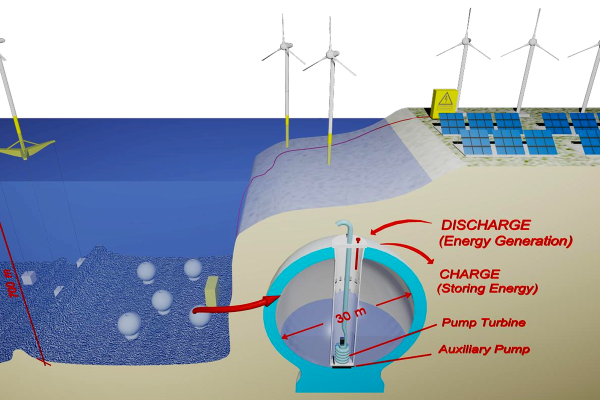
Pumped hydro storage is one of the oldest grid storage technologies, and one of the most widely deployed, too. The concept is simple – use excess energy to pump a lot of water up high, then run it back through a turbine when you want to get the energy back later.
With the rise in renewable energy deployments around the world, there is much interest in finding ways to store energy from these often-intermittent sources. Traditional pumped hydro can help, but there is only so much suitable land to work with.
However, there could be a solution, and it lurks deep under the waves. Yes, we’re talking about underwater pumped hydro storage!
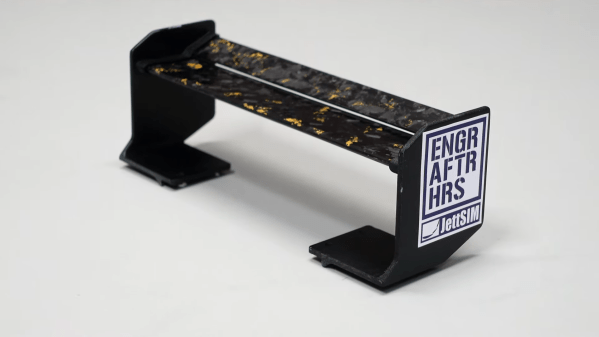
When it comes to building decent aerodynamic devices, you want to focus on getting your geometry accurate, and making sure your parts are strong enough to deal with the force they’re generating. This build from [Engineering After Hours] delivers on those fronts, consisting of a high-downforce wing for a small RC car.
The video points out that, at best, even a decent RC car will have pretty crappy aerodynamic parts from the factory, with a lift-to-drag (L/D)ratio of 2-3:1 at best. This means that, while they may create some small amount of downforce, they’re also creating plenty of drag at the same time.
The dual-element wing designed here is much more efficient, hitting an L/D ratio in the vicinity of 17:1 – a huge improvement. Even a casual eye can note that the design looks a lot more like something you’d see on a full-size car, versus some of the whackier designs seen on toys.
The wing is built with a forged carbon fiber process using 3D-printed molds, to give the wing plenty of strength. Given that it’s built for an RC car that can do over 100 mph, making sure the wing is stiff enough to perform at speed is key.
[Engineering After Hours] does a great job of showing how to prepare the molds, fill them with carbon fiber, and pour the resin, and discusses plenty of useful tips on how to achieve good results with the forged carbon process.
The result is an incredibly impressive rear wing with aerodynamic performance to match its good looks. It may be more complicated than 3D printing, but the results of the work are that much tougher.
The average home kettle is set up to switch off automatically when water reaches its boiling point. But would a kettle filled with alcohol, which has a significantly lower boiling point, actually turn off? [Steve Mould] set out to find out.
The prediction was that a kettle full of 40% strength vodka would boil dry, as the vodka would evaporate before it actually got to a hot enough temperature to cause the kettle’s cutout mechanism to kick in. The experiment was done outside to minimise the dangers from the ethanol vapor. As it turns out, the vapor from the boiling vodka is about 80% ethanol and just 20% water, so eventually the mixture left in the kettle is mostly water and it boils hot enough to trigger the cutout mechanism.
However, the experiment doesn’t end there. Trying again with 99% ethanol, when the fluid started boiling, the kettle switched off even more quickly. So what’s going on?
The kettle in question uses a bimetallic strip, which trips the switch off in the base of the kettle when it gets too hot. There’s also a tube inside the kettle that carries vapor from the internal cavity and lets it pass over the bimetallic strip. When the liquid inside the kettle boils, it forces hot vapor through the tube, out of the kettle and over the bimetallic strip.
This strip triggers at a temperature significantly lower than the boiling point of water; indeed, as long as the liquid in the kettle is fairly hot and is boiling enough to force vapor out the tube, the kettle will switch off. [Steve] points out that it’s a good mechanism, as this mechanism allows the kettle to respond to boiling itself, rather than the arbitrary 100 C point which water technically only boils at when one is at sea level.
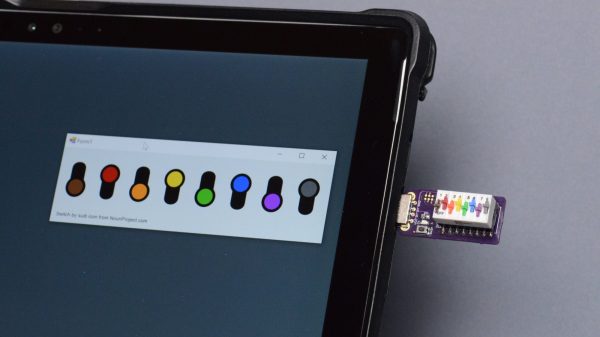
Oftentimes, when programming, we’ll put configuration switches into a config file in order to control the behaviour of our code. However, having to regularly open a text editor to make changes can be a pain. This colorful little DIP switch dongle from [Glen Aikins] makes for a fun alternative solution.
Do want.
The build is simple, relying on a rainbow-colored 8-pin DIP switch as the core of the project. A PIC16F1459 then reads the position of the switches, with the 8-bit microcontroller doing the job of speaking USB to the host machine. The device enumerates as a USB HID device, and reports to the host machine when queried as to the state of its 8 switches. [Glen] used a basic C# app to show a digital representation of the switches on screen changing as per the real physical DIP switch plugged into the machine.
It’s a great tool for controlling up to 8 different parameters in a program you might be working on, without having to dive into your editor to change the relevant parts. Also, it bears noting that the rainbow design is simply very fetching and a cool thing to have plugged into your computer. It’s a more serious device than [Glen’s] hilarious 4-byte “solid state drive” that we saw recently, but we love them both all the same!
On the 14th of January, 2022, the Hunga Tonga-Hunga Ha’apai volcano began a gigantic eruption that would go on to peak in ferocity the next day. The uninhabited island volcano would quickly make headlines as the country of Tonga was cut off the world and tsunamis bore out from the eurption zone.
In a volcanic event of this size, the effects can be felt around the world. With modern instruments, they can be properly understood too. Let’s take a look at how the effects of the Hunga Tonga eruption were captured and measured across the globe.
The idea is simple: hide the Cat Prank box in a cupboard or other space in a friend’s house, and it will meow from its secret location. When found, either the light sensor or motion sensor will trigger the yowling of an angry feline, with hopefully startling effects.
An Arduino Mini is the brains of the operation, paired with an XY-V17B sound module which plays the required animal wailings. There’s also a 433 MHz radio module that lets the prankster trigger meowing via remote control.
Code is available for those wishing to build their own. We’d love to see a mod with a time delay built in, so the device could be hidden and left to start meowing at some later date when the prankster is far away.
Similar work has graced these pages before, like the devilishly fiendish OpenKobold design. Just make sure your friends are receptive to such jokes before you go ahead and invest time and hardware in the prank!
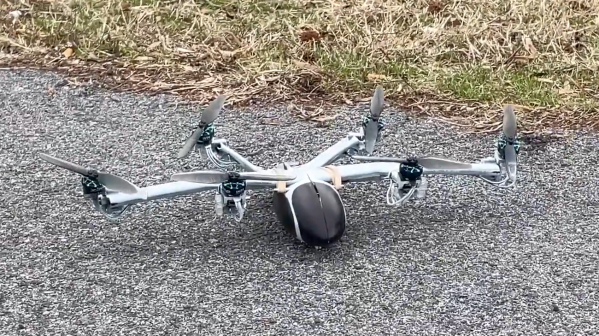
eVTOL (Electric Vertical Take-off and Landing) craft are some of the more exciting air vehicles being developed lately. They aim to combine the maneuverability and landing benefits of helicopters with the environmental benefits of electric drive, and are often touted as the only way air taxis could ever be practical. The aircraft from Joby Aviation are some of the most advanced in this space, and [Peter Ryseck] set about building a radio-controlled model that flies in the same way.
The design is inspired by the Joby eVTOL test vehicle.
The result is mighty complex, with six tilt rotors controlled via servos for the utmost in maneuverability. These allow the vehicle to take off vertically, while allowing the rotors to tilt horizontally for better efficiency in forward flight, as seen on the Bell-Boeing V-22 Osprey.
The build uses a 3D-printed chassis which made implementing all the tilt rotor mounts and mechanisms as straightforward as possible. A Teensy flight controller is responsible for controlling the craft, running the dRehmFlight VTOL firmware. The assembled craft only weighs 320 grams including battery; an impressive achievement given the extra motors and servos used relative to a regular quadcopter build.
With some tuning, hovering flight proved relatively easy to achieve. The inner four motors are used like a traditional quadcopter in this mode, constantly varying RPM to keep the craft stable. The outer two motors are then pivoted as needed for additional control authority.
In forward flight, pitch is controlled by adjusting the angle of the central four motors. Roll is achieved by tilting the rotors on either side of the plane’s central axis, and yaw control is provided by differential thrust. In the transitional period between modes, simple interpolation is used between both modes until transition is complete.
Outdoor flight testing showed the vehicle is readily capable of graceful forward flight much like a conventional fixed wing plane. In the hover mode, it just looks like any other multirotor. Overall, it’s a great demonstration of what it takes to build a successful tilt rotor craft.

 The video points out that, at best, even a decent RC car will have pretty crappy aerodynamic parts from the factory, with a lift-to-drag (L/D)ratio of 2-3:1 at best. This means that, while they may create some small amount of downforce, they’re also creating plenty of drag at the same time.