Big Infinity Mirror Clock Invites You To Gaze Deeply

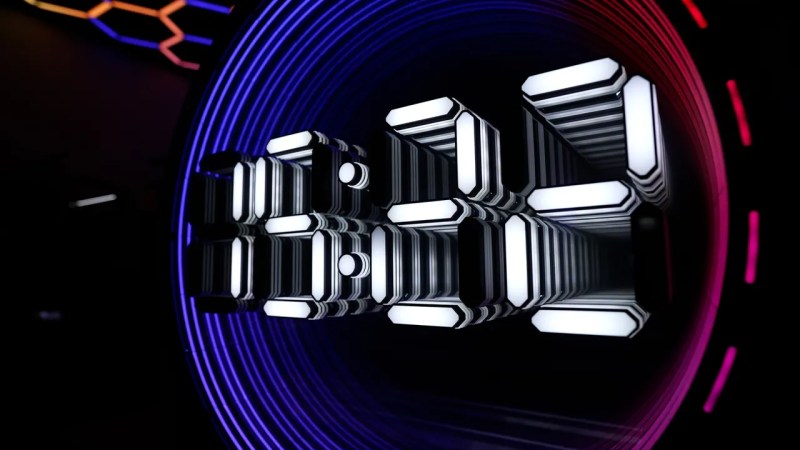
[Andy Huot] has a fantastic-looking infinity mirror digital clock that really raises the bar. It uses high quality components, smart use of RGB LED animations, and a clever “stacked diffuser” vertical design to the 7-segment display elements that really enhances the infinity mirror effect. It needs to be seen in action, so check it out.

The end result is expressly portal-like, with the smooth animations of the LEDs really playing into the effect. The size helps, too. It’s 24 inches in diameter, giving it considerable presence.
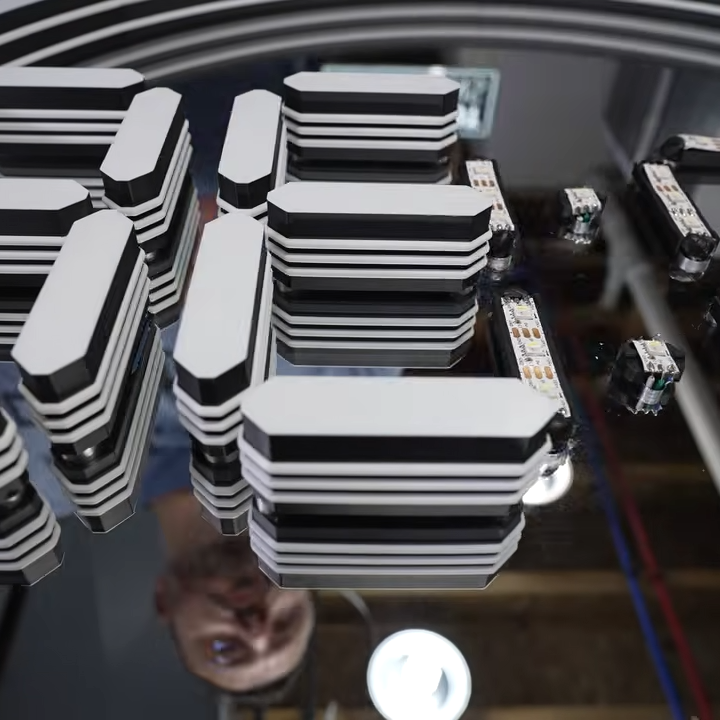
The stacked diffuser design for each display element really enhances the effect.

A basic infinity mirror design consists of lit elements sandwiched between a reflective back surface and a partially-reflective, partially-transmissive top cover. That same basic principle is used here, but with great care given to ensure nothing so much as a fingerprint spoils the illusion. For example, the top cover is a disk of acrylic with a 90% reflective film affixed to the inside surface. That’s easy enough to DIY with some car tint, but [Andy] found that for the very best results it was worth having high-quality film professionally applied.

We like the use of 3D-printed custom jigs for soldering the segments of RGB LED strips, and holding the pre-measured wires in place with some putty is a great way to keep them in place while working. In case you’re wondering, the mirrored acrylic making up the back wall has holes in it for mounting each segment’s LED strip in a holder, and running the wires to the rear.

The video (embedded below) documents every step of the assembly, and it’s a serious build. While the design files for the 3D-printed parts are not free, there’s certainly enough detail for an enterprising hacker to replicate the design in their own way.

Continue reading “Big Infinity Mirror Clock Invites You To Gaze Deeply”
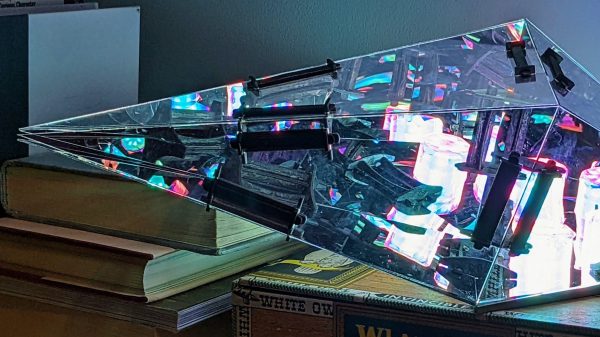
Infinity Mirror Hypercrystal Is As Beautiful As It Sounds

Sometimes, we feature projects that are full to the brim with advanced functionality or solve some tricky little problem for the end-user. Other times, we feature stuff that just looks super damn cool, and the Infinity Mirror Hypercrystal is firmly in that latter category.

This show-stopping build comes to us from [Inanna Malick], who put together the design using algorithmic and generative art techniques she’s been working on for years. The form is a non-symmetrical, non-platonic solid, with each of its eight faces laser cut from mirrored acrylic. Plywood sections are used to hold together the structure.

Initially, the build was illuminated from within by white LEDs, but [Inanna] wasn’t satisfied with the look, which was too rooted in regular human technology. They were instead covered up with transparent dichroic tape, creating the lurid shifting colors that do so much to add to the mystery of the legendary Hypercrystal.

The result is an infinity mirror piece that looks more advanced, more alien, and more luridly enticing than most we’ve ever seen. The dichroic shift placed on the LEDs goes a long way to elevating this sculpture to new aesthetic heights. Video after the break.

Continue reading “Infinity Mirror Hypercrystal Is As Beautiful As It Sounds”

A Hair-Raising Twist On Infinity Mirrors

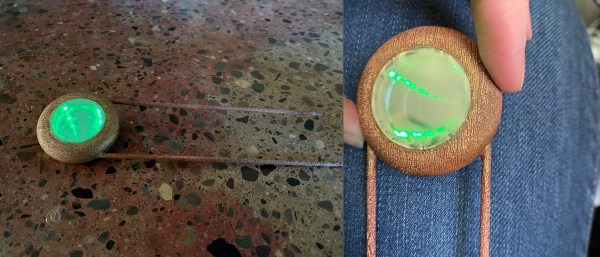
Just when we thought we’d seen it all in the infinity mirror department, [FieldCrafting] blazed a tiny, shiny new trail with their electroplated infinity mirror hair pin. We’d sure like to stick this in our French twist. Fortunately, [FieldCrafting] provided step-by-step instructions for everything from the 3D printing to the copper electroplating to the mirror film and circuitry application.

And what tiny circuitry it is! This pin is powered by a coin cell and even has a micro slider switch to conserve it. The stick parts are a pair of knitting needles, which is a great idea — they’re pointy enough to get through hair, but not so pointy that they hurt.

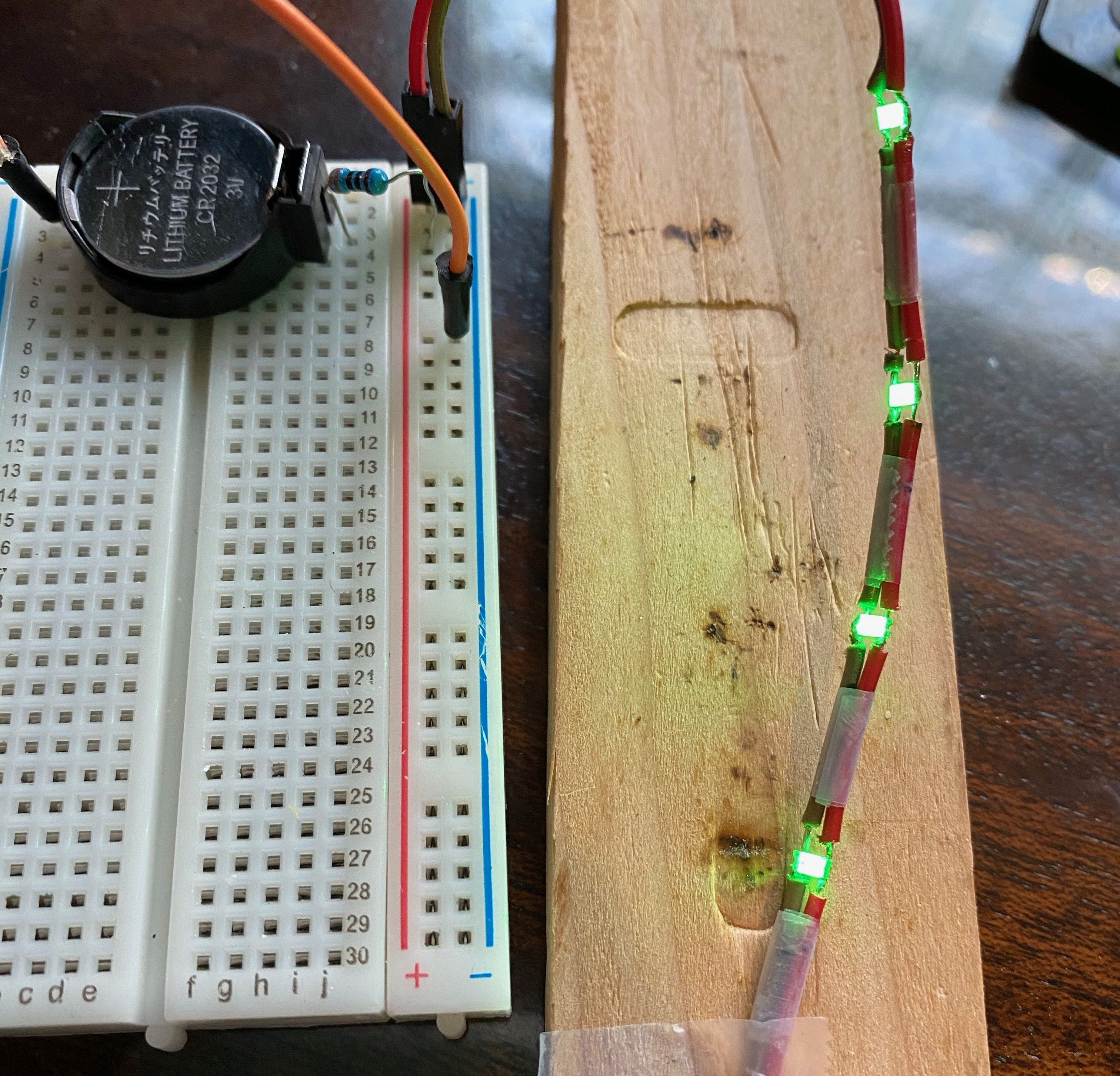
[FieldCrafting] was planning to solder 1206 LEDs to copper tape and line the cavity with it, but somehow the CAD file ended up with 0603, so there wasn’t enough space for two tape traces. We think it’s probably for the better — [FieldCrafting]’s solution was to use two-conductor wire, strategically stripped, which seems a lot less fiddly than trying to keep two bare tape traces separated and passing pixies.

Don’t have enough hair for one of these? Surely you could use some handsome infinity coasters to round out that home bar setup.

Escape Tunnel In Your Living Room: A Different Take On The Infinity Mirror

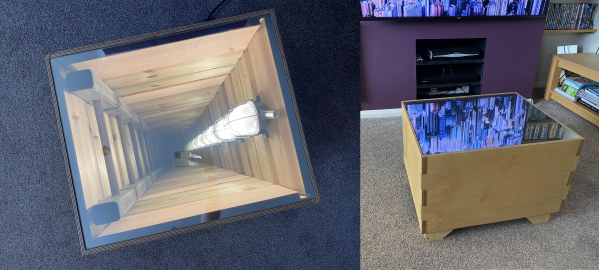
Most infinity mirrors are just minor variations on the same old recipe. Take a frame, add a normal mirror in the back, a one-way mirror on the front, and put some LEDs between them. [Stevens Workshop] took a slightly different approach and built an escape tunnel coffee table that really caught our attention.

To create the tunnel and ladder illusion, [Steven] kept the mirrors, but made a deeper wood frame, installed a light bulb in an industrial-looking socket instead of the usual LEDs, and added a single ladder rung. The end result makes for a very interesting conversation piece, and some of us prefer it to the multicolored LED look. Though he added his own touches, the idea was actually borrowed from from [asthhvdrt36] and [BreezleSprouts] on Reddit who used slightly different light and ladder designs.

While there’s nothing groundbreaking here, it’s certainly a case of “why didn’t I think of that”. Sometimes the old and familiar just needs a different perspective to create something fascinating. One of the advantages of the classic infinity mirror is the thin profile, which we’ve seen integrated into everything from guitars to coasters.

Infinity Mirror Guitar Shreds Forever

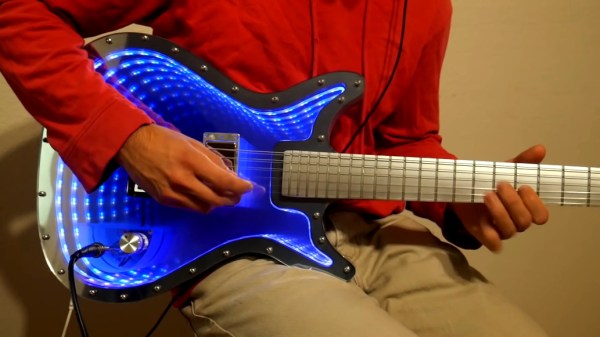
Just when we thought there was nothing left to make into an infinity mirror, [Burls Art] goes and builds something that seems obvious now that it exists — an infinity mirror guitar. Check out the build video after the break, where [Burls Art] gets right to it without wasting any time.

He started by making a 3/4″ wood frame for the body and the one-piece neck and headstock. The acrylic on the top has two-way mirror film, and the back piece is painted with mirror paint to get the infinity effect going. [Burls Art] also fashioned acrylic boxes for the pickup and the electronics. Those are both buffed to be frosty, so the lights reflect nicely off of them.

There’s nothing super-fancy going on with the electronics, just some app-controlled RGB LEDs. We would love to see a version where the LEDs respond in real time to the music. The effect is still quite cool, so if you don’t want to watch the whole build, at least check out the demo at the end where [Burls Art] plays a riff. Never has a delay pedal been so appropriate.

If you’re not much of a luthier, don’t fret about not being able to make a cover version. We’ve seen plenty of infinity mirrors, but if you want something useful, whip up some infinity drink coasters.

Continue reading “Infinity Mirror Guitar Shreds Forever”

Infinity Mirror At Warp Speed

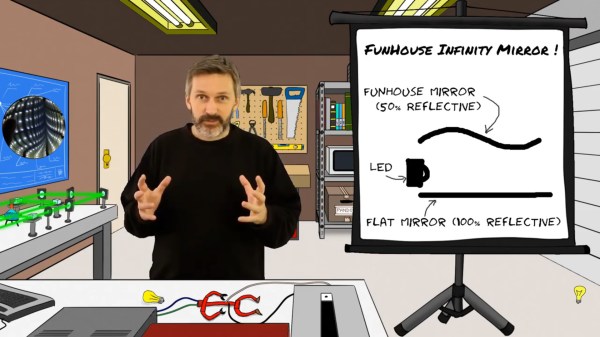
Inventing often combines more than one old ideas into a new one. Even when the fused things are similar, the result can be more valuable than the sum of its parts. Unlike those analog watches with a digital clock below the face, when [Mojoptix] combined the re-reflecting properties of an infinity mirror with the image twisting qualities of a funhouse mirror, we get more than just a pair of mirrors. The resulting images look like a lot of fun. Warping one surface of two parallel mirrors doesn’t just alter the result a bit, because the planes feed off each other’s view, the final product is an exponentially skewed show.

Our host mounts a 3D printed ring with an hubward-facing strip of LEDs to an ordinary glass mirror. Over that, he designs four mated plates that hold semi-reflective film sheets in different shapes. The first is a hyperbolic paraboloid, but it’s probably easier to think of it as shaped like a Pringles chip (crisp). Once the light is applied, it looks like a bowtie made by a deranged god or the start of an infinite rabbit hole of light and reflection. To further the madness, he hits us with four shapes at once, so we hope you’ll take a moment to enjoy the video below.

This guy is no stranger to optics, and we’ve reported on a couple of other cool inventions that teach a concept through demonstration. His precision calipers demonstrate the Moiré effect, and his digital sundial capitalizes on parallel light beams.

Continue reading “Infinity Mirror At Warp Speed”

It’s About Time We Saw Another Infinity Mirror Clock

Have you made an infinity mirror yet? They’re pretty much a rite of passage project at this point. But unlike that DIY power supply, most of them serve no function beyond looking cool (not that there’s anything wrong with that). Might as well make it do something, right?

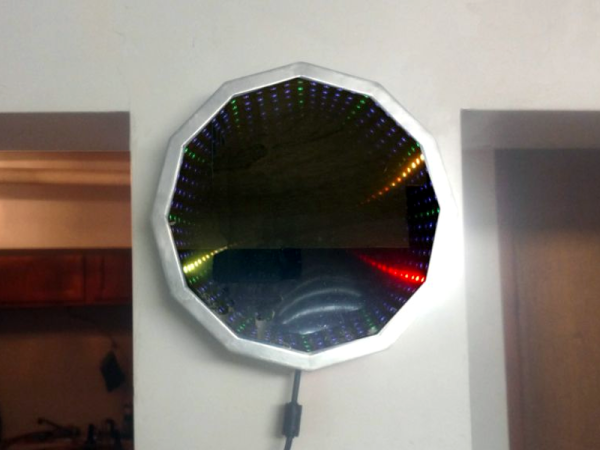
[How Do You – DIY] has a built a few mirrors because he likes experimenting with the effects of different reflective surfaces in various positions. This time, he’s built a clock from the ground up. Basic infinity mirror rules apply here, though he used semi-transparent reflective film on both sides for greater effect and put an adjustable warping bar in the back so the trail curves toward the center. The actual timekeeping is done by an Arduino Nano.

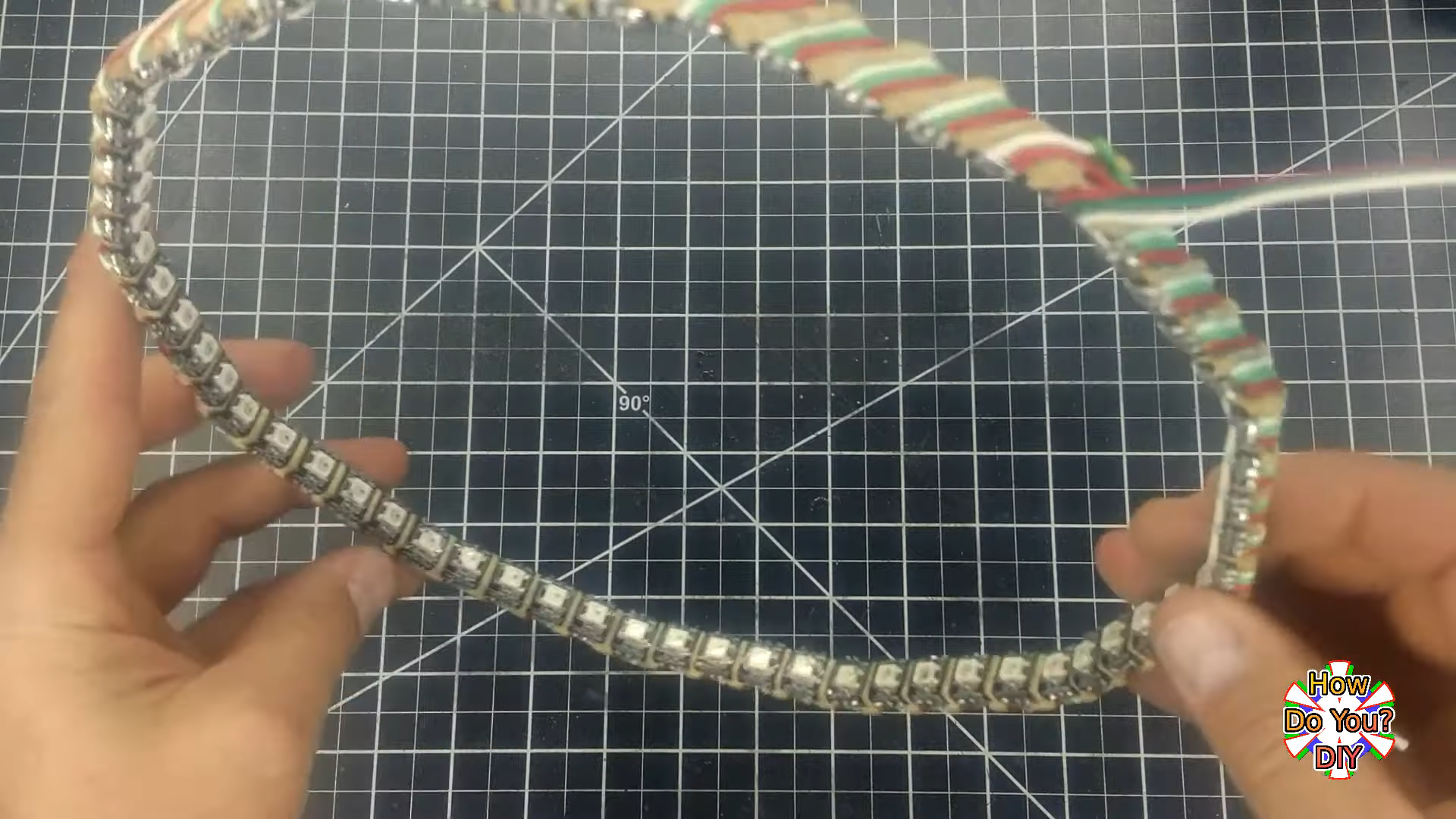
The RGB LEDs on his strip were a few millimeters too far apart for his liking, so he added a few dozen hours to the build by cutting it apart and painstakingly placing them all around the wood frame. Then he Dremeled a groove for each set of three wires that link the LEDs so that they sit flush. The final product is beautiful, and it’s a shame that this LED-holding frame is hidden away inside the equally well-crafted aluminium frame.

Don’t waste another minute — sweep past the break to check out the build video. If it’s a portable and functional conversation piece you want, make a set of infinity mirror coasters.

Oh, and did we mention that we’re running a clock contest? Hint, hint.

Continue reading “It’s About Time We Saw Another Infinity Mirror Clock”