Hunting Replicants With The 2019 LayerOne Badge

Blade Runner showed us a dystopian megatropolis vision of Los Angeles in the far-off future. What was a distant dream for the 1982 theater-goes (2019) is now our everyday. We know Los Angeles is not perpetually overcast, flying cars are not cruising those skies, and replicants are not hiding among the population. Or… are they?

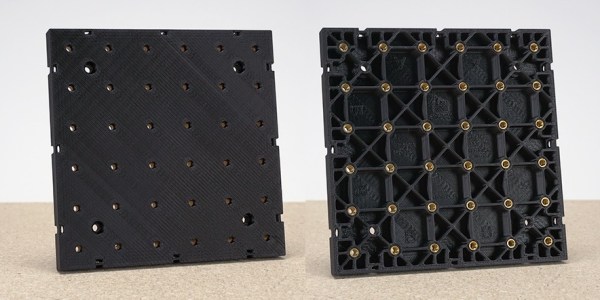
The LayerOne conference takes place in greater Los Angeles and this year it adopted a Blade Runner theme in honor of that landmark film. My favorite part of the theme was the conference badge modeled after a Voight-Kampff machine. These were used in the film to distinguish replicants from humans, and that’s exactly what this badge does too. In the movies, replicants are tested by asking questions and monitoring their eyes for a reaction — this badge has an optional eye-recognition camera to deliver this effect. Let’s take a look!

Continue reading “Hunting Replicants With The 2019 LayerOne Badge”

Motion Tracking Face Really Does Follow You Around The Room

Many of us have had the experience of viewing an artwork in a gallery, in which the eyes appear to follow one around the room. In our high-technology work, this no longer need be achieved with artistic skill. You can just build something that actually moves instead.

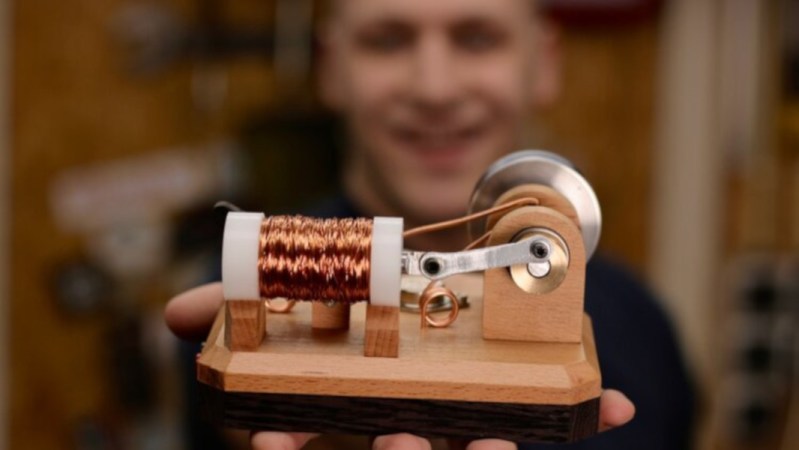
Chartreuse is the creation of [alynton], and has a personality all its own. A face was created out of laser cut wood, and assembled layer by layer. It was then given glowing LED eyes, and mounted on a rotating plate. Combined with an Arduino and an ultrasonic sensor, it’s capable of tracking targets moving within its field of view, and rotating to follow them. Chartreuse’s expression changes as well, with from happy to forlorn, depending on the situation.

It’s a great example of the artistic results that can be achieved by layering lasercut materials, as well as how art can be brought to life with simple maker staples like servos and microcontrollers. Motion tracking has plenty of useful applications, too – like aiming heat directly at cold humans. Video after the break.

Continue reading “Motion Tracking Face Really Does Follow You Around The Room”

Rare Earth Metals Caught In Trade War

It seems these days that the news is never good. Speaking from experience, that’s really nothing new; there’s always been something to worry about, and world leaders have always been adept at playing the games that inevitably lead to disturbing news. Wars always result in the very worst news, of course, and putting any kind of modifier in front of the word, like “Cold” or “proxy”, does little to ameliorate the impact.

And so the headlines have been filled these last months with stories of trade wars, with the primary belligerents being the United States and China. We’ve covered a bit about how tariffs, which serve as the primary weapons in any trade war, have impacted the supply of electronic components and other materials of importance to hackers.

But now, as the trade war continues, a more serious front is opening up, one that could have serious consequences not just to the parties involved but also to the world at large. The trade war has escalated to include rare earth metals, and if the threats and rumors currently circulating come to fruition, the technologies and industries that make up the very core of modern society will be in danger of grinding to a halt, at least temporarily.

Continue reading “Rare Earth Metals Caught In Trade War”

C.H.I.P. Or Z.O.M.B.I.E? We Can’t Decide

Imagine for a moment that you are back in 2015. Radio Shack are going to the wall, Heathkit returning from the dead, and Arduino spliting into two warring Arduinos. And someone has announced a tiny Linux-capable microprocessor board called the C.H.I.P. that will cost only $9. We all thought that last one was pretty cool at the time, didn’t we. Then Heathkit’s new products turned out to be pretty lacklustre, the warring Arduinos merged, and the C.H.I.P? The consensus was that $9 was a tall order for that BoM at the time, and then the Raspberry Pi people gave away a free Pi Zero on the front of a magazine before selling it for £5 ($6.30). It didn’t matter that the C.H.I.P. had a nifty all-in-one screen and keyboard combo called the Pocket C.H.I.P. which was a significant object of desire, the venture lasted for three years before finally hitting the rocks last year.

Now the C.H.I.P. is back, in a crowdfunding campaign fronted by one of its original engineers. It’s been renamed the Popcorn, and it comes in three variants. The Original Popcorn is a compatible C.H.I.P. by any other name, while the Super Popcorn is a much higher-spec machine that comes in quad and octacore variants with AmiLogic SoCs. All three have 32 GB eMMC on board, and the specs are suitably impressive but not out of the ordinary for a 2019 single board computer. Prices are $49, $69, and $89, which takes away that optimistic $9 price tag that made the original so attractive. There is no Pocket C.H.I.P. which is a shame because for us that was the only reason to buy a C.H.I.P, but there is a companion board called the Stovetop that provides Raspberry Pi-style desktop and display interfaces.

We wish them well, but it’s difficult to escape the conclusion that the hardware world has moved on and the window of opportunity has closed. It’s not that these boards are not good ones, more that they now join a plethora of others which come a lot closer to the low price of the original. Still, there remains a C.H.I.P. community still out there, so perhaps that will save the day for them.

We interviewed the C.H.I.P.’s creators back in 2015, and marked its passing last year.

Thanks [Rose] for the tip.

Waterproofing The Best Watch Ever Made

The Casio F-91W is probably the most popular wristwatch ever made. It’s been in production forever, it’s been worn by presidents, and according to US Army intelligence it is “the sign of al-Qaeda”. There’s a lot of history in this classic watch. That said, there is exactly one problem with this watch: it’s barely water resistant. [David] thought he had a solution to this problem, and it looks like he may have succeeded. This classic watch is now waterproof, down to 700 meters of depth. If you’re ever 700 meters underwater, you have bigger problems than a watch that isn’t waterproof.

The basic idea of this hack is to replace the air inside the watch with a liquid. This serves two purposes: first, the front glass won’t fog up. Second, liquids are generally incompressible, or at least only slightly compressible. By replacing the air in the watch with mineral oil, the watch is significantly more water resistant.

Filling a watch with mineral oil is done simply by disassembling the watch, submerging it in a dish of mineral oil, and carefully reassembling the watch. Does it work? Don’t know about this watch, but this was done to another classic Casio watch and tested to 1200 psi. That’s a kilometer underwater, and the watch still worked afterward. We’ll take that as a success, although again if you’re ever a kilometer underwater, you have bigger problems than a broken watch.

Yet Another Robotic Rubik’s Solver

The Rubik’s Cube was a smash hit when it came out in 1974, and continues to maintain a following to this day. It can be difficult to solve, but many take up the challenge. The Arduino Rubik’s Solver is a robot that uses electronics and maths to get the job done.

The system consists of computer-based software and a hardware system working in concert to solve the cube. Webcam images are processed on a computer which determines the current state of the cube, and the necessary moves required to solve it. The solving rig is constructed from steel rods, lasercut acrylic, and 3D printed parts, along with an Arduino and six stepper motors. The Arduino receives instructions from the solving computer over USB serial link. These are then used to command the stepper motors to manipulate the cube in the correct fashion.

It’s no speed demon, but the contraption is capable of solving a cube without any problems. Manipulation of the cube is reliable and smooth, and the build is neat and tidy thanks to its carefully designed components. Of course, there are now even Rubik’s Cubes that can solve themselves. Video after the break.

Continue reading “Yet Another Robotic Rubik’s Solver”

Artistic Attempt To Send Digital Signals Via Fungus

Art projects can fundamentally be anything you like, as long as you say they’re art at the end of it all. They don’t always work, or work well, but they often explore new ideas. Often, artists working on installations fall back on similar tools and techniques used by the maker community. [Julian] is no exception, and his Biotic Explorers work has many touchstones that will be familiar to the Hackaday set.

The device attempted to send signals via Mycellium fungus.

The Biotic Explorers Research Group is a broad art project, involving the creation of a fictitious scientific association. [Julian] created imaginary scientists, reports, and research to flesh out this world. The project culminates in the development of a prototype communications system, which uses pH sensors at either end of a fungal network in soil to send messages.

Liquids are applied to change the pH of the system, which can be picked up at the other end of the soil bed. The pH levels are read as digital signals, with pH levels either side of neutral reading as high and low bits. pH sensors can be expensive, so [Julian] chose the cheapest available, and tapped into their LCD display lines to read their output into an microcontroller. The system displays data using commonly available OLED displays, and hobby servo motors are used to control the dispensing of liquid.

Due to time constraints, [Julian] was unable to get the system fully functional. Sending data as pH levels through fungus proved unreliable and slow, but we suspect with further development, the system could be improved. Regardless, the project serves as an excellent example of the work that goes into a functional art installation. The thesis sheds further detail on the development of the project.

We’re no strangers to an art installation here – whether it’s Markov chains or glowing balloons.