Automated Cat Feeder With A View

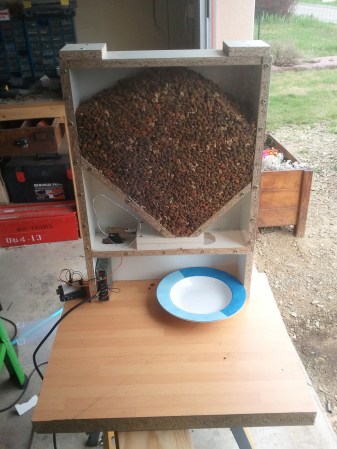
[Robovergne] wrote in to share his fantastic automated cat feeder with us. After researching the common commercial products he could find, he decided to build one that utilized a home made linear actuator to pull a certain amount out of a reservoir. Initially, he attempted to use microwave motors but ultimately found them to be too weak to force the bits of cat food should they get stuck. He was afraid this extra strain would cause motor failure before too long. Ultimately, he replaced the microwave motor with a fairly strong servo that seems to do the job just fine. He’s currently using an Arduino to time it all, but he does mention that he feels it is a waste of the arduino for such a simple task.

As you can see in the videos after the break, his mechanism seems quite solid. There isn’t a lot of play in the movement and the amount of food coming out seems to be fairly controllable.
Continue reading “Automated Cat Feeder With A View”

Keyboard Composes Its Own Music

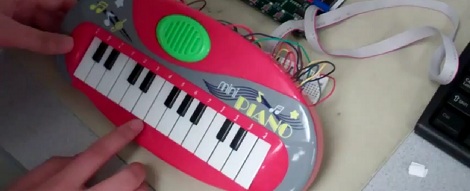
Summer is right around the corner and all the final projects from electronic design classes are rolling into the tip line. This time, we’ve got [Chaorong] and [Siyu]’s auto-composing keyboard from their time in ECE4760 at Cornell.

The keyboard has two modes: a ‘happy’ mode and a ‘tender’ mode, the difference being the tender mode is slower and sounds a little like a lullaby. After two keys are pressed, the ATMega644 figures out what key it should play in and starts generating a random-ish sounding song using a Markov probability matrix.

There’s a third option for the keyboard as well: play a short melody and the software will loop through a few permutations of the melody. After the break, you can see [Siyu] play Ode to Joy and have the autocomposer improvise around the tune. Very, very nice work and we can’t wait to see more senior design projects hit the tip line.

Continue reading “Keyboard Composes Its Own Music”

RCA Capacitive Electronic Disk

capacitive video disk

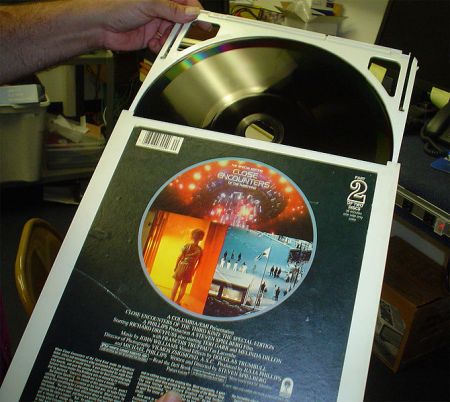
Although not a hack in the sense that it was made by a large corporation, check out this capacitive electronic disk that [danielbpm] wrote in about. Here’s a Wikipedia article about it, as well as a video (which didn’t embed correctly) about how it was made. The disks look like a typical audio record, and it was conceived of in 1964. A prototype was manufactured in 1972.

Unlike the more well-known Laserdisk format, the [Capacitive Electronic disk], or [CED] used an actual stylus to read the disks. Because of this, the [Wikipedia] article astutely points out that both systems were mutually incompatible. Somewhere there might have been a scratched Laserdisk next to the VCR with a sandwich stuffed in it. The computer with a broken coffee holder wouldn’t come for another few years.

Although it may have been a good format in it’s own right, like Betamax or HD-DVD, this system wasn’t destined to become the Blu-Ray player of it’s time.

Electronic Table Top Catapult

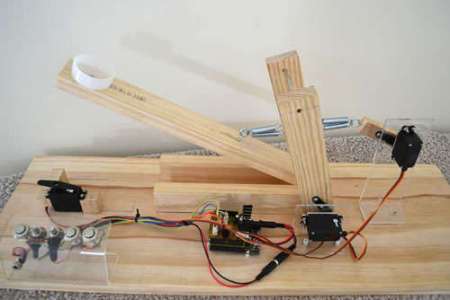
[Unusualtravis] came up with this fairly slick electronic catapult. This easy to construct and moderately cheap rig has an arduino as the brains and controls for 3 servos. One is the release, another controls tension, and the third controls the angle. Both the circuit and the construction are very simple making this a perfect weekend project. He would have preferred it to be a bit smaller, so shoot him your design if you manage to shrink it.

We’ve always been rather fond of catapults of whatever complexity, so feel free to send in any variations you’ve worked on.

Continue reading “Electronic Table Top Catapult”

6 Camera Face Scanning Rig

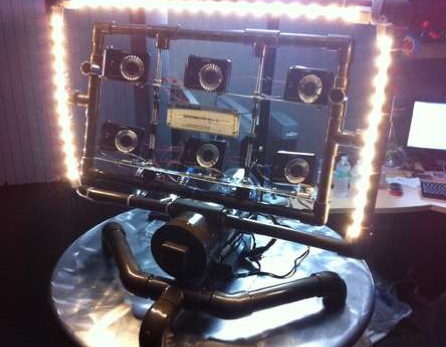
[Ajeromin] was asked to build something cool for a museum exhibit. He took the challenge, and with his facial capture device, we feel he delivered. The writeup is very short, most of the story is in the annotated images. After deciding he was going to do facial capture and convert it to 3d, he had to start planning. There are many ways to do this, but usually the person having their face captured isn’t an excited child at a museum. The presented some unique challenges in that he knew he would have to capture all the images at once, and quickly too. To do this, he lit the entire rig very well to reduce the amount of noise in the pictures and wired all 6 cameras up to snap at the same moment. He even encapsulated the circuit in a glass jar just so the kids could see more of the parts.

The next logical step would be to attach this to a 3d printer and let people buy 3d printed models of their face. The quality is certainly good enough as he shows in one of the final images.

Great job [Ajeromin]


Tindie: An Etsy For Electronics

If you have a finished project you’re now bored with, here’s Tindie. It’s a one-man operation headed b [emile] that hopes to connect makers with people who think DIY projects are really cool and have money.

There are already a few websites that cater to the builder who wants to sell projects: Kickstarter for one, but this is based on the concept of campaigns. Tindie aims to be a techie etsy, according to [emile]’s market research post on reddit;  a places for makers with a soldering iron to sell stuff, but who are baffled by the concept of knitting.

Right now there’s nothing to buy on Tindie – [emile] is looking for hackers to sell their projects so the store doesn’t launch with an empty stockroom. If you’ve got an old project sitting on your shelf that you’d like to sell, put it up. [emile] is only taking 5% of the sales – just enough to pay for the hosting. Hopefully it will be popular enough for the eventual Tindie/regretsy blog.

Quick And Easy Wildlife Camera

This wildlife camera is really easy to put together. You should keep it in mind if you’re ever tying to figure out what’s eating the heads off of all of your tulips. [Revoltlab] put it together, and although there’s one fatal flaw in this particular system, the concept is quite sound.

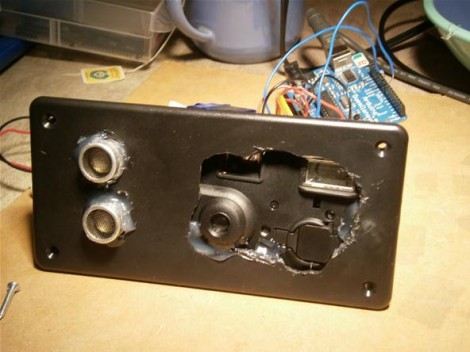
The build uses a camera, paired with an ultrasonic range finder. When something passes within the pre-set distance for the sensor, a servo motor clicks the shutter button on the camera. It’s all driven by an Arduino and powered from a 9V battery.

If you watch the video after the break you’ll discover the flaw we mentioned. This is a disposable film camera and requires winding between pictures. That hasn’t been implemented yet. But we’ve got an old digital camera with a broken LCD screen which would be perfect for the job. We’d have to do a bit more work to turn the camera on before taking the picture though.

There are a couple of possible upgrades to the idea. [Revoltlab] mentions removing the IR filter from the camera and adding an infrared flash for night-vision shots. But we would also recommend ditching the servo motor for a simple remote shutter solution as a way to avoid scaring the wildlife with the motor noise.

Continue reading “Quick And Easy Wildlife Camera”