Motion Sprinkler Chases Away Defecating Dogs

Don’t want dogs pooping on the front lawn? You could put up a sign, your could chase them away like a crotchety old miser, or you could build a motion detecting sprinkler system. It’s pretty hard to line up for a doody when you’re getting sprayed in the face (or worse) with cold water.

The setup is pretty simple. The bump-in image above shows the view from a webcam. The server monitoring the video is running software that detects motion between one frame and the next. When it sees something in the right position it signals an Arduino to trigger the solenoid which has been holding back the water. Check out the movie after the break which shows [Phil Tucker] tramping across the grass to trigger the  trap.

Sprinkler hacks are always a lot of fun. This variable-range sprinkler is still one of our favorites.

Continue reading “Motion Sprinkler Chases Away Defecating Dogs”

Toaster Oven Reflow Project Goes Way Overboard

This project may take the cake on high-end reflow retrofits. It’s a HUGE project which uses a toaster oven to reflow surface mount circuit boards. And the fact that it bursts with features makes us giddy.

So what parts have we come to expect on these devices? Obviously a heat source which usually comes from a reused toaster oven. Then you need a way to switch the heating elements on and off based on feedback. Since solder profiles have precise timings and temperatures a clock is usually involved. All of this can be done with a temperature probe on a multimeter and a smartphone as the timer. But what we have here is full-automation and then about a thousand more features.

The driver above has a full user interface. It’s got its own PID routines which help to ensure proper holding temperatures and accurate ramping when going from one temperature to the next. The cable exiting the controller below the red buttons is providing feedback via a thermocoupler.  So program in your solder profile and let it go. But wait, don’t you want to record and graph what actually happened during this reflow run? Well that’s what the serial connection is for. In fact, you can even load new profiles and control all aspects of the device from a PC interface.

Switching for the toaster oven is done in a different way as well. Instead of just switching mains power, the circulation fan and the heating elements have been electrically separated. This way the fan can run whether the elements are on or not.

New And Improved Potentar

We like what we’re seeing and hearing with [Dorian Damon’s] newest version of the Potentar. This is revision 2.0 of the instrument we saw in a December links post. He calls it the Potentar, since it uses a linear potentiometer in a way similar to how the frets on a guitar work (Potentiometer + Guitar = Potentar).

The first thing you should notice is the case upgrade. The original used what looked like unfinished scrap wood, but finished wood of this case really makes the thing look like a traditional instrument. With this design he loses the Arduino in favor of a standalone ATmega328 chip. You’ll notice knobs and a switch on the face of the body. This allows for selecting a couple different kinds of scales and turning the power off. The linear potentiometer and sewing machine button are the same as before. After the break you can catch his description and a quick performance thanks to the audio jack for patching it into an amp.

Continue reading “New And Improved Potentar”

Building A Bug-zapping Lightsaber

[youtube=https://www.youtube.com/watch?v=w0a34ivs0xo]

I have heard the joke several times that a light saber would make a great bug zapper. However, when [Ricky Sumbody] requested it on Facebook, I thought “why not?”. [Ricky] made a common mistake, he thought the bulb was the part that actually zaps the bugs. A quick google search revealed that many people had the same thought. I decide that, even though building a functional bug zapping light saber might not look as cool, I was going to do it anyway.

If you’re going to follow these instructions, be aware that this is a device that is literally designed to shock things to death.  It is dangerous.

Continue reading “Building A Bug-zapping Lightsaber”

A Game Of Skill For The North Carolina Maker Faire

The North Carolina Maker Fare was last weekend, and over the course of the festivities  [Dave] was asked for the documentation for the arcade game he built. It’s a neat build, so we’re very glad he chose to share it with us.

Anyone who has been to an arcade in the last 15 years has seen the game [Dave] was inspired by. The object of the game is to hit a button when the sequentially illuminated lights are in a particular position. [Dave] built his own version out of 90 LEDs and a very tiny FPGA dev board.

The 90 LEDs are controlled by the FPGA using charlieplexing, and are illuminated in sequence when the game starts. A heavy-duty emergency switch button modified into a momentary push button takes a hit whenever the player thinks the LED will land in the ‘jackpot zone.’  If the player wins, a buzzer sounds and much excitement is had by all.

Seeing as how the arcade version of this game is a complete rip off and is impossible to win, we really like [Dave]’s version. You can check out his demo video after the break.

Continue reading “A Game Of Skill For The North Carolina Maker Faire”

A LEGO Turing Machine For [Alan]’s Centennial

2012 is the 100-year anniversary of [Alan Turing]’s birth, and to celebrate the centennial, [Jeroen] and [Davy] over at Centrum Wiskunde & Informatica in The Netherlands built a Turing machine out of LEGO.

A Turing machine is an extremely simple device, but is still able to compute everything your desktop can. The machine is generally described as an infinite paper tape with a read/write head. On this paper tape, the numbers ‘1’ and ‘0’ are written. By precisely defining what the Turing machine should do when it comes across a ‘1’ or ‘0’, its able to do the same calculations as a laptop, albeit at a much slower rate.

The LEGO Turing machine has a series of pins signifying each bit. These pins are moved underneath a read/write head containing a light sensor and robotic arm. When a pin is down, the camera sees a dark spot signifying one state. When the pin is up, light reflects off a white LEGO piece signifying another state.

[Jeroen] and [Davy] built an IDE for their Turing machine, so if you’ve got a few LEGO NTX bricks lying around you can grab the Git and build your own. Check out the mini documentary after the break.

Continue reading “A LEGO Turing Machine For [Alan]’s Centennial”

Fast And Easy Solder Paste Stencils

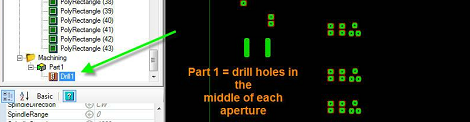
If you’re making your own boards with SMD parts, you might want to get a solder paste stencil. Usually made of laser-cut mylar or extremely thin steel, these stencils allow you to squeegee solder paste onto your board’s pads and make assembly a whole lot easier. [Rochey] needed a stencil for a board he was working on, and lacking a laser cutter he turned to what he had available – a few bits of plastic and a CNC machine.

[Rochey] began making his stencils out of laminating pouches and an xacto knife. This worked well, but it was time-consuming, and a bit fiddly when cutting 1 mm square holes. To speed up the process, [Rochey] put one of these laminating pouches on his CNC machine, exported the ‘Top Cream’ layer in Eagle to the CNC software of his choice, and had his machine attack the plastic with a 1 mm drill bit.

To [Rochey]’s surprise, everything went as planned; in five minutes, he had a stencil with perfectly accurate holes that masked off everything but the SMD pads.

Thanks [Fabien] for sending this one in.