Hack A Watchman

I have been on the hunt in our local thrift and random junk stores lately for a small TV to hopefully modify into a decent enough computer monitor for my Apple //C and Trash80. While there are TONS of TV’s out there, none were really striking me in tube size or picture quality. Roaming around the last resource I happened to find this tiny Sony Watchman Color LCD TV.

Of course this thing is way too tiny for a computer monitor. I thought it would be a great thing to have around the bench for when I am repairing a video game system, or messing about with the TV out Arduino library (the 3 buck price tag on half off day didn’t help either). Directly out of the store this thing is totally useless as there are no inputs and its tuner is for analog “over the air” stations which no longer exist.

Join me after the break to see how I turned this buck fifty paperweight into a functional bench tool!

Continue reading “Hack A Watchman”

DIY Signal Generator Probe

A signal generator is a handy bit of kit and with the right components, it’s pretty easy to build one. Fabricating a proper signal generator probe is another matter entirely. [Frank]’s DIY signal generator probe does exactly what it claims to, and is very cheap to boot.

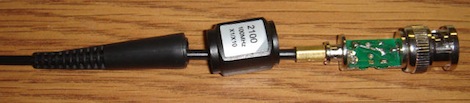
After [Frank] made a simple signal generator with a few parts he had lying around, he needed a probe. Not wanting to deal with poking loose wires around his circuits, he decided to modify a scope probe. Six dollars and two weeks later, [Frank] had a suitable scope probe on his doorstop shipped from halfway around the world.

The strain relief on the probe was removed, and the resistors and trim cap on the PCB was desoldered. All that was left to do was solder a piece of wire from the BNC jack to the probe lead. The strain relief was put back on and clearly labeled for use as a signal generator probe. Not bad for 10 minutes of work.

Animated Turn Signals Add A Little Bit Of Cylon To Your Automobile

[StarfireMX] churned out a fantastic turn signal replacement for his Mustang. When he switches on his blinker, a chasing pattern of amber LEDs is shown on the front corner of his car. Pretty cool, and as far as we can tell this is still street legal. But once he gets onto private property [StarfireMX] can have a little bit more fun with the replacements. The LEDs are actually fully addressable RGB modules. They can display a variety of colors and patterns, with wireless control from a touch-screen unit he also built.

Both the turn signal unit, and the remote controls are Arduino driven with XBee modules for wireless communications. Pop the hood and you’ll find even more blinky lights to accent the engine, which are also tweaked using the remote control.

Don’t miss the demonstration video after the break. Near the end of the clip you can see how the controller is mounted with heavy-duty Velcro behind the grill. Inside the project box there’s a voltage regulator which drops the 12V down to 5V and can put out a whopping four amps to make sure the LEDs have plenty of current.

Continue reading “Animated Turn Signals Add A Little Bit Of Cylon To Your Automobile”

Resurrecting An XT

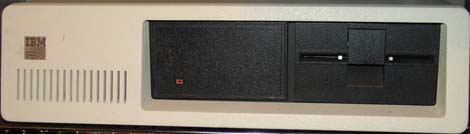
The best laid plans of mice and men oft go awry. At least that’s what we’d tell ourselves if we couldn’t find a 30-year-old computer monitor. [Andrew] picked up an old IBM XT on eBay recently and tried to get the video working. He hasn’t seen any success yet, but the way he goes about solving this problem is very clever.

[Andrew] was stuck with a cool old computer with no way to output anything onto a screen. The XT had an MDA port but neither his TV nor his VGA monitor would accept MDA frequencies. As a workaround, [Andrew] connected an Arduino to the XT keyboard port. On the factory floor, IBM workers used the XT keyboard to load code onto the machines while POSTing. He was able to change the frequency of the MDA CRT controller to CGA frequencies, and with the help of some small components got some video working.

The Hsync and Vsync are still off, and [Andrew] hasn’t been able to get the machine to finish POSTing, but he figures he can use the XT keyboard port for bidirectional communication. He’s written a very small kernel to test out a few things, but unfortunately the XT’s power supply died recently. Once [Andrew] replaces that, we’re sure he’ll get his box up and running.

Freakyphone Has A Puzzle For You!

freakyphone

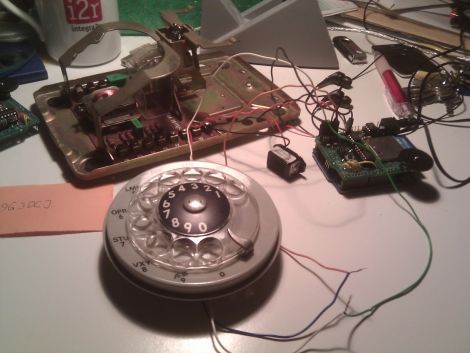
[Mime] likes to make puzzles and games for his friends to play, often using recycled electronics to construct them. He had been contemplating a sound-based game for some time when he came across an old rotary phone at a garage sale that would be perfect for what he had in mind.

He calls his creation the Freakyphone, and the goal of the game is to guess the name of a historical figure via a series of audible clues. The phone was constructed using an Arduino that plays audio using a sound shield from Adafruit. While he was ultimately unable to get the phone’s ringer to work properly, [Mime] says that the build process was relatively easy overall.

When activated, the phone buzzes for attention, prompting the player to pick up the handset. After introducing the game, the phone will ring additional times with random sound clips to clue the player into the historical figure’s name. If the player correctly enters the person’s name using the rotary dial, they receive a “winning tone” and the game is over.

It’s always nice to see someone building gadgets for their friends just for the sake of fun – nice work!

Continue reading to see a video showing how the Freakyphone was built along with a demo of the game.

Continue reading “Freakyphone Has A Puzzle For You!”

Sustainability Hacks: Bio-diesel Motorcycle Speed Record

Sometimes you don’t need a lot of horsepower to win a speed record. In a fluke of no one else competing in the alt fuel class,  [John]’s biodiesel motorcycle set a new land speed record at the LTA event last summer.

[John]’s bike is a junkyard 1978 Kawasaki KZ400. The stock engine was replaced with a Chinese knock off of a Yanmar air-cooled diesel motor. The fuel is regular old vegetable oil. From the looks of the exhaust, we’re assuming [John]’s garage has a rich french fry smell to it.

Compared to highway speeds, [John]’s runs for a land speed record are a little absurd – a nice bonus when you’re the only driver in your class. The first pass of 42 mph was a little disappointing, so [John] removed the fender, tail light and brakes. After all the unnecessary weight was removed, the top speed – and new record – was 56.5 mph.

Converting a diesel car to run on french fry oil is great and a lot better for the environment than burning liquefied dinosaurs. In any event, a green motorcycle is a lot better than 2000 pounds of automobile moving less than 200 pounds of person. Check out a few of [John]’s land speed runs after the break.

Continue reading “Sustainability Hacks: Bio-diesel Motorcycle Speed Record”

How To Build Your Own Cat Door

[Dino] continues his to satisfy his weekly hacking goal by building a cat door for his pets. He has a Habitat For Humanity resale store nearby that was doing a 50% off sale on doors. So he picked up a six-panel door and set to work.

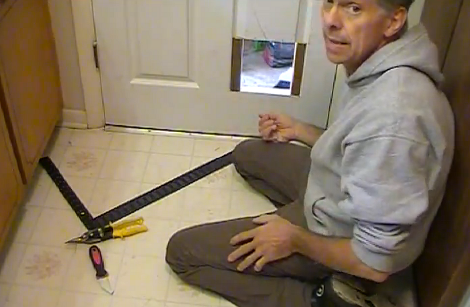
The first step is drawing out the opening and cutting it with a jigsaw. Once he was done, there’s some reinforcement work to be done because this is a hollow-core door. Since he had already cut a bit of the bottom off of the door to fit his jamb opening, he had some wood stock that was already the right thickness. That bit was secured to the top and bottom of the opening with glue and some brads. The same was done on the sides with a different piece of scrap, then the door was hung in the opening to reach the point in the project seen above.

Here [Dino] prepares to add a flap to cover the opening. He used acrylic for the flap because it’s light-weight and clear. A piece of piano hinge makes it easy to swing in both directions. The final touch is a magnet which keeps the flap from swinging in the breeze using parts from a magnetic cabinet latch. No sooner does he have the flap in place than a brave kitty gives it a test run.

Hopefully he doesn’t have the kind of pests that caused other hackers to build facial recognition cat door locks.

Continue reading “How To Build Your Own Cat Door”