Alarm Clock Forces You To Play Tetris To Prove You Are Awake

tetris_alarm_clock

Oversleeping sucks, but we’ve all been there. Whether its a matter of hitting the snooze button a dozen times too many, or turning off the alarm and drifting back to sleep – sooner or later, you are going to wake up late.

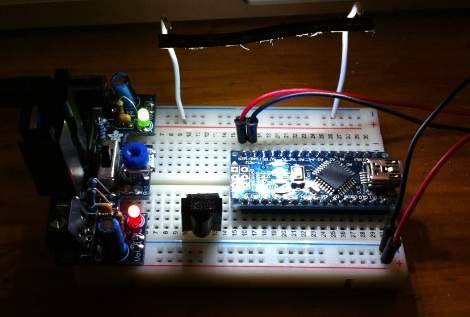
Instructables user [nolte919] has overslept a time or two in his life, and he set out to design a clock that would make it nearly impossible to wake up late. His clock is Arduino-based and shares many features with off the shelf models including multiple alarms, a backup battery, and snooze features. His alarm however goes one step further and ensures you are fully awake each morning.

If you hit the user-defined snooze limit, the alarm sounds and will not turn off until you have cleared 4 lines in Tetris. That’s right, you have to prove to the clock that you are awake and coherent before it will shut off. Technically you can silence the alarm for a 30 second period so you can focus on Tetris, but that’s all the break you get.

It really is a novel way of ensuring you are awake in the morning, and heck, how bad can the day be when you start off by playing video games for a few minutes?

Stick around to see a quick video of his Tetris alarm clock in action.

Continue reading “Alarm Clock Forces You To Play Tetris To Prove You Are Awake”

CEE Is A Swiss Army Knife For Analog Electronics

The team at nonolith labs announced their CEE, a device for billed as, “an analog buspirate” that is meant to control, experiment, and explore the world of analog electronics. Nonolith labs started a kickstarter campaign for the CEE.

The CEE is capable of sub-millivolt and milliamp sampling at 44.1k samples/second, and sourcing 2 channels of 5V @ 2A with a little bit of soldering. This allows for precise control of motors and sensors with the web-based UI. We’re thinking this would be a great way to teach high schoolers the art of electronics, and would be great combined with a few lectures from Paul Horowitz.

The CEE ties into nonolith labs Pixelpulse, a pretty handy tool for visualizing analog and digital signals. You can check out a demo of Pixelpulse simulating a charging capacitor here.

We’re hoping this focus on education on analog electronics catches on – you can learn a lot more by building a 555-based mini Segway than you can slapping a microcontroller in every project. This would go under the same theory as, “any idiot can count to one.”

Check out the video of the CEE on the kickstarter campaign page.

Bottle Rocket POV Video

pov_fireworks_video

It’s a holiday weekend, and much like you, we’re taking a bit of time to relax and kick back a few drinks while we mingle with friends and family. Obviously, one of the bigger events this weekend plays host to is the fireworks show put on by your city or your drunken neighbors.

Roman candle wars aside, have you ever wondered what the 4th of July looked like from the fireworks’ point of view? We did, and so did [Jeremiah Warren], who put together an awesome video showing what really happens after you light the fuse and run away like a little girl.

The dizzying video was shot using a pair of key chain cameras that he strapped directly to the rockets before launching. It’s pretty entertaining, so be sure to check it out if you have a few minutes to spare.

This probably doesn’t quite fit the criteria to be considered a hack, but with explosions and the crazy point of view video, we had to pass it along.

Continue reading “Bottle Rocket POV Video”

Sandbox Game In A Sandbox

The team at Monobanda have been working on a sandbox game called Mimicry that uses a Kinect to read the terrain of a sandbox.

From the teaser video and press release, the eventual goal appears to be controlling both a character in the game and the environment simultaneously. By reading the terrain of the sandbox with a Kinect, the team was able to import that into the game world. The team says the game world is inhabited by tiny virtual characters that, “roll around, jump and glide through the Mimicry world.” Anyone playing Mimicry can create obstacles for these little creatures or build them a race track. The Monobandia team says the point of this game is, “to create your own games.” With a fully editable world and its ‘rolling ball’ inhabitants, we can’t wait to make our own custom Beyblade arena.

Since the release of the Kinect SDK a few weeks ago, we’ve been seeing some really amazing projects that should have been day-1 demos from Microsoft. We’ve been impressed with the projects we’ve seen so far, and can’t wait to see what others come up with next. If you have a neat build, be sure to send it into the tip line.

Check out a video testing the game mechanics after the break.

Continue reading “Sandbox Game In A Sandbox”

A Simple Dolly For Time-Lapse Photography

[Henrique] wrote in to tell us about his time-lapse photography hack. Triggering of the camera is done via CHDK, or Canon Hack Development kit. This experimental kit allows Canon Powershot cameras to run scripts as well as other neat features without permanently changing anything. User scripts for this hack and others can be found here.

Once the Camera was set up to take pictures in a predetermined amount of time, a LDR (light dependent resistor) is used to detect when a picture is actually taken. A LED on the camera flashes every time an image is stored in the camera, so this provided an easy way to sense when this happens.

Once this signal is received, a PIC 16f84 processor and the associated circuitry then causes the stepper to step once per shot. The results of this experiment are very impressive, so be sure to check out the results after the break.

Continue reading “A Simple Dolly For Time-Lapse Photography”

Robotic Schadenfreude – Quadrotor Blooper Reel

quadrotor_fail

While quadrotors might just become the killing machines of choice some time in the future, we’re pretty sure it will be awhile before they run amok and wipe humans off the face of the planet, if the following video is any indication.

The team over at UPenn’s GRASP Lab film everything they do when it comes to quadrotors for posterity’s sake. When your awesome job consists of directing quadrotors through all sorts of acrobatic hijinks however, mistakes are going to happen. Thankfully, the team doesn’t keep these a secret, and while we’re typically wowed by what these flying machines can do, it’s also pretty fun to see them fail in such spectacular fashion.

If you have a spare minute, kick back, fire up the video, and enjoy the mechanical mayhem that ensues. We certainly sleep better at night knowing that while these things are awesome, a well-placed hula hoop is all it takes to ensure continued human supremacy.

Continue reading “Robotic Schadenfreude – Quadrotor Blooper Reel”

3D Display Using A Kinect

Youtube user [programming4fun] got a Kinect for father’s day and with just a little bit of code, came up with a 3D display using only a Kinect. Instead of the usual Kinect hacks like computer vision or playing Mario, we think the ‘Holographic display’ for the Kinect is one of the most useful implementations of the Kinect we’ve seen.

The build uses the Kinect SDK. The end result is a lot like the Kinect snowglobe we covered earlier, only instead of custom acrylic domes and a projector, this build enables pseudo-3D on any display. The hack works by having the Kinect track the users head. From that, it’s pretty simple to display a projection of a 3D model.

The system only supports a 3D display for one person, although with shutter glasses, that could be could be doubled. [programming4fun] says he’s thinking about adding anaglyph 3D – while the effect on video is pretty amazing, he says it’s not entirely convincing in real life.

We talked to the extremely modest [programming4fun], and he says the build isn’t technologically impressive at all. We’d disagree with that assessment because interfaces requiring movement have been around since 1963 and they still haven’t caught on for a wide audience. While there have been a few motion controlled devices that have worked well, most of them have been pretty bad. The Kinect 3D display seems like it would have some utility with a Microsoft Surface type device.

[programming4fun] says if there’s enough interest he might be convinced to clean up his code and create an installer. Check out the video after the break.

UPDATE: [programming4fun] uploaded another demo with a “behind the scenes” look after this was published. Check it out.

Continue reading “3D Display Using A Kinect”