
papercraft_strandbeest

Papercraft Strandbeest Is A Great Rainy Day Project

Here in the Midwest it sometimes seems like Spring will never, well…spring. We get that “April showers bring May flowers”, but nearly all of the last month has been cold and rainy around these parts. While things are improving, we think it’s always good practice to have a few fun projects at the ready, just in case your plans with the kids get rained out.

We think that Hackaday reader [Dombeef’s] papercraft strandbeest is a perfect idea for a rainy afternoon. The supply list is pretty short, requiring little more than some scissors, pliers, paperclips, and glue in addition to the thick paper that makes up the body of the strandbeest. The paper is cut into pieces according to the PDF template he includes in his Instructable, secured to one another via small pieces of paperclip.

Once the legs are all constructed, a main axis is built from one of the remaining paperclips, and everything is joined together under the main portion of the strandbeest’s body.

As you can see in the video, the legs work quite well, though the strandbeest can probably benefit from a hand crank in the short term. [Dombeef] plans on adding a small motor to his creation, which should get the strandbeest moving about quite rapidly once completed.

If you are looking for more fun projects to do with the kids, look no further than this papercraft gyroscope or these squishy circuits.

Continue reading “Papercraft Strandbeest Is A Great Rainy Day Project”
rc_car

Racing Wheel Guided R/C Car With Video Feed

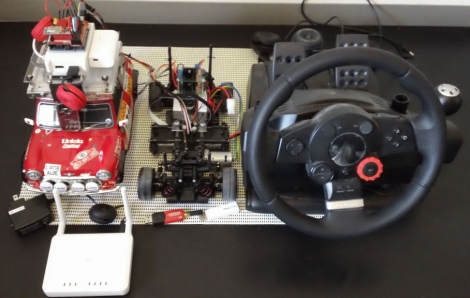
Instructables user [Kaeru no Ojisan] enjoys constructing R/C kit cars and wanted to build one that could be driven using a PC racing wheel he had on hand. Not satisfied with simply guiding it with the racing wheel, he added a web cam to the car so that he can monitor its location from the comfort of his desk chair.

The car is loaded down with all sorts of electronics to get the job done, requiring four separate battery packs to keep them online. An Arduino controls the motor and the steering servos, receiving its commands wirelessly via a Bluetooth add-on. The camera connects to a USB to Ethernet converter, which enables the car’s video feed to be transmitted via the onboard wireless router.

The racing wheel interface seems to work just fine, though we don’t doubt that the whole setup can be easily simplified, reducing both weight and battery count. While [Kaeru no Ojisan] says that the car is in its concept stages and there are a few bugs to work out, we think it’s a good start.

Stick around to see a quick video of the car in testing.

Continue reading “Racing Wheel Guided R/C Car With Video Feed”

Diagnosing Diseases Like MacGyver

pancratitis_test

If you ever watched MacGyver as a kid, you know that given any number of random objects, he could craft the exact tool he would need to get out of a sticky situation. If he ever made his way into the medical research field, you could be sure that this test for Acute Pancreatitis would be among his list of accomplishments.

Designed by University of Texas grad student [Brian Zaccheo], the Acute Pancreatitis test seen in the image above looks as unassuming as it is effective. Crafted out of little more than foil, jello, and milk, the test takes under an hour to diagnose patients while costing less than a dollar.

The test works by checking the patient’s blood for trypsin, an enzyme present in high concentrations if they are suffering from pancreatitis. Once a few drops of the patient’s blood is placed on the gelatin layer of the test, it is left to sit for a bit, after which sodium hydroxide is added. If elevated trypsin levels are present, it will have eaten through the gelatin and milk protein, creating a pathway for the sodium hydroxide to reach the foil layer. If the foil is dissolved within an hour, a circuit is formed and a small LED lights up, indicating that the patient has acute pancreatitis.

The test really is ingenious when you think about it, and will be a huge help to doctors practicing in developing countries, under less than ideal working conditions.

[via PopSci via Gizmodo]

LM386 Altoids Tin Amp

altoids_amp

Hacker [Dino Segovis] is back again with the fifth installment in his “Hack a Week” series. This time around he has put together a 1/2 watt audio amplifier that would make for a great weekend project. He’s a big fan of the LM386 amplifier chip because it does so much in such a small package. Since it is so versatile, he used it as the centerpiece of his Altoids tin amplifier.

Now an audio amp inside an Altoids tin isn’t exactly a new concept, but [Dino] takes the time to discuss the circuit in detail, which is great for any beginners out there who are looking for a fun and relatively easy project. After a high-speed video of the assembly process he walks us through the completed amp, then treats us to a couple of short demos.

One thing that makes his amp different than others we have seen in the past is the addition of a 1/4” guitar jack, which allows him to use his amplifier as a combo amp/distortion effect box.

It’s another job well done, so be sure to keep reading if you’d like to watch the latest Hack a Week episode in its entirety.

Continue reading “LM386 Altoids Tin Amp”

Hackaday Links: Saturday, April 30th

Custom EBike with a 200+ km range

ebike

[Doctorbass] constructed an awesome electrical bike back in 2008 from a Mongoose bicycle. The bike boasts a top speed of 76km/h and a total range of 210 km on a single charge. Some car company needs to hire this guy STAT.

[via Make]

Build to order Xbox 360 laptops

xbox_laptop

[Ed] recently got his hands on a CNC machine and immediately constructed an Xbox 360 laptop. They look pretty sharp, and he’s willing to make a custom laptop if you are interested. We’re thinking someone needs to organize a contest between [Ed] and [Ben Heck].

A portable GameCube to rule them all

gamecube_portable

It’s no secret we enjoy portable console hacks around here, and this portable GameCube is quite the looker. Clearly a lot of thought and work went into this mod, and it shows.

[Thanks, Samjc3]

Ultrasonic backup sensor for the parking impaired

park_ranger

If you decided not to spring for those backup sensors on your new ride, [Eric’s] got you covered. He walks us through how he created an ultrasonic backup sensor using an Arduino and an add on programmable logic board.

Mega laser construction begins

mega_laser

Europe’s Extreme Light Infrastructure project is set to start building the world’s most powerful laser measuring in at 200 petawatts. Scientists are betting on the laser to be able to tear apart the vacuum of space and time itself, if only for a fraction of a second. Seems like a solid plan to us – what could possibly go wrong?

[Thanks, KonaStar]

Help Identify This Vintage Electronics Component

mystery_board

[Windell] over at Evil Mad Scientist Laboratories has reached out in order to help them identify a mystery piece of electronics equipment they came across a few years ago. Discovered at an electronics surplus store, the mystery component looks like a cross between an over-sized chess board and a breadboard. Failing to identify it they eventually disposed of the board, snapping a couple of pictures for good measure before it was gone for good.

Recently while visiting a local electronics flea market, they came across what looked to be a similar, though much smaller board. This piqued their curiosity and compelled them to dig out the pictures of the mystery board in hopes of finally discovering what it was. Using markings on the new board they found, the team at EMSL located some images of a patchboard cartridge that looked quite similar to their mystery object. Upon closer inspection however, they think that the two pieces might be related, but are not quite the same item.

Swing by their site and chime in if you happen to have any good leads – we’re sure they will appreciate it.

BBC Covers An Old-school Hacker

Yesterday, the BBC posted an article on [Julian Skidmore]’s AVR-based homebrew computer.

[Julian]’s project uses an AVR and a derivative of Forth to recreate the capabilities of the 8-bit computers of yesteryear. With 8kB of RAM, [Julian] got a TV-out up and running, and even included code for a Lunar Lander game.

We’re happy for [Julian] getting some notoriety as an old-school solder monkey, but we’re wondering why the BBC is covering a project not unlike the something that could be seen on hackaday once a week. Could it be the first inkling of respect for the hacker and DIY community in the general public’s eye?

In any event, we love the initiative shown in [Julian]’s quote at the bottom of the BBC article: “Building the machine is a way to learn the essentials of what a computer is all about.” If you want to understand something, you’ve got to build it yourself. Truer words…