[youtube=http://www.youtube.com/watch?v=MD_-YnFZFP8&hl=en]
I found this while looking for a teardown of a Wii Nunchuck remote since they’re cheap and include a 3 axis accelerometer. I mentioned an interface board the other day, but the responsiveness of the interface in this video grabbed my attention. If you like it, you should check out this [via] Nunchuck Arduino RF controlled robot. You can find details on that bot here. The accelerometer itself only runs about $10, but it’s a pretty small SMD part.
Notacon 2008: Last-mile Wireless

[Mark Doner] presented on how the WISP he works for near Toledo is set up. His most important point was that 802.11 is garbage when it comes to the type of installations WISPs do. 802.11 expects the clients to adjust based on the traffic from other clients, but when all your clients are directional they won’t see each other. Mark uses Motorola’s Canopy equipment, but he also mentioned Trango and Redline as other vendors. The radios operate in the 5.7GHz band which doesn’t have any power restrictions so they can use refurbished Dish Network dishes when they’re doing long shots. For customers that are nearly at the edge of service, they have 900MHz equipment as well. Heavy fog and freezing rain have proven to be the only weather that really affects the service. For back-haul between their towers they use Dragonwave equipment. Each of the radios costs ~$350 and features GPS to determine distance and maintain sync with the AP. It was interesting to see how a good WISP operates as opposed to the flakey ones we’ve had to deal with in the past.
Notacon 2008: The TSA Bagcam
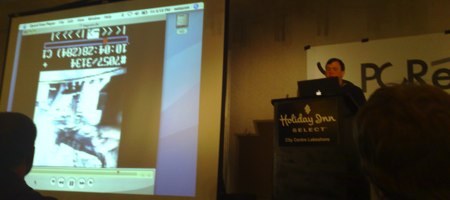
[algormor] gave one of the more controversial talks at Notacon. After receiving a few too many inspection slips and destroyed baggage he decided to find out what was going on behind the scenes. First, he purchased a cheap bag from Walmart with a zipable liner. To record the video, he purchased a SwannGUARD MicroDVR. It’s a palm-sized device that records 128×128 15fps video. It comes with a plastic cover that he mounted to the inside of the bag. A hole was cut for the video camera right above the badge holder. Since the camera is motion triggered, he could slide the badge up, covering the hole, to deactivate the camera. He’s taken the bag on at least four trips. So… what did the footage show?
Notacon 2008: Circuit Bending Intro
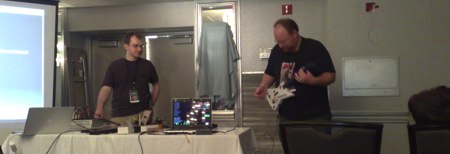
The first talk we went to at Notacon was [Sam Harmon]’s great introduction to circuit bending, the process of modifying sound generating electronics to create new musical instruments. Reed Ghazala is considered the father of circuit bending for his pioneering work starting in 1966. Sam pointed out that a “prepared piano” could be considered the non-electric precursor to circuit bending. It involves the musician placing different types of material on the piano’s components. Sam presented many different examples of where to start with circuit bending: the Casio PT-10, PAiA Theremax, Atari Punk Console. He also mentioned a couple AVR projects: AVRSYN and todbot’s Arduino work.
The session ended with [Thom Robertson] showing off the Weird Sound Generator he built and his GHX software for playing real music with a Guitar Hero controller.
FRS Foxhunting For Model Rockets
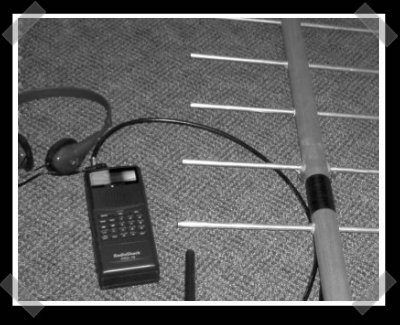
Since we had a FRS radio hackit a while back, [Weirdguy] sent this in. [Scott] gutted a frs radio and added it to his rocket chassis. It’s powered on for the flight, and he can listen to the rockets progress. To locate the rocket once it’s on the ground, he built a 462Mhz Yagi antenna to use with a Radio Shack hand held scanner. This is old hat for most Ham Radio guys – they do ‘Fox Hunts‘ for hidden transmitters just for fun.
Beer-30, OLED Style
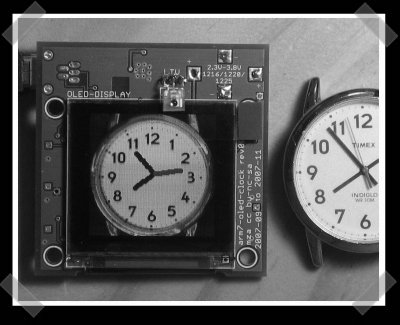
[Matt] built this OLED display based clock for his electronics class. He used an ARM7 processor, designed a nice custom board for it and got busy. The clock face is actually a picture of the watch, and the hands are drawn on top as the time changes. Here’s to the first OLED project on Hack-A-Day.
Custom Mounting Manual Minolta/Sony Lenses
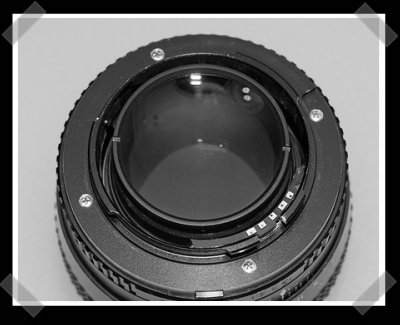
We usually get Canon mods, but [polossatik] sent in some interesting Sony/Minolta lens modding work by [Shaocaholica], who’s been really been taking lens modding to a new level of quality. He picked up several old Rokkor F1.2 lenses and swapped parts around to make four decent lenses. Then he had [Pete Ganz] turn down some new mounts on his lathe. Finally, a quick round of epoxy to add a lens id chip activates the on board image stablization and focus confirmation. Be sure to check out the photo build log here.