Hackaday’s Official Kickstarter Policy

we don’t have one… yet.

We’re getting inundated with campaigns on crowdfunding sites like kickstarter and indiegogo. Sometimes they’re really cool projects, sometimes they’re not. Unfortunately, they are all basically appeals for coverage on hackaday so they can get money. That immediately puts a negative taste in our mouths. Then again, if a hacker legitimately makes something really awesome, why wouldn’t we want to help spread the word?

We don’t want to stop a really cool project from being shared with you just because it is on kickstarter, but we also don’t want to serve as a crowdfunding advertising platform. It ends up being complicated, especially if the idea is really cool, but the details are sparse.

So, what do you think? Share your thoughts on how hackaday should handle crowdfunding in projects.

p.s. This started as a rant about how sick of the constant pleas for kickstarter coverage we’re getting. We’re trying to stay positive and constructive here, please do the same in the comments.


Hacking A Floating RGB LED Decorative Ball

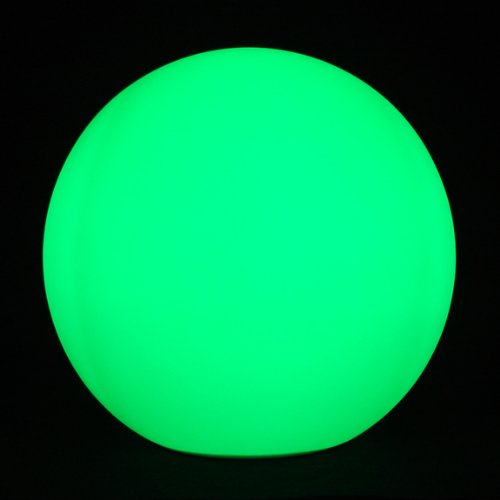
Knowing that I’m always happy to get something new and glowy, my wife brought home a cheap “floating pool light” that she found on sale for roughly $10. This is a large white floating ball that has LEDs inside and cycles through different colors. Meant to be put into a pool for neat effects, we found it to be much more interesting just used around the house.

However, it was a bit too bright and cycled colors too quickly for our taste. It was actually somewhat distracting when we were just trying to sit and have a few beers late at night on our patio. This gave me a perfect excuse to tear it apart and start hacking… like I wasn’t going to do that anyway.

What I found inside was extremely simple. There’s a single un-marked chip that holds the different display modes (there were 3 display modes: warm, cool, and white). The LEDs were arranged in an array of Reds, Blues, Greens, and Whites (half marked yellow).

Continue reading “Hacking A Floating RGB LED Decorative Ball”

Ask Hackaday: What’s Your Backup Solution?

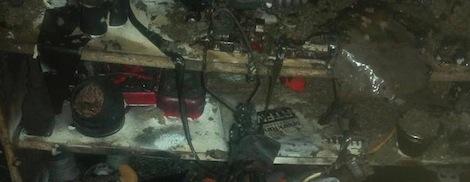
Here’s some very, very sad news from [Charles] over at The Maker’s Workbench: on July 16th, his house was hit by lightning causing his workshop to catch fire. His family is safe, but unfortunately thousands of dollars in gear has gone up in smoke. [Charles] lost a Reprap, a ton of dev boards, a huge amount of tools including an awesome soldering setup, and his laptop and file server.

Short of taking up residence inside Yucca Mountain, there’s little that can be done to prevent random, disastrous acts of Thor. The only bright side to [Charles]’ ordeal (if there is one) is that most of his file server – including all the code he’s written over the years – was backed up on the cloud.

Hackaday readers aren’t much for marketing buzzwords like ‘the cloud,’ so we’re wondering what your backup solutions are. If the cloud isn’t for you, is a NAS at home a good idea? rsync will do wonders, but even hard drives at an off-site location fail; maybe tape is the best choice. Of course if you have a laser cutter, there’s always the option of cutting patterns of holes in stainless steel plates and preserving your data for thousands of years.

If [Charles]’ story doesn’t inspire you to backup often and preserve your data, consider this: the greek poet [Sophocles] wrote 123 plays, seven of which still survive. Put in perspective, that’s like the only songs in The Beatles’ catalog surviving 2,500 years coming from the Yellow Submarine soundtrack.

Ask Hackaday: How About Some Model Rocket Hacks?

There’s nothing like the smell of black powder in the morning, along with the excitement and burnt propellant in the air that comes after launching a model rocket. All those 60s, 70s, 80s and 90s kids out there may remember the classes of model rocket engines – generally A, B, C, and D sized engines used to push your cardboard tube with balsa fins skyward.

A lot has changed in the world of model and amateur rocketry in the last few years. In 2009, the Tripoli Rocketry Association won a lawsuit against the Bureau of Alcohol, Tobacco, Firearms and Explosives to allow the sale of Ammonium perchlorate rocket engines to anyone. This lawsuit took almost 10 years to come to a head, but finally anyone can walk into Hobby Lobby and come out with D, E, F, and G engines in hand. Even our old favorite, Estes rockets, has gotten into the game by putting out a few awesome G-powered kits. With these off-the-shelf motors, anyone (in the US, at least) can launch a G-powered model rocket weighing under 1500 grams (3.3 lbs) without the need for a certification.

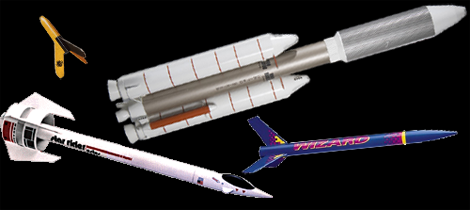
With that in mind, we’re putting out a call for model rocket hacks. If you put together an microcontroller-powered altimeter project, awesomeSend it in. On board video camera? Great! Even if you built a huge replica of the Titan IIIe (or the Estes Star Rider, a personal favorite), send that thing in. If you’re going for a huge Saturn V, the record to beat is a 1/10 scale model, so get on it.

Ask Hackaday: Who Wants To Build A Function Generator?

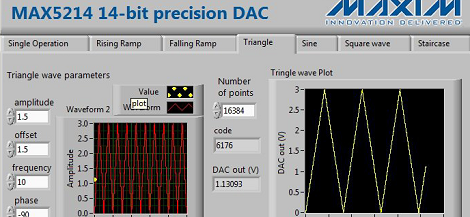
[tari] sent in a tip about a MAX5214 DAC evaluation board AVNET is giving away this summer.  The MAX5214 / MAX5216 is a neat little chip providing a 14 or 16 bit DAC with a serial interface in a tiny 8-pin package. [tari] thinks this eval board could be hacked into a function generator, and we’ve got to agree. Now, who wants to build one?

It’s entirely possible to take the MAX5214 chip and put it in a circuit with a small ARM uC, a display, and a few knobs, but that seems like a waste of time given function generators of this caliber are already available for about $60. It seems the most efficient hack of this dev board will be simply adding an amplifier to this board’s output and possibly programming a better interface than the current LabView software available.

If you want to tinker around with some free hardware and make something useful in the process, have a go at making a function generator out of this dev board. Be sure to send it in when you’re done.

Ask Hackaday: Has Anyone Built A Radio Telescope?

[Michael] sent in a question regarding the latest advances in software defined radios available for $20 on eBay:

I’ve been looking in to SDR lately, mainly for the possibility of using it for incredibly cheap radio astronomy. So far all I’ve found are whispers. I’m 18 and have very little experience, but I figured you might be able to help me find a little more info.

This really brings me back, [Michael]. I saw Contact in the theater (surprisingly, a rare case when the book and movie are equals), and in my childish exuberance went out and listened to lightning on Jupiter. The financial difficulties of expanding my setup meant the experiments stopped there, but at least I knew amateur radio telescopy was possible.

The latest and greatest advance in software defined radio – namely, a $20 TV tuner dongle – brings something new to the table. Instead of the thousands of dollars in gear that was required in 1997 when I last looked into this, it’s possible to set up a  passable radio telescope for under $100.

I’ll leave it to the Hackaday commentors to fill [Michael] in on the details, but here’s my suggestion:

Optimize your setup for 1420 MHz. There are three reasons for this: firstly, very few things in the universe absorb radio waves at a frequency of 1420MHz; there’s a reason it’s so often used in radio astronomy. Secondly, most government agencies around the world ban (or at least don’t look too kindly upon) transmitting on 1420 MHz. This frequency has been somewhat protected for use by astronomers. Thirdly, most of the Realtek TV tuner dongles have a frequency range of 64 – 1700 MHz, so it’s possible to receive 1420 MHz with this minimal setup.

As far as antennas go, your best bet is probably going to be one of those old C-band parabolic antennas from the 80s. That will make your telescope highly directional and give it a huge amount of gain. There is the problem of having a 20-foot-wide eyesore in your back yard, however. Alternatively, you could use a smaller DirecTV satellite dish, but I’m not making any promises with that. It’ll work, but it’s too small for an optimal setup.

I’ll concede the floor to anyone who has additional information. If you’ve built a radio telescope, send it in and I’ll put it up.