How Anodization Is Used To Make Pretty IPod Colors

What do those colorful iPod Nano cases have in common with sapphires? In both substances the color is not on the surface, but integrated in the structure of the material. As usually, [Bill Hammack] unveils the interesting concepts behind coloring metal through anodization in his latest Engineer Guy episode.

We’re not strangers to the anodization process. In fact we’ve seen it used at home to change the color of titanium camping utensils. [Bill] explains what is actually going on with the electrochemical process; touching on facts we already knew; like that the voltage range will affect the color of the annodized surface. But he goes on to explain why these surfaces are different colors and then outlines how anodized metals can be dyed. That’s right, those iPod cases are colored with dye that will not wash or scratch off.

Pores are opened when the aluminum goes through anodization. Those pores are filled with dye, then the metal is boiled in water which closes them, sealing in the color. Pretty neat!

Continue reading “How Anodization Is Used To Make Pretty IPod Colors”

Conductive Ink Circuit Experiments

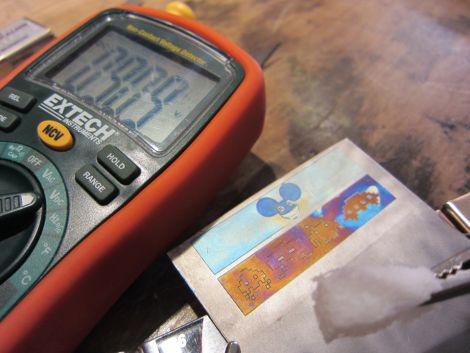
This glowing LED is proof that the experiments [Nvermeer] is doing with conductive ink are working. We’re filing this one as a chemistry hack because  you need to hit the lab ahead of time in order to get the conductivity necessary for success. He reports that this technique uses a copper powder suspended in an epoxy intended for spray painting. Before mixing the two he etched the powder in ammonium persulfate, then washed it in deionized water which made it a much better conductor.

We gather that the ink was applied with the brush seen in the photo. But since this uses that spray paint friendly solution to host the copper powder we wonder about stenciling with something like masking tape in order to spray the circuit paths onto the substrate.

There’s not too much info up yet, but [Nvermeer] does link to one of our other favorite conductive ink projects.

DIY Science – Acid/Base Natural Indicators

natural-indicators

Nearly everything at [HAD] is at least based on science in some way or another. If, however, you would like to do some actual scientific experiments with stuff around the house, [Observationsblog] might be for you.

The particular posts that [Ken] wrote in to tell us about were all about acids, bases, and natural indicators. In his first post he goes over some definitions of acids, bases, and what pH exactly means. A good refresher for those that have forgotten some of their high school (or college) chemistry classes.

The other two posts have to do with making your own natural acid/base indicators. The first is called Anthocyanin, and can be extracted from Red Cabbage.  Quite specific directions can be found here. Similar directions can be found to turn the Indian spice of [Turmeric] into an indicator as well. Although these concepts probably won’t help build your next robot, they could easily be copied inspire young minds for a great science fair project!

What The Flux: Buy It Or Brew It Yourself

Flux generally makes our lives easier. It’s the best bet when trying to prevent solder bridges with fine-pitch components like you see here. But it is also indispensable when it comes to desoldering components from a board (we’re talking just one component without disturbing all of the others). But have you ever looked at what it costs to pick up a syringe of liquid flux from an online retailer? In addition to the cost of the product itself there’s usually a hazardous material handling fee that is rolled into the shipping cost. So we were happy that [Christopher] sent in a link to the DIY flux page over at Dangerous Prototypes.

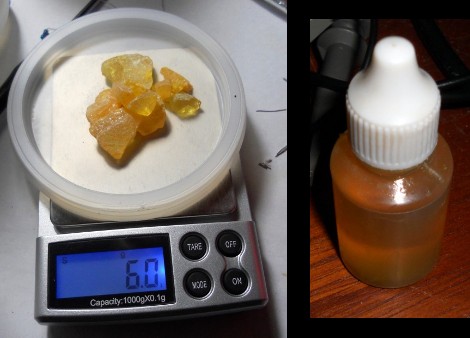
The concept is simple enough. Mix some rosin with some solvent. Turns out these items are really easy to source. The solvent can be acetone (which you may have on hand for removing toner transfer from freshly etched PCBs) or plain old rubbing alcohol. And an easy source for rosin is your local music store. They sell it to use on bow hair for String players. Grind it up, throw it in a bottle and you’re good to go. Now does anyone know where we can source needle-tipped bottles locally?

For those that still just want to buy flux we highly recommend watching part one and part two of [Ian’s] flux review series.

Cabbage Haters Can Turn Their Leftovers Into Litmus Paper

[William Finucane] is making his own litmus paper by harnessing the power of cabbage. The process is much easier than the faux gunpowder he made, as it take just the one ingredient and a few kitchen tools.

In case you’ve forgotten your High School chemistry, Litmus is a set of dyes that change color when exposed to basic or acidic materials. It is common in liquid form, or as a paper. [William] is getting his dye from the leaves of red cabbage by running half a head through a blender with just a bit of water. Once that is reduced to pulp and boiled in the microwave (mmm, must smell great!) he separates the liquid using a coffee filter. A fresh coffee filter serves as a donor for the substrate, just dip some strips in the cabbage juice and let them dry. You can test them with some Ammonia as seen in the video after the break, or just start grabbing whatever is under the sink and see what happens.

Continue reading “Cabbage Haters Can Turn Their Leftovers Into Litmus Paper”

Lego Mindstorms Used To Automate Tedious Laboratory Tasks

lego-bone-machines

Modern society owes so much to medical research, though what happens behind the scenes in a laboratory is usually far less than glamorous. A group of scientists at the University of Cambridge are working to develop synthetic bone tissue, but the process to create the samples used in the study is incredibly tedious.

To make the bones, a substructure must be dipped in a mixture of calcium and protein, rinsed, then dipped in a mixture of phosphate and protein…hundreds and hundreds of times. Equipment that can automate the process is available but very cost prohibitive, so the scientists did what they do best and built a set of robots to do the work for them.

Their new bone manufacturing setup was constructed using Lego Mindstorm kits, which were a perfect solution to their problem in several ways. The kits are relatively cheap, easy to construct, easy to program, and able to perform the same function precisely for days on end.

Now instead of burning time manually creating synthetic bone samples, the group can focus on the more important facets of their research.

Continue reading to see a video presented at the 2012 Google Science Fair, showing how everything came together for the crew at Cambridge.

[via Make]

Continue reading “Lego Mindstorms Used To Automate Tedious Laboratory Tasks”

Neosporin…the Retrobright For Bench Equipment?

polishing-knobs

[linux-works] picked up an old power supply from eBay, and as it was built back in the 60’s or 70’s, it was in need of a little TLC. One thing that immediately caught his eye was the condition of the knobs, dials, and banana plug receptacles – they were dull and faded, showing off 40+ years of heavy usage.

He started off by simply removing the knobs from the power supply, giving them a thorough cleaning with soapy water before leaving them to air dry. They didn’t look any better afterward, so he decided to take a different approach and apply some triple antibiotic ointment to the knobs. As it turns out, letting the ointment sit for a few minutes then wiping the knobs with a soft cloth really made them shine, as you can see in the image above. [linux-works] attributes the effect to the white petrolatum base of the product rather than the antibiotics, likely making a wide array of products equally suitable for the job.

We know how well Retr0bright has worked for the vintage computer folks, so we’ll be interested to see how long the effects of the triple antibiotic treatment last. It certainly can’t hurt those readers who spend their time perusing flea markets in search of classic electronic equipment.