Extending The Features Of An IP Camera

adding-external-control-via-IP-camera

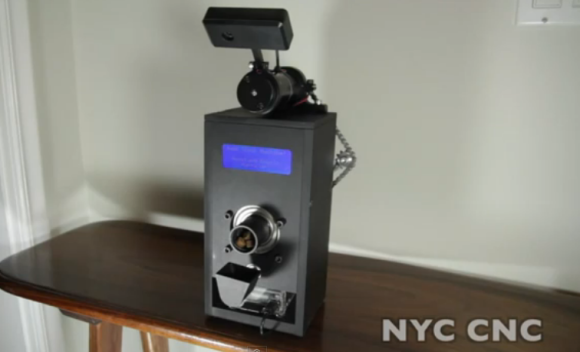
[Dave Astolfo] wanted to be able to let his CNC mill run by itself with the ability to monitor it remotely. The only problem with that idea is that if he checked in and saw something bad happening he needed a remote kill switch as well. He ended up killing two birds with one stone by adding extra features to an IP camera.

These Internet Protocol cameras are pretty nifty. Just plug their power cord in and they’ll connect to WiFi and start streaming video. Many of them offer features like pan and tilt, and this model even features IR LEDs for night viewing that can be switched on and off through the web interface. That’s the point at which [Dave] started his hack. He patched into the leads on the IR LEDs. They’re monitored by an ATtiny85. When he turns on the LEDs via the webpage the ATtiny85 senses it and drives a servo motor to push the ESC key on the keyboard. As you can see in the clip after the break, this will stop the milling in its tracks. We especially liked the use of LEGO Technique pieces to make the servo mount removable.

Continue reading “Extending The Features Of An IP Camera”

Printing Images With A Wood Burning CNC Machine

printing-images-with-a-wood-burning-cnc-machine

Just to clear up any confusion from the title, this wood burning CNC machine runs on electricity. The wood burner acts as the print head. It’s the thing in the upper right of the field that looks a bit like a soldering iron. In this case it’s being used like a dot matrix printer.

We suppose this is a form of halftone printing, although it doesn’t produce the uniformity we’ve seen with mill-based halftone techniques. [Random Sample] built the machine from wood, drawer sliders, and stepper motors with toothed belts. His Python script takes an image and transforms it into a file which can be used to guide each of the three axes of the machine. An Arduino receives these commands via the USB connection. Each image prints in a grid, with darker pixels created by leaving the hot tip in contact with the wood for a longer period of time.

Don’t miss the sample video embedded after the jump.

Continue reading “Printing Images With A Wood Burning CNC Machine”

Through Hole Plating And Milling At Home

Here’s a PCB fabrication process that makes us envious. It’s pretty darn close to fab-house quality at home. [Cpirius] is using a CNC mill and through hole plating technique to produce his double-sided circuit boards.

The video embedded after the break shows one board from start to finish. It begins with the mill drilling holes through some double-sided copper clad stock. Once the millings have been cleaned off the holes are coated with a mixture of waterproof ink and carbon. This prepares them for plating by making the holes themselves conductive. The board is then run through an electroplating process based on this guide.

Possibly the most interesting part of the process starts 52 seconds into the clip. The mill uses a conductive probe to generate a height map of the entire board. This allows it to vary the routing depth for perfectly cut isolation traces. That final routing process is pictured above.

Continue reading “Through Hole Plating And Milling At Home”

Art Installation Plots Every Game Of Lunar Lander That Is Played

This art installation makes a video game from the 1970’s popular again. It can be found at the Dublin Science Gallery’s GAME exhibition. Museum goers step up to the coin-op style game cabinet and the onlookers will see how they’re doing as the landing is plotted on this board.

Hardware details are a bit hard to come by but we hear that there will me more on the build posted soon. For now the Flickr set is the best source of information. From reading the captions we know that a set of three Mac minis run everything. There are also a few close-ups and a video overview of the drive hardware which you can see mounted on the upper left of the image above. We can tell you that this is a string plotter similar to builds we’ve seen in the past. The telemetry data from the Lunar Lander game is converted to instructions and fed directly to that device. See it in action in the clip after the break.

Continue reading “Art Installation Plots Every Game Of Lunar Lander That Is Played”

Pick And Place That Can’t Pick Or Place… But It Looks Very Promising

This sexy piece of CNC can really fly. It’s a pick and place machine which [Danh Trinh] has been working on. The thing is, so far it lacks the ability to move components at all. But the good news is the rest of the system seems to be there.

He posted a demo video of his progress so far which you can see embedded after the break. He starts of by showing off his computer vision software which he wrote in C#. The demonstration includes the view from the gantry-mounted camera, as well as the computer filtering which seems to accurately locate the solder pads and silk screen on the PCB. The second half of the video looks at the hardware seen above. It’s just executing some static code but the whine of those stepper motors is music to our ears. [Danh] reports that the movements of the needle that will eventually serve as the tip of the vacuum tweezer seem to be very accurate.

These home-built pick and place projects are quite a challenge, but we’ve seen a lot of really awesome work on them lately.

Continue reading “Pick And Place That Can’t Pick Or Place… But It Looks Very Promising”

Cutting Styrofoam With A CNC Machine And Turning It Into Aluminum

One of the most popular ways of turning an object trapped inside the world of a computer into a real, metal object is the art of lost wax, or lost foam casting. In this process, a full-scale model of the object to be made in metal is crafted in either foam or wax, placed in a pile of sand, and burned away by molten metal.

[ptflea] over at the Bamberg, Germany hackerspace Backspace came up with a very clever build that automatically cuts foam into the desired shape, ready to be taken out to the backyard foundry. The build is based around an old flatbed scanner and a hot wire cutter. The old scanner conveniently had  an equal number of steps per axis, so attaching an Adafruit motor shield and replacing the old control electronics was just an issue of finding the correct resistors.

Software control is provided by a Processing app [ptflea] whipped up and is able to carefully cut very delicate shapes that even the steadiest hand would have trouble with.

Making stuff out of styrofoam is cool and all, but the real goal for this project was setting things on fire and melting old heatsinks. The styrofoam molds were placed in a bucket full of sand, and the furnace – a few ytong bricks, a crucible, and a propane burner – started to melt some aluminum. The molten aluminum was poured onto the mold and after cooling, the makers of Backspace had a few very cool aluminum trinkets.

A nice build that is able to produce some very nice metal objects. We suspect, though, that a higher-density foam (something along the lines of blue or green insulation sheets, if they have those in Germany) could produce an even higher level of detail if you’d like to build your own.

Videos after the break.

Continue reading “Cutting Styrofoam With A CNC Machine And Turning It Into Aluminum”

Desktop Mill Built As A High School Project

This desktop mill would be impressive coming from anyone, but we’re really excited that it was made as a high school project. [Praneet Narayan] built it during his design and technology class. As his build log shows, he worked with a range of different tools to make sure he had a rock-solid platform on which to mount the motors and cutting head.

The uprights of the frame are made from two steel plates. After hacking them to rough shape with a plasma cutter he finished the edges with a mill. The two parts were then tack welded together so that the mounting holes could be drilled in one step, ensuring alignment between the two sides. The rest of the frame parts are built from extruded rails but he did machine a set of mounting plates to pull it all together. You can see the finished machine milling a message in MDF in the clip after the break.

Continue reading “Desktop Mill Built As A High School Project”