Cutting Styrofoam With A CNC Machine And Turning It Into Aluminum

One of the most popular ways of turning an object trapped inside the world of a computer into a real, metal object is the art of lost wax, or lost foam casting. In this process, a full-scale model of the object to be made in metal is crafted in either foam or wax, placed in a pile of sand, and burned away by molten metal.

[ptflea] over at the Bamberg, Germany hackerspace Backspace came up with a very clever build that automatically cuts foam into the desired shape, ready to be taken out to the backyard foundry. The build is based around an old flatbed scanner and a hot wire cutter. The old scanner conveniently had  an equal number of steps per axis, so attaching an Adafruit motor shield and replacing the old control electronics was just an issue of finding the correct resistors.

Software control is provided by a Processing app [ptflea] whipped up and is able to carefully cut very delicate shapes that even the steadiest hand would have trouble with.

Making stuff out of styrofoam is cool and all, but the real goal for this project was setting things on fire and melting old heatsinks. The styrofoam molds were placed in a bucket full of sand, and the furnace – a few ytong bricks, a crucible, and a propane burner – started to melt some aluminum. The molten aluminum was poured onto the mold and after cooling, the makers of Backspace had a few very cool aluminum trinkets.

A nice build that is able to produce some very nice metal objects. We suspect, though, that a higher-density foam (something along the lines of blue or green insulation sheets, if they have those in Germany) could produce an even higher level of detail if you’d like to build your own.

Videos after the break.

Continue reading “Cutting Styrofoam With A CNC Machine And Turning It Into Aluminum”

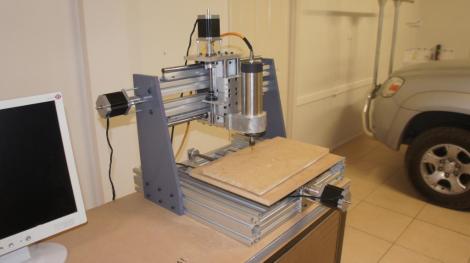
Desktop Mill Built As A High School Project

This desktop mill would be impressive coming from anyone, but we’re really excited that it was made as a high school project. [Praneet Narayan] built it during his design and technology class. As his build log shows, he worked with a range of different tools to make sure he had a rock-solid platform on which to mount the motors and cutting head.

The uprights of the frame are made from two steel plates. After hacking them to rough shape with a plasma cutter he finished the edges with a mill. The two parts were then tack welded together so that the mounting holes could be drilled in one step, ensuring alignment between the two sides. The rest of the frame parts are built from extruded rails but he did machine a set of mounting plates to pull it all together. You can see the finished machine milling a message in MDF in the clip after the break.

Continue reading “Desktop Mill Built As A High School Project”

CNC Jacquard Loom Will Weave Anything

[youtube=http://www.youtube.com/watch?v=osCPWMyJOj8&w=470]

The Jacquard loom, invented in the early 1800s, used punched cards to manufacture relatively complex textiles such as damask and brocade. These punched cards were eventually used by census workers, mechanical calculators, early analog computers, the earliest digital computers, and even the humble Arduino.

That doesn’t mean the Jacquard loom was left in the 17th century, though. This one made it to the Open Hardware Summit in New York last week and it was so cool the organizers of the Maker Faire graciously found space for it.

The entire loom is controlled by computer – no punched cards required – and is build out of inexpensive aluminum extrusion. It can also make any two color graphic into a textile (yes, even the Hackaday logo). The loom wasn’t quite operational during the one day it spent at Maker Faire, but we’ve been promised updates in the future.

New And Improved DIWire Bender

[youtube=http://www.youtube.com/watch?v=xrr4peibbNI&w=470]

The DIWire bender we saw last summer made its way to Maker Faire this year with a new and improved version that is now able to bend steel even more accurately than the previous aluminum-bending version.

I chatted up [Marco Perry] (above, obviously), and he explained a new feature of the DIWire bender that makes soldering or welding creations made out of CNC bent wire even easier. The new machine features a sharpie that precisely marks where the wire should be welded.

The folks behind the DIWire – Pensa – have a ton of really cool wire sculptures at their booth at Maker Faire, quite incidentally within spitting distance of Hackaday’s Red Bull booth. Be sure to check them out if you’ve got a chance.

Fitting A CNC Machine, 3D Printer, And Vinyl Cutter In A Suitcase

Maker Faire NY is awash with new and interesting computer controlled tools, but the most unusual so far appears to be Popfab, a combination router, 3D printer, and vinyl cutter able to collapse down into a suitcase.

Popfab is the brainchild of [Nadya Peek] and [Ilan Moyer] of the MIT CADLAB. With interchangeable heads for routing PCBs, 3D printing, and vinyl cutting. A conventional machine of this capabilities would have motors all over the place, but [Ilan] used a CoreXY system to make the stepper motors stationary relative to the frame of the machine.

The electronics are standard Printrboard and Pronterface fare, but it’s still a remarkable build that also fits into a suitcase.

Pictures of the machine, the XY system (good luck wrapping your head around that, but I can tell you it relies on the differential movement of the two motors) and the lovely [Nadya] holding up the plastic extrusion head. We’ll get a video up tomorrow. after the break

Continue reading “Fitting A CNC Machine, 3D Printer, And Vinyl Cutter In A Suitcase”

Adding Digital Readout To A Non-CNC Mill

In the quest to add a digital readout to his mill, [Yuriy] has done a lot of homework. He’s sourced a trio of very capable scales, researched what kind of hardware his DRO should be based on, and even built a very cool display using seven-segment LEDs. After nearly a year of work, [Yuriy] finally hit upon something that works well: an Arduino and an Android tablet, perfectly matched for one of the prettiest machine shop displays we’ve ever seen.

[Yuriy] based his build off a trio of digital scales he bought from Grizzly. These scales bolt on to the frame of his mill and send data to their own display. An Arduino was used to pull the data off these scales and sent via Bluetooth to a Nexus 7 Android tablet.

Considering a DRO solely based on an Arduino and a character LCD would look a little chintzy – and the fact Arduinos can’t do floating point arithmetic – we’re really impressed with [Yuriy]’s very elegant solution.

Thanks [Lee] for sending this one in.

Turning A Shipping Container Into A 3D Printer

Built inside a 20-foot shipping container placed on its end, the Kamermaker – ” room maker” in Dutch – is one of the largest 3D printers we’ve ever seen. Able to print objects as big as 2 meter square and 3.5 meters high, the Kamermaker is designed to print huge objects including furniture, architectural elements, and even entire rooms.

The Kamermaker is a collaboration between Architectburo DUS and Utilimaker and the result of wanting to build the world’s largest 3D printer pavilion. Built inside a stainless steel-clad shipping container, the Kamermaker features a scaled-up version of the X, Y, and Z axes you’d find in any other 3D printer. The only change is a scaling up of current designs, allowing it to print small wind turbines covering its surface or, theoretically, a life-size TARDIS.

Because using traditional plastic filament would be prohibitively expensive, the Utilimaker team chose to extrude plastic pellets on the fly as it is used. There’s an excellent video of the filament extruder here along with a walk-through of the machine in operation after the break.

Continue reading “Turning A Shipping Container Into A 3D Printer”