A Pragmatic Guide To Motors With Jonathan Beri

[Jonathan Beri] is a Maker of all sorts, with an affinity for robots, APIs, and Open Source. By day he works on making Android & iOS SDKs easier to use and by night he can found begging a PID controller to “just work already.” Recently he contributed to, “Make: JavaScript Robotics,” printed by Maker Media (2015).

[Jonathan] covers a lot of ground during his motors talk at the 2015 Hackaday SuperConference. He discusses brushed DC, stepper, servo, and brushless motors. Although just scraping the surface of each type of motor [Jonathan] touches the important details you can use to determine which type of motor is best for your project. The slide show he has put together has quite a bit of information and tips for beginners that might go overlooked when choosing a motor. For instance a list of 30 attributes that should be considered when selecting a motor. Included in that list are the 7 attributes [Jonathan] places priority on when he chooses a motor for one of his projects. We’ll delve deeper into that after the break.

Continue reading “A Pragmatic Guide To Motors With Jonathan Beri”

Rory Aronson On Documenting Open Source Projects

Every project starts off with an idea. Sometimes those ideas are bigger than one person, or even a small group of people. That was the position [Rory Aronson] found himself in with Farmbot, his finalist entry in the 2015 Hackaday Prize. Documentation was key for [Rory]. Farmbot first came into the world in the form of a white paper. The paper included a request for collaborators, making this an open source project from day 0. Documentation has been important throughout the Farmbot project, so it was naturally the topic of [Rory’s] talk at the 2015 Hackaday SuperConference.

Continue reading “Rory Aronson On Documenting Open Source Projects”

Augmenting Human Vision With Polarimetric Cameras

Light is just a wave, and the wavelength of light determines its color and determines if it can cook food like microwaves, or if it can see through skin like x-rays. There’s another property of waves human’s don’t experience much: polarization, or if the light wave is going up and down, side to side, or anywhere in between.

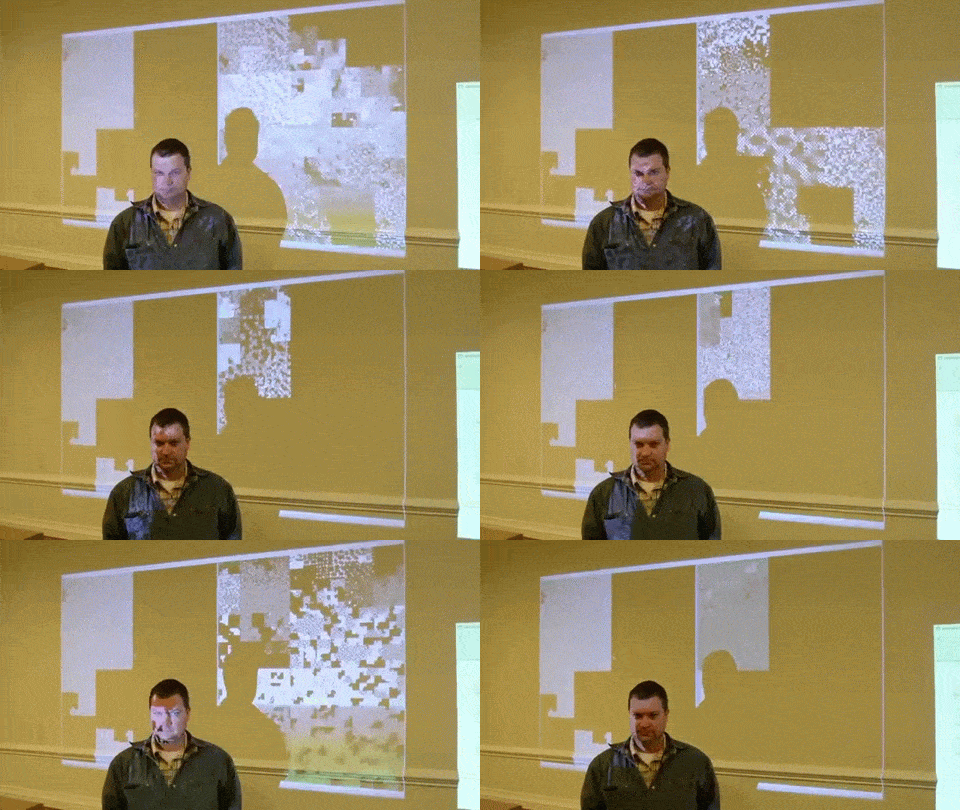
[David Prutchi]’s project for the Hackaday Prize was like many projects – a simple, novel idea that’s easy and relatively cheap to implement. It’s a polarimetric camera meant to see what humans can’t. By seeing the world in polarized light, the DOLPi can see landmines, cancerous tissue, and air pollution using only a Raspberry Pi and a few Python scripts He gave a talk at this year’s Hackaday SuperConference about polarization cameras and the DOLPi project. After enjoying the video, join us after the break for more details.


Continue reading “Augmenting Human Vision With Polarimetric Cameras”

Danielle Applestone And The Story Of Every Othermill

Many of us may qualify as “makers,” but how about a “maker of machines?” [Danielle Applestone] tells us what kinks to look for whilst embarking on your hardware startup adventure. Co-founder of Other Machine Co, the company that makes a PCB Mill that holds tolerances as tight as a thousandth of an inch, [Danielle] holds degrees in chemistry and materials science from MIT and UT Austin. While she may tell you that the math for running a hardware company is easy, knowing what numbers to crunch and keeping track of them has been part of her key to success. So take 20, and give yourself a moment to take in [Danielle’s] tips from her Hackaday Superconference talk on beating the hurdles ahead in the land of hardware startups.

Continue reading “Danielle Applestone And The Story Of Every Othermill”

How Y Combinator Brings Hardware Startups To Life

The world is more used to software startups than hardware startups. Luke Iseman is here to help. He is the Director of Hardware at Y Combinator and discusses some details that need to be kept in mind when starting up your own hardware company. Take a look at the talk he presented at the 2015 Hackaday SuperConference and then join us after the break to cover a few key points of his discussion.

Continue reading “How Y Combinator Brings Hardware Startups To Life”

Vinduino: Full Irrigation With 25% Less Water

Irrigation is a fairly crude practice. Sure, there are timers, and rain sensors, but all in all we’re basically dumping water on the ground and guessing at the right amount. [Reinier van der Lee] wanted a better way to ensure the plants in his vineyard are getting the right amount of water. And this is Goldilocks’ version of “right”, not too little but also not too much. Southern California is in an extreme/exceptional drought. Water costs a lot of money, but it is also scarce and conservation has a wider impact than merely the bottom line.

His solution is the Vinduino project. It’s a set of moisture sensors that work in conjunction with a handheld device to measure the effect of irrigation. Multiple moisture sensors are buried at different depths: near the surface, at root level, and below root level. This lets you know when the water is getting to the root system, and when it has penetrated further than needed. The project was recognized as the Best Product in the 2015 Hackaday Prize, and [Reinier] presented the project during his talk at the Hackaday SuperConference. Check out the video of that talk below, and join us after the break for a look at the development of this impressive product.

Continue reading “Vinduino: Full Irrigation With 25% Less Water”

Go From Prototype To Pilot Production With Zach Fredin

What’s it like to build a run of 100 prototypes in your basement? Get a first-hand account as [Zach Fredin] discusses his development and production of NeuroBytes. The system is a set of electronic models that represent neurons. Connecting them together into different networks helps to teach about how the human nervous system works. It’s a wonderful concept, and was recognized as a finalist for Best Product in the 2015 Hackaday Prize. More recently, [Zach] tells us it has been granted Recommended Status for a Phase I SBIR National Science Foundation grant. Looks like [Zach’s] new job is all NeuroBytes and is well funded. Congratulations!

Check out [Zach Fredin’s] talk from the 2015 Hackaday SuperConference, then join us after the break to dig further into the details of the project.

Continue reading “Go From Prototype To Pilot Production With Zach Fredin”