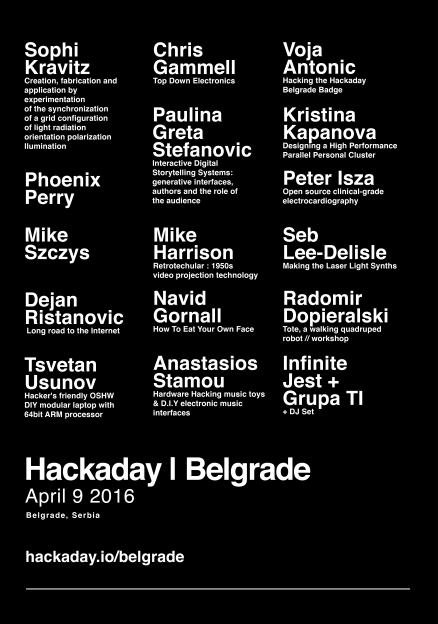
Hackaday is hosting a hardware conference in Belgrade on April 9th. This is arguably our first-ever European conference, and for the last few months we’ve been putting together a hackable conference badge, a list of speakers, and a set of hands-on workshops. Now, we’re finally ready to announce the workshops and talks for Hackaday | Belgrade. You can check out the scheduled talks and workshops below.
Tickets for Hackaday | Belgrade are still available, and tickets for the workshops will open up today. Tickets are also cheap – $35 for a regular ticket, and about $10 and $30 for the robot and DIY musical toy workshops, respectively. The workshop tickets are only to cover material cost, and you’ll get to take your project home with you.
The conference will be a blast. There will be bands and DJs, badge hacking competitions, and ten hours of talks and workshops. If you’re going, or are still on the fence, hang out on the event page to get the inside info on a few Hackaday events that will happen the night before and the day after.
The Workshops
Radomir Dopieralski – Tote, A Walking Quadruped Robot. Build your own spider-like robot and make it walk.
Anastasios Stamou – Hardware Hacking Musical Toys & DIY Electronic Musical Interfaces. Introductory circuit bending workshop teaching all the necessary techniques for designing and making experimental electronic musical interfaces out of recycled material.
The Talks
Voja Antonic – Hacking the Hackaday Belgrade Badge. The Belgrade conference features its own badge designed by Voja Antonic. Voja will introduce the Belgrade badge and the theory of operation behind the LED matrix, keyboard, power management, infrared transceiver, and accelerometer.
Navid Gornall – How To Eat Your Own Face. The story of hacking a 3D printer to print burger selfies with mayo. Printing with a non-Newtonian condiment presents a unique set of challenges which will be explored in this presentation.
Tsvetan Usunov – Hacker Friendly OSHW DIY Modular Laptop. Tsvetan is the mind behind Olimex, manufacturer of various embedded development platforms and tools. He will talk about the creation of a modular, hacker friendly laptop based on a 64-bit ARM processor.
Chris Gammell – Top Down Electronics
Dejan Ristanovic – Serbia: Long Road To The Internet. During the 1980s and 1990s, we had to hack the system in many ways just to stay connected, and to reinvent the wheel three times before breakfast. We also had some results, including Sezam, the biggest BBS in this part of Europe
Kristina Kapanova – Designing A High Performance Parallel Personal Cluster. This talk introduces an open source, homebrew mini cluster consisting of a Radxa Pro single board computer based on the quad-core ARM Cortex-A9 CPU. In particular, this talk demonstrates it is possible to achieve very advanced simulations in the field of quantum computing.
Sophi Kravitz – Creation, fabrication, and application by experimentation of the synchronization of a grid configuration of a light radiation orientation polarization illumination.
Seb Lee-Delisle – Making The Laser Light Synths. The Laser Light Synths are LED emblazoned musical instruments that anyone can play. Along with high power lasers, they form part of a large outdoor installation that switch the traditional roles of audience and performer.
Mike Harrison – Retrotechular : 1950s Video Projection Technology. A talk on the history and technology of the Eidophor, a little known, absurdly complicated, and very expensive product that dominated the large-screen projection market from the 1950s to the 1990s.
Peter Isza – Open Source Clinical Grade Electrocardiography. This talk covers the development of a true clinical grade, open source Holter ECG which will be sold for close to its manufacturing cost.
Paulina Stefanovic – Interactive Digital Storytelling Systems: Generative Interfaces, Authors and the Role of the Audience. This talk will cover the development and design of interactive content and interactive performance that shifts the focus from the creator of the system to the creative involvement of the audience.





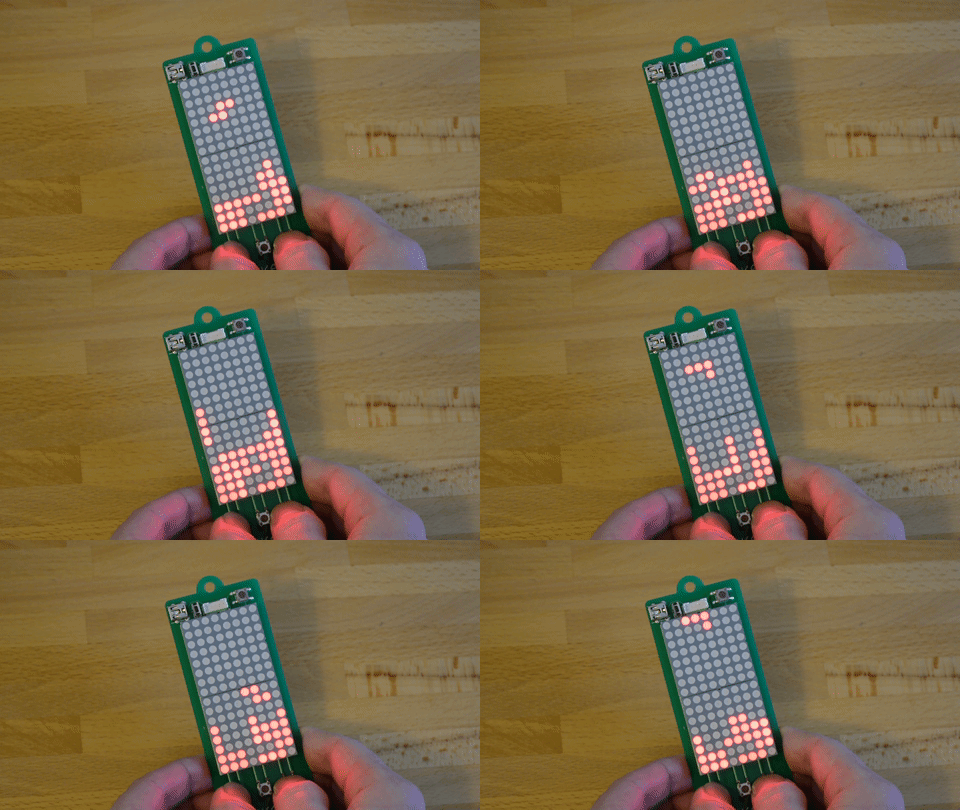

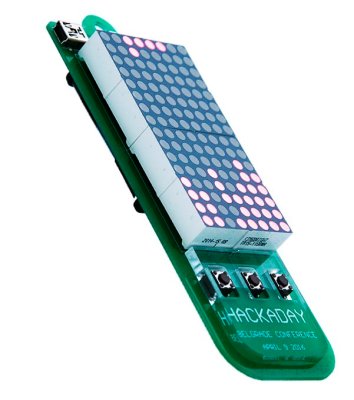 This is the first Hackaday event where we have an active electronic badge.








