Two Weeks To HOPE X, And We’re Going

hopex_web_topbar_b

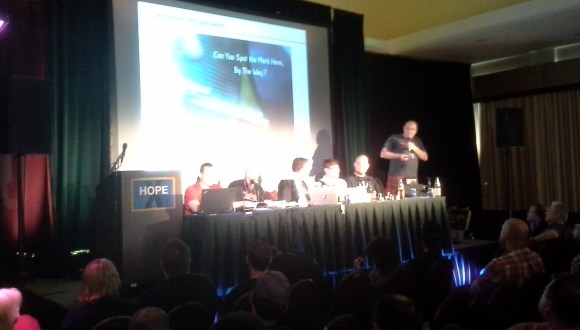
In a little less than two weeks, the biannual HOPE conference in NYC will be in full swing. Attendance is more than likely to put you on a list somewhere, so of course we’ll be setting up shop, enjoying the sights and sounds, and throwing swag at hundreds of attendees.

Highlights of HOPE X include a keynote from [Daniel Ellisburg], a video conference with [Edward Snowden], a Q&A with the EFF, a talk I’ll certainly be attending, and the always popular talk on social engineering headed up by [Emmanuel Goldstein].

As with all our extracurriculars, Hackaday will be giving out some swag (200+ tshirts, stickers, and THP goodies), and manning a vendor booth. Look for the eight foot Hackaday flag held up with duct tape. We’ll also be doing the usual video and blog thing from HOPE, for all of you who can’t attend thanks to your company’s security reviews, and some super secret things I can’t believe the overlords signed off on.

In other 2600 news, they ain’t doin too good, with tens of thousands of dollars of debt thanks to rather crappy legal stuff with their distributors. Buying a ticket would help the 2600 guys out, as would buying July’s issue (also on Kindle).

Magic In The Midwest: Maker Faire Kansas City

What did you do over the weekend? I spent both days at Maker Faire Kansas City and it was awesome. This is the fourth year the Faire has been held in Union Station, a stunning Kansas City landmark that celebrates its centennial this fall.

The Things

As you might imagine, there were 3D printers galore. One of my favorites was the One Up family from Q3D. These acrylic beauties start at $199 and offer a heated bed plate option.

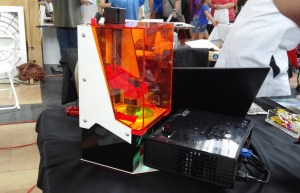
Maker Juice Labs, purveyors of 3D printing inks for SLA brought a LittleSLA printer which they demonstrated by making some very nice key chains.

Little SLA does it stereolithographically.

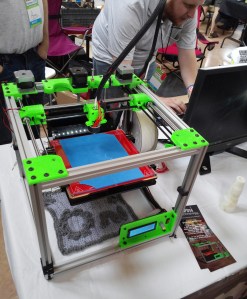
SeeMeCNC had their Rostock Max V2 printer cooking up some huge prints, and Oni Technology, a local KC company, had their H Bot cranking.

Locally-made Oni H Bot.

At the Modio booth, my companion and I constructed heroes and monsters from a rainbow-colored pile of 3D-printed body parts and weapons. With Modio’s iPad app, you can create characters from the existing parts library, modify those parts, and print them on any 3D printer. All of the parts are designed to snap together. Modio recently teamed up with MakerBot and hopes to port their app from the iPad to the iPhone and Android in the near future.

I managed to resist the inexplicable Hostess booth and their free piles of Twinkies, Cup Cakes, and Coffee Cakes. They had a display that promised banana Twinkies and some Greek yogurt oddities, but only had the regular stuff on hand. On Sunday, I saw many people lugging around entire boxes of free Donettes and other goodies.

Continue reading “Magic In The Midwest: Maker Faire Kansas City” →

[Lenore] Eviscerates Her Racing Snail

[youtube=https://www.youtube.com/watch?v=pzymwuPdQp4&w=580]


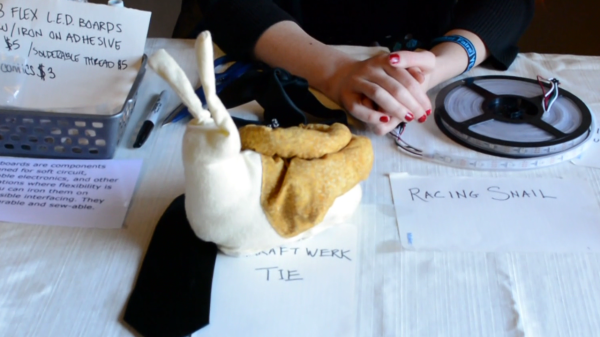
You may have walked past [Lenore’s] unassuming card table at Maker Faire this year. But we’re really glad we stopped for a little chat. She went so far as to pull the working parts out of her racing snail to show them to us!

Wait, wait… racing snail? Yeah, this is a pretty neat one from a few years ago. The snail is a relatively large version of a bristlebot (incidentally, we believe bristlebots were originated by EMSL). The thing that’s missing here are the bristles. Instead of using a scrub-brush for this large version, [Lenore] discovered that velvet has a somewhat uni-directional grain. But using a piece of mouse-pad cut to the same footprint as the velvet she was able to get the flat-footed snail to move in a forward direction purely through the jiggle of a vibrating motor.

If this sparked your interest there are tons of other bristlebot variations to be found around here. One of our favorites is still this abomination which shifts weight to add steering.

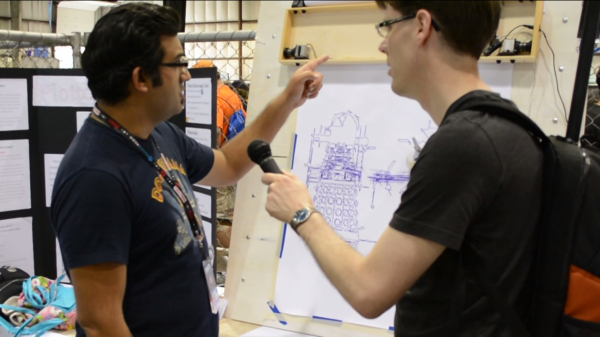
Standing in front of a gravity based pen plotter

Plotterbot Drawing Daleks


Two strings, two motors, and some very creative software. That’s the magic behind the Plotterbot, which was drawing Daleks when we crossed its path at Maker Faire. This is the Mark II, which was built after cannibalizing Mark I. Unfortunately we can’t tell you what the difference is between the two.

The machine itself is a pretty nice little package. There is a box that hangs on the wall with a motor/spool combination at each end. In the middle of those two is an Arduino Mega with a custom driver shield. It takes an SD card with the drawing files on it. There is also a small touchscreen display which allowed for easy selection of what you’d like drawn on that paper taped to the wall below the unit.

Back when we were running the Trinket contest [Jay] used the Plotterbot to draw a Skull and Wrenches made out of a multitude of smaller Skull and Wrenches. He was nice enough bring that piece of art and present it to us at the Faire. Thanks [Jay]!

Continue reading “Plotterbot Drawing Daleks” →

Connecting Inexpensive PH Probes With Ease

[youtube=https://www.youtube.com/watch?v=yKigsN8046k&w=580]


We’ve mentioned that it’s hard to find someone not selling or crowd funding something at Maker Faire. Despite the fact that [Ryan Edwards] is selling his boards, we still got the feeling that he’s a hacker who is selling just to make sure the idea he had is available for other hackers to use. He showed us his interface boards for inexpensive pH probes.

Since we’re always looking for more chemistry hacks to run, it was nice to hear [Ryan’s] description on how these probes (which can be had for around $9 on eBay) actually work. It turns out it’s all about salt. When it comes to the electronics, the board provides a connector for the probe on one edge, and pins for voltage, ground, and I2C on another. Rig this up with your microcontroller of choice and you’ll be building your own automatic pool doser, fish tank minder, or one of a multitude of food-related hacks.

Head on over to Sparky’s Widgets to see a few other demo applications.

green monochrome CRT vector display

Vector Graphic Flappy Bird Harder Than It Should Be

The dark room at Maker Faire was loud,  after all it’s where Arc Attack was set up plus several other displays that had music. But if you braved the audio, and managed not to experience a seizure or migraine from all the blinking you were greeted with these sharply glowing vector displays on exhibit at the TubeTime booth. We did the best we could with the camera work, but the sharpness of the lines, and contrast of the phosphorescent images against the black screen still seems to pop more if viewed in person.

This isn’t [Eric’s] first attempt at driving high-voltage tube displays. We previously covered his dekatron kitchen timer. But we’d say he certainly stepped things up several notches in the years between then and now. He blogged about Asteroids, which is running on the same hardware as the Flappy Bird demo from our video above. An STM32F4 Discovery board is running a 6502 emulator to push the game to [Eric’s] CRT vector driver hardware.

Just before we were done at the booth, [Eric] turned to us with a twinkle in his eye. He confessed his delight in purposely leaving out any button debounce from the Flappy Bird demo. As if it wasn’t hard enough it tends to glitch after passing just a few of the pipe gates. Muhuhahaha!

Showing the tablet interface for the scope

Discovering A Wifi Enabled 10MHz Oscilloscope

[youtube=https://www.youtube.com/watch?v=qEqWtKGJhFQ&w=580]


As most of our readers know, [Mike] was visiting Bay Area Maker Faire  last weekend with a big Jolly Wrencher on his back. During his tour he encountered the neat oscilloscope shown in the video above, made by the Belgian company Velleman. Even though it only has a 10MS/s sampling rate and a 10MHz bandwidth, our guess is that it may still be useful for some hobbyists out there as it can communicate with any PC/smartphone/tablet using its Wifi interface.

Inside the black box is a 3.7V 1800mAh Li-ion battery with a USB port to recharge it or update the oscilloscope’s firmware. As seen in the video, the tablet’s touchscreens may enable more natural interaction with the user interface. The protocol used to export the acquired samples is open, which may allow users to create their own analysis program. The oscilloscope uses an 8 bit analog to digital converter and a 4K samples buffer.