Once upon a time, typing “www” at the start of a URL was as automatic as breathing. And yet, these days, most of us go straight to “hackaday.com” without bothering with those three letters that once defined the internet.
Have you ever wondered why those letters were there in the first place, and when exactly they became optional? Let’s dig into the archaeology of the early web and trace how this ubiquitous prefix went from essential to obsolete.
Where Did You Go?
The first website didn’t bother with any of that www. nonsense! Credit: author screenshot
It may shock you to find out that the “www.” prefix was actually never really a key feature or necessity at all. To understand why, we need only contemplate the very first website, created by Tim Berners-Lee at CERN in 1990. Running on a NeXT workstation employed as a server, the site could be accessed at a simple URL: “http//info.cern.ch/”—no WWW needed. Berners-Lee had invented the World Wide Web, and called it as such, but he hadn’t included the prefix in his URL at all. So where did it come from? Continue reading “What Happened To WWW.?”→
Historically, efforts to create original games and tools, port over open source emulators, and explore a game console’s hardware and software have been generally lumped together under the banner of “homebrew.” While not the intended outcome, it’s often the case that exploring a console in this manner unlocks methods to run pirated games. For example, if a bug is found in the system’s firmware that enables a clever developer to run “Hello World”, you can bet that the next thing somebody tries to write is a loader that exploits that same bug to play a ripped commercial game.
But for those who are passionate about being able to develop software for their favorite game consoles, and the developers who create the libraries and toolchains that make that possible, the line between homebrew and piracy is a critical boundary. The general belief has always been that keeping piracy at arm’s length made it less likely that the homebrew community would draw the ire of the console manufacturers.
As such, homebrew libraries and tools are held to a particularly high standard. Homebrew can only thrive if developed transparently, and every effort must be taken to avoid tainting the code with proprietary information or code. Any deviation could be the justification a company like Nintendo or Sony needs to swoop in.
Unfortunately, there are fears that covenant has been broken in light of multiple allegations of impropriety against the developers of libogc, the C library used by nearly all homebrew software for the Wii and GameCube. From potential license violations to uncomfortable questions about the origins of the project, there’s mounting evidence that calls the viability of the library into question. Some of these allegations, if true, would effectively mean the distribution and use of the vast majority of community-developed software for both consoles is now illegal.
As the Common Business Oriented Language, COBOL has a long and storied history. To this day it’s quite literally the financial bedrock for banks, businesses and financial institutions, running largely unnoticed by the world on mainframes and similar high-reliability computer systems. That said, as a domain-specific language targeting boring business things it doesn’t quite get the attention or hype as general purpose programming or scripting languages. Its main characteristic in the public eye appears be that it’s ‘boring’.
Despite this, COBOL is a very effective language for writing data transactions, report generating and related tasks. Due to its narrow focus on business applications, it gets one started with very little fuss, is highly self-documenting, while providing native support for decimal calculations, and a range of I/O access and database types, even with mere files. Since version 2002 COBOL underwent a number of modernizations, such as free-form code, object-oriented programming and more.
Without further ado, let’s fetch an open-source COBOL toolchain and run it through its paces with a light COBOL tutorial.
If you’ve only been around for the Internet age, you may not realize that Hackaday is the successor of electronics magazines. In their heyday, magazines like Popular Electronics, Radio Electronics, and Elementary Electronics brought us projects to build. Hacks, if you will. Just like Hackaday, not all readers are at the same skill level. So you’d see some hat with a blinking light on it, followed by some super-advanced project like a TV typewriter or a computer. Or a picture phone.
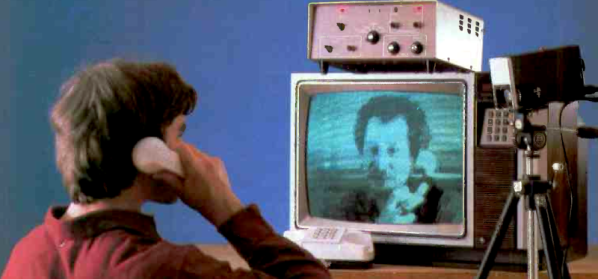
In 1982, Radio Electronics, a major magazine of the day, showed plans for building a picture phone. All you needed was a closed-circuit TV camera, a TV, a telephone, and about two shoeboxes crammed full of parts.
Like many picture phones of its day, it was stretching the definition a little. It actually used ham radio-style slow scan TV (SSTV) to send a frame of video about once every eight seconds. That’s not backwards. The frame rate was 0.125 Hz. And while the resulting 128 x 256 image would seem crude today, this was amazing high tech for 1982.
Last week, the mainstream news was filled with headlines about K2-18b — an exoplanet some 124 light-years away from Earth that 98% of the population had never even heard about. Even astronomers weren’t aware of its existence until the Kepler Space Telescope picked it out back in 2015, just one of the more than 2,700 planets the now defunct observatory was able to identify during its storied career. But now, thanks to recent observations by the James Web Space Telescope, this obscure planet has been thrust into the limelight by the discovery of what researchers believe are the telltale signs of life in its atmosphere.
Artist’s rendition of planet K2-18b.
Well, maybe. As you might imagine, being able to determine if a planet has life on it from 124 light-years away isn’t exactly easy. We haven’t even been able to conclusively rule out past, or even present, life in our very own solar system, which in astronomical terms is about as far off as the end of your block.
To be fair the University of Cambridge’s Institute of Astronomy researchers, lead by Nikku Madhusudhan, aren’t claiming to have definitive proof that life exists on K2-18b. We probably won’t get undeniable proof of life on another planet until a rover literally runs over it. Rather, their paper proposes that abundant biological life, potentially some form of marine phytoplankton, is one of the strongest explanations for the concentrations of dimethyl sulfide and dimethyl disulfide that they’ve detected in the atmosphere of K2-18b.
As you might expect, there are already challenges to that conclusion. Which is of course exactly how the scientific process is supposed to work. Though the findings from Cambridge are certainly compelling, adding just a bit of context can show that things aren’t as cut and dried as we might like. There’s even an argument to be made that we wouldn’t necessarily know what the signs of extraterrestrial life would look like even if it was right in front of us.
In the 2000s, the DVD industry was concerned about piracy, in particular the threat to their business model presented by counterfeit DVDs and downloadable movies. Their response was a campaign which could be found embedded into the intro sequences of many DVDs of the era, in which an edgy font on a black background began with “You wouldn’t steal a car.. “. It was enough of a part of the background noise of popular culture that it has become a meme in the 2020s, reaching many people with no idea of its origins. Now in a delicious twist of fate, it has been found that the font used in the campaign was itself pirated. Someone should report them.
The font in question is FF Confidential, designed by [Just van Rossum], whose brother [Guido] you may incidentally know as the originator of the Python programming language. The font in the campaign isn’t FF Confidential though, as it turns out it’s XBAND Rough, a pirated copy of the original. What a shame nobody noticed this two decades ago.
It’s a bit of fun to delight in an anti-piracy campaign being caught using a dodgy font, but if this story serves to tell us anything it’s that the web of modern intellectual property is so labyrinthine as to be almost impossible to navigate without coming a cropper somewhere. Sadly the people caught out in this case would be the last to call for reform of the intellectual property environment, but as any sane heads would surely agree, such reform is overdue.
There was a time when each and every printer and typesetter had its own quirky language. If you had a wordprocessor from a particular company, it worked with the printers from that company, and that was it. That was the situation in the 1970s when some engineers at Xerox Parc — a great place for innovation but a spotty track record for commercialization — realized there should be a better answer.
That answer would be Interpress, a language for controlling Xerox laser printers. Keep in mind that in 1980, a laser printer could run anywhere from $10,000 to $100,000 and was a serious investment. John Warnock and his boss, Chuck Geschke, tried for two years to commercialize Interpress. They failed.
So the two formed a company: Adobe. You’ve heard of them? They started out with the idea of making laser printers, but eventually realized it would be a better idea to sell technology into other people’s laser printers and that’s where we get PostScript.