Attach A Full Size Lens To A Tiny Camera

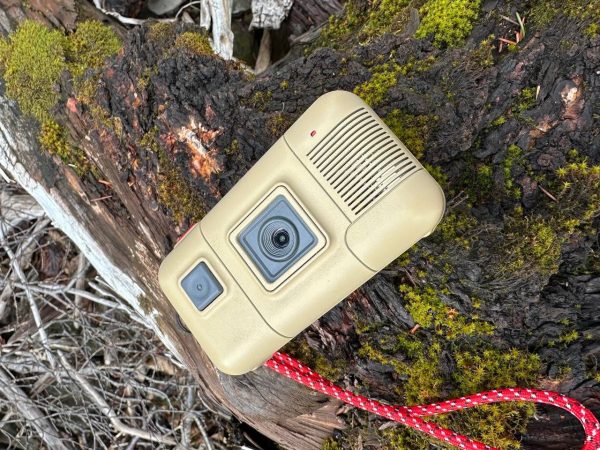
The Kodak Charmera is a tiny keychain camera produced by licencing out the name of the famous film manufacturer, and it’s the current must-have cool trinket among photo nerds. Inside is a tiny sensor and a fixed-focus M7 lens, and unlike many toy cameras it has better quality than its tiny package might lead you to expect. There will always be those who wish to push the envelope though, and [微攝 Macrodeon] is here to fit a lens mount for full-size lenses (Chinese language, subtitle translation available).

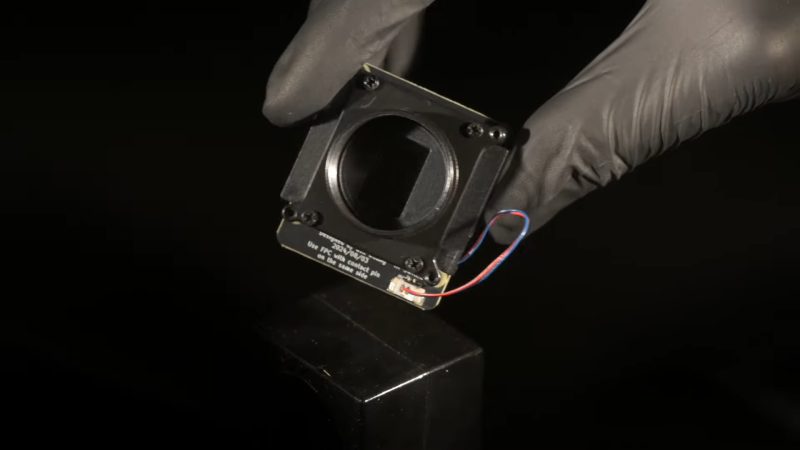
The hack involves cracking the camera open and separating the lens mount from the sensor. This is something we’re familiar with from other cameras, and it’s a fiddly process which requires a lot of care. A C-mount is then glued to the front, from which all manner of other lenses can be attached using a range of adapters. The focus requires a bit of effort to set up and we’re guessing that every lens becomes extreme telephoto due to the tiny sensor, but we’re sure hours of fun could be had.

The Charmera is almost constantly sold out, but you should be able to place a preorder for about $30 USD if you want one. If waiting months for delivery isn’t your bag, there are other cameras you can upgrade to C-mount.

Continue reading “Attach A Full Size Lens To A Tiny Camera”

Nostalgic Camera Is A Mashup Of Analog Video Gear

These days, you get a fantastic camera with the purchase of just about any modern smartphone. [Abe] missed some of the charm of earlier, lower-quality digital cameras, though, and wanted to recreate that experience. The way forward was obvious. He built a nostalgic digital video camera from scratch!

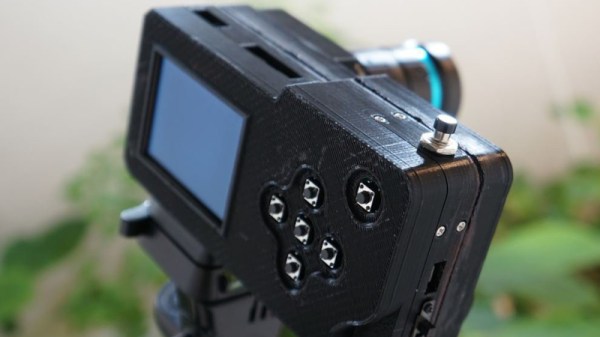
[Abe] figured he could build the entire project around analog gear, and then simply find a way to store the video digitally, thus creating the effect he was looking for. To that end, the build is based around a small analog video camera that’s intended for use with FPV drones. It runs on 5 to 20 volts and outputs a simple composite video signal. This makes it easy to display its output on a small LCD screen, originally intended to be used with an automotive reversing camera. These were both paired with a mini video recorder module from RunCam, which can capture composite video and store it on a microSD card in 640 x 480 resolution.

These parts were quickly lashed together, with the camera sending its output to the RunCam video recorder module, which then passed it on to the screen. Everything worked as expected, so [Abe] moved on to implementing an on-screen display using the MAX7456 chip, which is built specifically for this purpose. It overlays text on the video feed to the screen as commanded by an RP2040 microcontroller. Once that was all working, [Abe] just had to provide a battery power supply and wrap everything up in a nice retro-styled case. Then, at the last minute, the separate camera and recorder modules were replaced by a TurboWing module that combined both into one.

The result is a nifty-looking camera that produces grainy, slurry, old-school digital video. If you love 640 x 480 as a resolution, you’ll dig this. It’s got strong 90s camcorder vibes, and that’s a very good thing.

We love a good custom camera around these parts, especially those that offer deliciously high resolution. If you’re building your own, be sure to let us know. Video after the break.

Continue reading “Nostalgic Camera Is A Mashup Of Analog Video Gear”

Tearing Down Walmart’s $12 Keychain Camera

Keychain cameras are rarely good. However, in the case of Walmart’s current offering, it might be worse than it’s supposed to be. [FoxTailWhipz] bought the Vivitar-branded device and set about investigating its claim that it could deliver high-resolution photos.

The Vivatar Retro Keychain Camera costs $12.88, and wears “FULL HD” and “14MP” branding on the packaging. It’s actually built by Sakar International, a company that manufactures products for other brands to license. Outside of the branding, though, [FoxTailWhipz] figured the resolution claims were likely misleading. Taking photos quickly showed this was the case, as whatever setting was used, the photos would always come out at 640 x 480, or roughly 0.3 megapixels. He thus decided a teardown would be the best way to determine what was going on inside. You can see it all in the video below.

Pulling the device apart was easy, revealing that the screen and battery are simply attached to the PCB with double-sided tape. With the board removed from the case, the sensor and lens module are visible, with the model number printed on the flex cable. The sensor datasheet tells you what you need to know. It’s a 2-megapixel sensor, capable of resolutions up to 1632 x 1212. The camera firmware itself seems to not even use the full resolution, since it only outputs images at 640 x 480.

It’s not that surprising that an ultra-cheap keychain camera doesn’t meet the outrageous specs on the box. At the same time, it’s sad to see major retailers selling products that can’t do what they say on the tin. We see this problem a lot, in everything from network cables to oscilloscopes.

Continue reading “Tearing Down Walmart’s $12 Keychain Camera”

Hidden Camera Build Proves You Can’t Trust Walnuts

Typically, if you happened across a walnut lying about, you might consider eating it or throwing it to a friendly squirrel. However, as [Penguin DIY] demonstrates, it’s perfectly possible to turn the humble nut into a clandestine surveillance device. It turns out the walnut worriers were right all along.

The build starts by splitting and hollowing out the walnut. From there, small holes are machined into the mating faces of the walnut, into which [Penguin DIY] glues small neodymium magnets. These allow the walnut to be opened and snapped shut as desired, while remaining indistinguishable from a regular walnut at a distance.

The walnut shell is loaded with nine tiny lithium-polymer cells, for a total of 270 mAh of battery capacity at 3.7 volts. Charging the cells is achieved via a deadbugged TP4056 charge module to save space, with power supplied via a USB C port. Holes are machined in the walnut shell for the USB C port as well as the camera lens, though one imagines the former could have been hidden purely inside for a stealthier look. The camera itself appears to be an all-in-one module with a transmitter built in, with the antenna installed in the top half of the walnut shell and connected via pogo pins. The video signal can be picked up at a distance via a receiver hooked up to a smart phone. No word on longevity, but the included batteries would probably provide an hour or two of transmission over short ranges if you’re lucky.

If you have a walnut tree in your backyard, please do not email us about your conspiracy theories that they are watching you. We get those more than you might think, and they are always upsetting to read. If, however, you’re interested in surveillance devices, we’ve featured projects built for detecting them before with varying levels of success. Video after the break.

Continue reading “Hidden Camera Build Proves You Can’t Trust Walnuts”

Instant Sketch Camera Is Like A Polaroid That Draws

These days, everyone’s got a million different devices that can take a passable photo. That’s not special anymore. A camera that draws what it sees, though? That’s kind of fun. That’s precisely what [Jens] has built—an instant sketch camera!

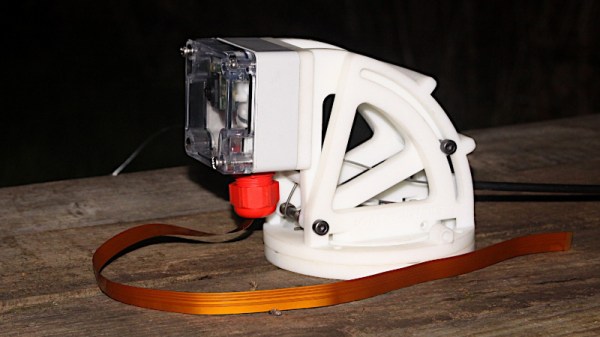
The sketch camera looks like a miniature drawing easel, holding a rectangular slip of paper not dissimilar in size to the Polaroid film of old. The 3D-printed frame rocks a Raspberry Pi controlling a simple pen plotter, using SG90 servos to position the drawing implement and trace out a drawing. So far, so simple. The real magic is in the image processing, which takes any old photo with the Pi camera and turns it into a sketch in the first place. This is achieved with the OpenCV image processing library, using an edge detection algorithm along with some additional filtering to do the job.

If you’ve ever wanted to take Polaroids that looked like sketches when you’re out on the go, this is a great way to do it. We’ve featured some other great plotter builds before, too, just few that are as compact and portable as this one. Video after the break.

Continue reading “Instant Sketch Camera Is Like A Polaroid That Draws”

Hacking A Pill Camera

A gastroscopy is a procedure that, in simple terms, involves sticking a long, flexible tube down a patient’s throat to inspect the oesophagus and adjacent structures with a camera fitted to the tip. However, modern technology has developed an alternative, in the form of a camera fitted inside a pill. [Aaron Christophel] recently came across one of these devices, and decided to investigate its functionality.

[Aaron’s] first video involves a simple teardown of the camera. The small plastic pill is a marvel of miniaturization. Through the hemispherical transparent lens, we can see a tiny camera and LEDs to provide light in the depths of the human body. Slicing the camera open reveals the hardware inside, however, like the miniature battery, the microcontroller, and the radio hardware that transmits signals outside the body. Unsurprisingly, it’s difficult to get into, since it’s heavily sealed to ensure the human body doesn’t accidentally digest the electronics inside.

Unwilling to stop there, [Aaron] pushed onward—with his second video focusing on reverse engineering. With a little glitching, he was able to dump the firmware from the TI CC1310 microcontroller. From there, he was able to get to the point where he could pull a shaky video feed transmitted from the camera itself. Artists are already making music videos on Ring doorbells; perhaps this is just the the next step.

Smart pills were once the realm of science fiction, but they’re an increasingly common tool in modern medicine. Video after the break.

Continue reading “Hacking A Pill Camera”

Small camera with greyscale image

Camera Capabilities Unlocked From A Mouse

There is a point where taking technology for granted hides some of the incredible capabilities of seemingly simple devices. Optical mice are a great example of this principle, using what are more or less entirely self-contained cameras just for moving the cursor across your screen. Don’t believe us? Check out this camera made from an old optical mouse from [Dycus]!

For those unfamiliar with optical mice, the sensor used for tracking movement, like a camera, is just an array of photosensitive sensors. This allows a simple on-board microcontroller to convert the small changes from the visual sensor into acceleration/movement information to be sent to the computer.

Proving how capable these sensors can truly be, [Dycus]’s camera manages a whole 30×30 array of picture quality. Along with glorious greyscale, the pictures achieved from such a camera are more than recognizable. Putting together the camera didn’t even require anything crazy beyond the sensor itself. What appears to be a Teensy LC board, basic buttons, and a small screen are essentially everything required to replicate the camera’s functionality. Pictures, both standard and “panoramic”, can be viewed in a variety of color palettes stored on board. Along with a surprisingly impressive feature set, the idea is impressive.

Limitations are often the mother of innovation, no matter if self-imposed or not, as seen here. However, [Dycus] still had a whole 30×30 array to photograph. What about a single pixel? Let’s make it even harder; we can’t look directly at the subject! This is exactly what was done here in this impressive demonstration of clever engineering.

Thanks to JohnU and Thinkerer for the tip!