Pi-Powered Camera Turns Heads And Lenses In Equal Measure

Have you ever seen photos of retro movie sets where the cameras seem to be bedazzled with lenses? Of course you can only film via one lens at a time, but mounting multiple lenses on a turret as was done in those days has certain advantages –particularly when working with tiny M12 lenses, like our own [Jenny List] recently did with this three-lens, Pi-zero based camera.

Given that it’s [Jenny], the hardware is truly open source, with not just the Python code to drive the Pi but the OpenSCAD code used to generate the STLs for the turret and the camera body all available via GitHub under a generous CC-BY-SA-4.0 license. Even using a cheap sensor and lenses from AliExpress, [Jenny] gets good results, as you can see from the demo video embedded below. (Jump to 1:20 if you just want to see images from the camera.)

The lenses are mounted to a 3D printed ring with detents to lock each quickly in place, held in place by a self-tapping screw, proving we at Hackaday practice what we preach. (Or that [Jenny] does, at least when it comes to fasteners.) Swapping lenses becomes a moment’s twist, as opposed to fiddling with tiny lenses hoping you don’t drop one. We imagine the same convenience is what drove turret cameras to be used in the movie industry, once upon a time.

Continue reading “Pi-Powered Camera Turns Heads And Lenses In Equal Measure”

Broken Phone To Cinema Camera With A Lens Upgrade

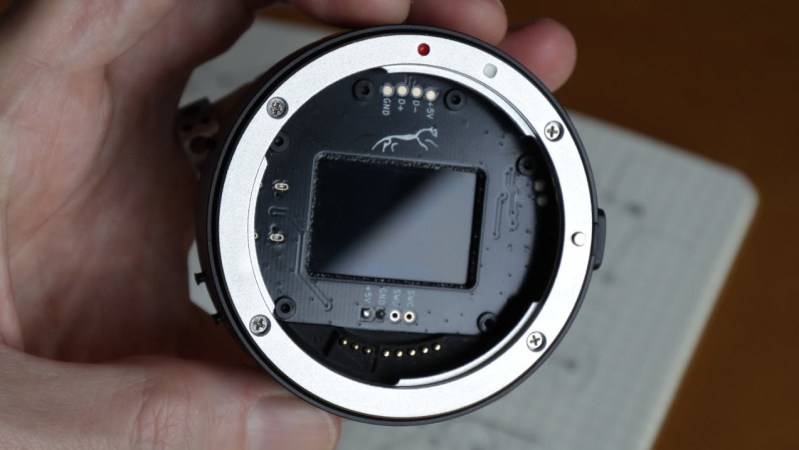
The advent of the mobile phone camera has caused a revolution in film making over the last couple of decades, lowering the barrier to entry significantly, and as the cameras have improved, delivering near-professional-grade quality in some cases. Mobile phone manufacturers hire film makers to promote their new flagship models and the results are very impressive, but there is still a limitation when it comes to the lenses. [Evan Monsma] has broken through that barrier, modifying an iPhone to take C-mount cinema lenses.

It’s likely many of us have one or two broken mobile phones around, and even if they aren’t flagship models they’ll still have surprisingly good camera sensors. This one is an iPhone that’s seen better days, with a severely cracked glass back and a dislodged lens cover on one of its cameras. Removing the back and the lens cover reveals the sensor. The video below the break has a lot of woodwork and filing away of the phone, as he modifies a C-to-CS ring to serve as a C-mount. In reality the flange distance makes it a CS mount so his C-mount lenses need an adapter, but as anyone who’s used a Raspberry Pi camera will tell you, that’s no hardship.

The final camera has a thick plywood back with a tripod mount installed, the other two cameras work with their Apple lenses, and the C-mount gives great results with a cinema lens. We’re concerned that the Super Glue he uses to fix it all together might not hold up to the weight of bigger lenses, but we’re here for this project and we love it.

Continue reading “Broken Phone To Cinema Camera With A Lens Upgrade”

DIY 35mm Film Scanning

If you are sitting on a horde of negatives, waiting for the digital photography fad to die off, it may be time to think about digitizing your old film. [Kinpro1024] can help with the PiDigitzier, an open-source film scanning solution. The build centers around a Pi Zero 2, a Pi HQ camera, and a diffusing  LED lighting fixture. Of course, there’s also some miscellaneous hardware and a camera lens; the example used a Pentax 50 mm f1.8 lens.

Half of the project is mechanical. An MDF tower provides a stable 250 mm workspace and decks that can slide up and down using threaded rods and curtain rods. Apparently, leveling the platforms is important not only for the optics but also to allow the MDF to move along the rods without binding.

Continue reading “DIY 35mm Film Scanning”

Detecting Surveillance Cameras With The ESP32

These days, surveillance cameras are all around us, and they’re smarter than ever. In particular, many of them are running advanced algorithms to recognize faces and scan license plates, compiling ever-greater databases on the movements and lives of individuals. Flock You is a project that aims to, at the very least, catalogue this part of the surveillance state, by detecting these cameras out in the wild.

The system is most specifically set up to detect surveillance cameras from Flock Safety, though it’s worth noting a wide range of companies produce plate-reading cameras and associated surveillance systems these days. The device uses an ESP32 microcontroller to detect these devices, relying on the in-built wireless hardware to do the job. The project can be built on a Oui-Spy device from Colonel Panic, or just by using a standard Xiao ESP32 S3 if so desired. By looking at Wi-Fi probe requests and beacon frames, as well as Bluetooth advertisements, it’s possible for the device to pick up telltale transmissions from a range of these cameras, with various pattern-matching techniques and MAC addresses used to filter results in this regard. When the device finds a camera, it sounds a buzzer notifying the user of this fact.

Meanwhile, if you’re interested in just how prevalent plate-reading cameras really are, you might also find deflock.me interesting. It’s a map of ALPR camera locations all over the world,  and you can submit your own findings if so desired. The techniques used by in the Flock You project are based on learnings from the DeFlock project. Meanwhile, if you want to join the surveillance state on your own terms, you can always build your own license plate reader instead!

[Thanks to Eric for the tip!]

Build Your Own 6K Camera

[Curious Scientist] has been working with some image sensors. The latest project around it is a 6K camera. Of course, the sensor gives you a lot of it, but it also requires some off-the-shelf parts and, of course, some 3D printed components.

An off-the-shelf part of a case provides a reliable C mount. There’s also an IR filter in a 3D-printed bracket.

Continue reading “Build Your Own 6K Camera”

A man holds a license plate in front of a black pickup (F-150 Lightning) tailgate. It is a novelty Georgia plate with the designation P00-5000. There are specks of black superimposed over the plate with a transparent sticker, giving it the appearance of digital mud in black.

A Deep Dive On Creepy Cameras

George Orwell might’ve predicted the surveillance state, but it’s still surprising how many entities took 1984 as a how-to manual instead of a cautionary tale. [Benn Jordan] decided to take a closer look at the creepy cameras invading our public spaces and how to circumvent them.

[Jordan] starts us off with an overview of how machine learning “AI” is used Automated License Plate Reader (ALPR) cameras and some of the history behind their usage in the United States. Basically, when you drive by one of these cameras, an ” image segmentation model or something similar” detects the license plate and then runs optical character recognition (OCR) on the plate contents. It will also catalog any bumper stickers with the make and model of the car for a pretty good guess of it being your vehicle, even if the OCR isn’t 100% on the exact plate sequence.

Where the video gets really interesting is when [Jordan] starts disassembling, building, and designing countermeasures to these systems. We get a teardown of a Motorola ALPR for in-vehicle use that is better at being closed hardware than it is at reading license plates, and [Jordan] uses a Raspberry Pi 5, a Halo AI board, and You Only Look Once (YOLO) recognition software to build a “computer vision system that’s much more accurate than anything on the market for law enforcement” for $250.

[Jordan] was able to develop a transparent sticker that renders a license plate unreadable to the ALPR but still plainly visible to a human observer. What’s interesting is that depending on the pattern, the system could read it as either an incorrect alphanumeric sequence or miss detecting the license plate entirely. It turns out, filtering all the rectangles in the world to find just license plates is a tricky problem if you’re a computer. You can find the code on his Github, if you want to take a gander.

You’ve probably heard about using IR LEDs to confuse security cameras, but what about yarn? If you’re looking for more artistic uses for AI image processing, how about this camera that only takes nudes or this one that generates a picture based on geographic data?

Continue reading “A Deep Dive On Creepy Cameras”

One Camera Mule To Rule Them All

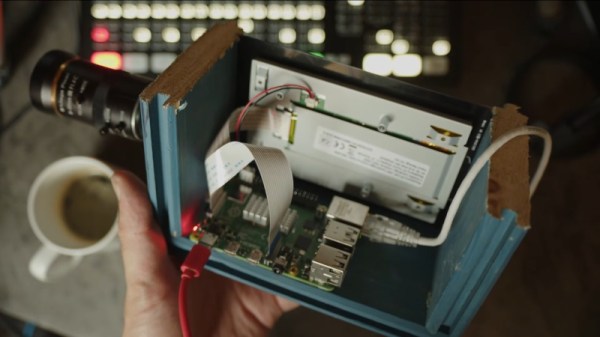
A mule isn’t just a four-legged hybrid created of a union betwixt Donkey and Horse; in our circles, it’s much more likely to mean a testbed device you hang various bits of hardware off in order to evaluate. [Jenny List]’s 7″ touchscreen camera enclosure is just such a mule.

In this case, the hardware to be evaluated is camera modules– she’s starting out with the official RPi HQ camera, but the modular nature of the construction means it’s easy to swap modules for evaluation. The camera modules live on 3D printed front plates held to the similarly-printed body with self-tapping screws.

Any Pi will do, though depending on the camera module you may need one of the newer versions. [Jenny] has got Pi4 inside, which ought to handle anything. For control and preview, [Jenny] is using an old first-gen 7″ touchscreen from the Raspberry Pi foundation. Those were nice little screens back in the day, and they still serve well now.

There’s no provision for a battery because [Jenny] doesn’t need one– this isn’t a working camera, after all, it’s just a test mule for the sensors. Having it tethered to a wall wart or power bank is no problem in this application. All files are on GitHub under a CC4.0 license– not just STLs, either, proper CAD files that you can actually make your own. (SCAD files in this case, but who doesn’t love OpenSCAD?) That means if you love the look of this thing and want to squeeze in a battery or add a tripod mount, you can! It’s no shock that our own [Jenny List] would follow best-practice for open source hardware, but it’s so few people do that it’s worth calling out when we see it.

Thanks to [Jenny] for the tip, and don’t forget that the tip line is open to everyone, and everyone is equally welcome to toot their own horn.