This week, you’re going to learn the ins and outs of the AN/GRC-46 thanks to this army training film from 1963. What is the AN/GRC-46, you ask? Why it’s a complete mobile-tactical sheltered radio-teletypewriter rig capable of CW, voice, and teletype transmission.
The film covers the components that make up the AN/GRC-46, their functions, the capabilities of the system, and proper operation procedures. There’s a lot going on in the tiny 1400lb. steel shelter, so each piece will be introduced from the ground up.
You’ll become familiar with the voltage distribution system and the AN/GRC-46’s included accessories. This introduction will be followed by a short course in RF signal transmission and the Frequency-Shift Keying (FSK) that is performed by the modulator. The ranges of both the transmitter and receiver are discussed, along with the capabilities mentioned before: CW operation using the keyer, voice operation, teletype operation, and reperforation of teletype tape.
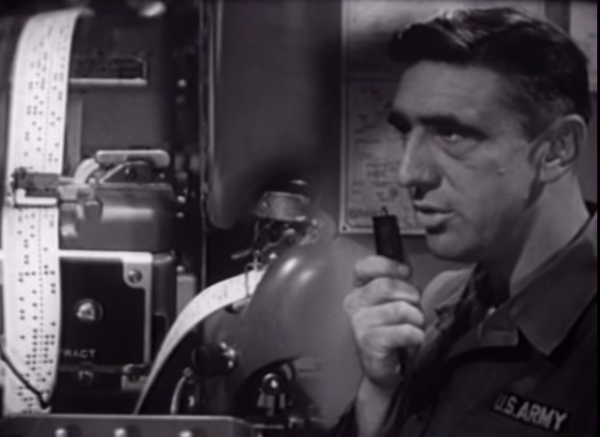
Finally, you’ll observe a seasoned operator make contact and send a teletype message with movements so careful and deliberate that they border on mesmerizing. When he’s not sending messages or taking long walks on the beach, he can usually be found cleaning and/or lubricating the transmitter filter.
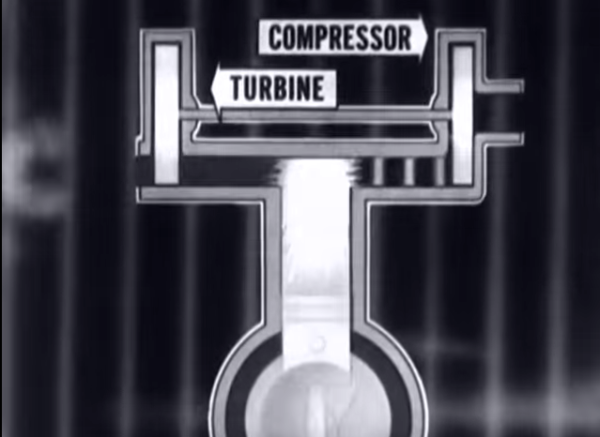
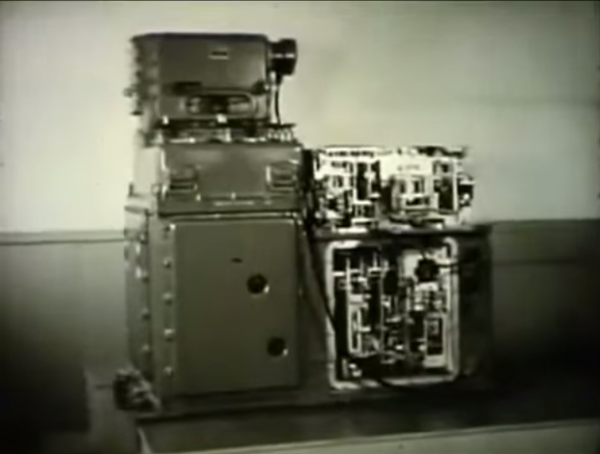
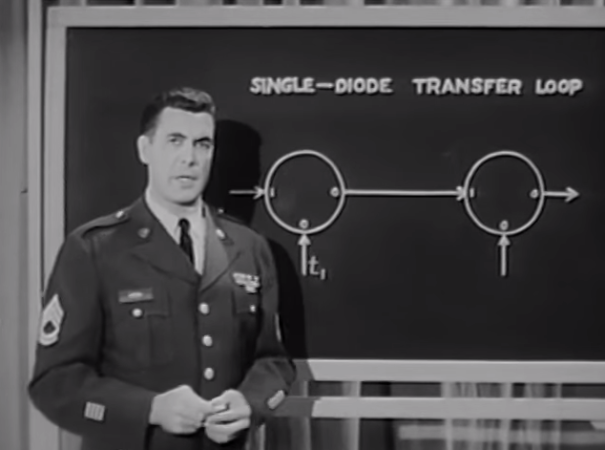
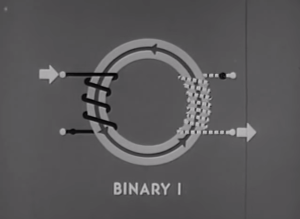 The film covers a lot of theory and does so clearly and concisely. It begins by explaining what a magnetic core is and why it’s used, and then moves on to describe how the cores are used to store bits and the method by which they can transfer information to other cores. Along the way, it provides background on bi-stable devices and provides explanation of magnetization behavior in terms of magnetizing force and flux density.