The diesel engine was, like many things, born of necessity. The main engine types of the day—hot bulb oil, steam, coal gas, and gasoline—were not so thermally efficient or ideal for doing heavy-duty work like driving large-scale electrical generators. But how did the diesel engine come about? Settle in and watch the 1952 documentary “The Diesel Story“, produced by Shell Oil.
The diesel engine is founded on the principle of internal combustion. Throughout the Industrial Age, technology was developing at breakneck pace. While steam power was a great boon to many burgeoning industries, engineers wanted to get away from using boilers. The atmospheric gas engine fit the bill, but it simply wasn’t powerful enough to replace the steam engine.
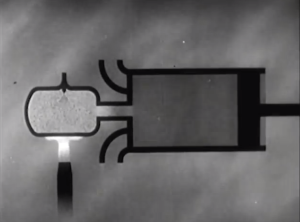 By 1877, [Nikolaus Otto] had completed work on his coal gas engine built on four-stroke theory. This was the first really useful internal combustion engine and the precursor of modern four-stroke engines. It was eventually adapted for transportation with gasoline fuel. In 1890, the hot bulb oil engine was developed under the name Hornsby-Akroyd and primarily used in stationary power plants. Their flywheels had to be started manually, but once the engine was going, the bulb that drove combustion required no further heating.
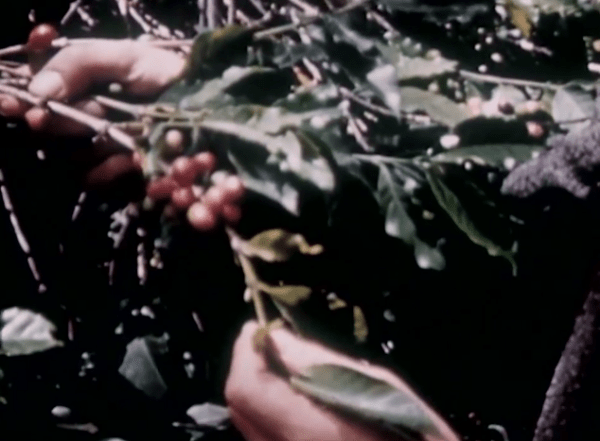
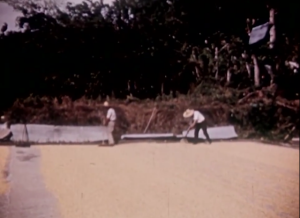 The day’s harvest is collected, weighed, and bagged for further production. The fruits are crushed to remove each bean from its red jacket. Then, the beans are washed and spread out in the sun for 8-10 days. They are frequently rotated so they dry evenly. The dried coffee is packed in bags and sent into the city.
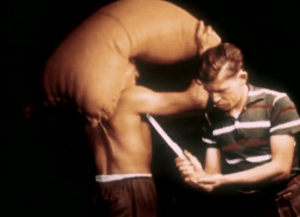 At a warehouse, the coffee is inspected, sorted, and graded. Bags are stamped with the coffee’s country of origin and intended destination before going to the seaport. A very important step happens here. As each bag walks by on the shoulders of a worker, another guy stabs it to get a sample of the beans. The on-site A&P officials take over at this point and do their own inspections, sending samples to the US. Here, the coffees are roasted and taste tested for both strength and flavor from a giant lazy Susan full of porcelain cups.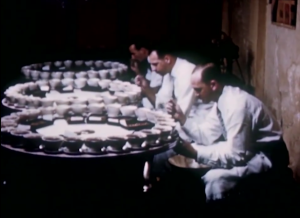
 Chances are, you take color for granted. Whether or not you give it much thought, color is key to distinguishing your surroundings. It helps you identify fire, brown recluse spiders, and the right resistor for the job.
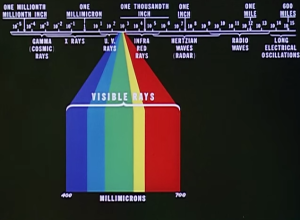 Each color that makes up the spectrum of visible rays has a particular wavelength. The five principal colors—red, yellow, green, blue, and violet—make possible thousands of shades and hues, but are only a small slice of the electromagnetic spectrum.
 We’ve probably all experimented with a very clear demonstration of the basic principles of lift: if you’re riding in a car and you put your flattened hand out the window at different angles, your hand will rise and fall like an airplane’s wing, or airfoil. This week’s Retrotechtacular explains exactly how flight is possible through the principles of lift and drag. It’s an Army training documentary from 1941 titled “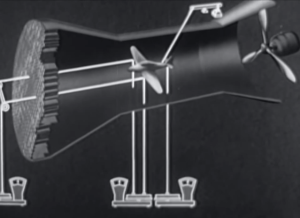
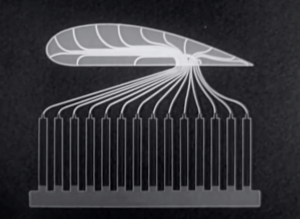 Airfoil models are also unit tested in wind tunnels. They are built with small tubes running along many points of the foil that sit just under the surface. The tubes leave the model at a single point and are connected to a bank of manometer tubes. These tubes compare the pressures acting on the airfoil model to the reference point of atmospheric pressure. The different liquid levels in the manometer tubes give clear proof of the pressure values along the airfoil. These levels are photographed and mapped to a pressure curve. Now, a diagram can be made to show the positive and negative pressures relative to the angle of attack.