Building Giant Temperature Displays From Gottlieb Display Wheels

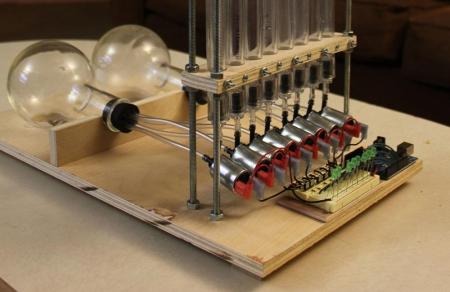
On Saturday, we found a cool article where pinball machine display wheels were being used as a display. In that article, one of the listed inspirations was this giant Gottlieb wheel being used to display the water temperature of a pool.  Before we go further, we’d like to mention that this project is hosted on a magazine’s website that requires you to register to get 1 free download. We did, and no financial information was required.

[Ludovic], they author of the project, was looking for an efficient and highly visible way to display the temperature in his pool. He wanted something he could see from 30 yards away, that had minimal power usage. These pinball reels were perfect, being easy to read and having virtually zero power draw when not updating.

Keep reading for a video and some more information.

Continue reading “Building Giant Temperature Displays From Gottlieb Display Wheels”

A 3D Printed, Electromechanical Computer

If you had a machine that could print complex mechanical parts in an hour or so, what would you do? [Chris] is doing the coolest thing we can imagine and is building an electromechanical computer from 3D printed parts.

You may remember [Chris] from his efforts to getting his tiny, 1/10th scale Cray-1 supercomputer up and running. Even though he has the OS on a disk, actually booting the machine is a bit of a problem; much the same as his electromechanical computer project. Late last year we saw [Chris] building a few gears for his computer, but now he’s got a punch card reader that looks very much like a Jacquard loom.

Even though the computer doesn’t actually do anything yet, it’s amazing to think that [Chris] is building out of plastic that will run computer programs. You can check out the video of [Chris]’ video of his punch card reader after the break.

Continue reading “A 3D Printed, Electromechanical Computer”

Watch A Rocket Engine Test Live This Afternoon

If you want to see something awesome this afternoon, watch SpaceX’s live broadcast of an engine test today at 3:00 pm EDT/12:00 pm PDT/7:00 pm GMT. You’ll see nine Merlin rocket engines power up to full thrust during a test for the upcoming launch of a Dragon space capsule to the ISS.

This is just a static test – hopefully the nine Merlin engines won’t go anywhere. To get an idea of the power behind these engines this is a test of just  Merlin engine being fired at the SpaceX open house in Texas a year or so ago. Today, nine engines will be fired at once.

Check out the videos after the break to see just how awesome the Falcon 9 is going to be.

via boingboing

Continue reading “Watch A Rocket Engine Test Live This Afternoon”

Getting A Textured 3D Scan From Just A Webcam

Here’s an oldie but a goodie that passed us up the first time it went around the Internet. [Qi Pan], (former) PhD student at Cambridge, made a 3D modeling program using only a simple webcam. Not only does this make very fast work of building 3D models, the real texture is also rendered on the virtual object.

The project is called ProFORMA, and to get some idea of exactly how fast it is, the model of a church seen above was captured and rendered in a little over a minute. To get the incredible speed of ProFORMA, [Qi] had his webcam take a series of keyframes. When the model is rotated about 10°, another keyframe is taken and the corners are triangulated with some very fancy math.

Even though [Qi]’s project is from 2009, it seems like it would be better than the ReconstructMe, the Kinect-able 3D scanning we saw a while ago. There’s a great video of [Qi] modeling a papercraft church after the break, but check out the actual paper for a better idea of how ProFORMA works.

Continue reading “Getting A Textured 3D Scan From Just A Webcam”

Gigantic Liquid Crystal Display Is Like A Giant Calculator

Some say he turns on his soldering iron by saying, “Flame on!.” He deadbug solders – QFP packages. All we know is he’s called [stig] and he sent in an awesome an awesome video of a new display at the Nature Research Center in Raleigh, North Carolina. It’s a 10 foot by 90 foot LCD display that uses 6 inch square glass panels containing the same liquid crystals you’d find in a calculator.

The display/installation is called Patterned by Nature and is built using 3600 pieces of LCD privacy glass. When a voltage is applied to the glass it changes from clear to opaque. While this technology has been around for decades (just look at your calculator), only in the last few years has LCD privacy glass come down in price to make a project like this economical.

The gigantic display was created in part by Sosolimited, an art studio who has made a similar project before. The display hanging in the atrium of the Raleigh Nature Research Center is amazingly efficient for its size  drawing only 75 watts.

If you’d like to try your hand at a similar build, we wish you luck; this LCD glass is still somewhat expensive but perhaps in a few years the price will come down enough that we can play Tetris on the side of a building.

Continue reading “Gigantic Liquid Crystal Display Is Like A Giant Calculator”

3 Axis Accelerometer With LED Bar Displays

[Viktor] doesn’t remember why he started this project. He doesn’t know what he had in mind in the beginning, nor what the intended use was.He knows he wanted something interactive with blue LEDs.  What he ended up with, was a 3 axis Accelerometer with a pretty cool display that sits on his desk to amuse visitors.

Constructed using a PIC16F887 for the brains and a Freescale MM7361 3 axis  accelerometer, you can pull the schematics from his site. The code is available on demand as well.

[via HackedGadgets]

Continue reading “3 Axis Accelerometer With LED Bar Displays”

A Flight Simulator Made Out Of A Real 737 Cockpit

[Trent] sent in an awesome story about a single man who bought the nose of a 737, put it in his garage, and built a flight simulator inside the cockpit. His name is [James Price], and right now the only thing we’re wondering is when we can have a visit.

The cockpit came from an aircraft boneyard in Oklahoma. After [James] plunked down $1500 for the shell of a cockpit, he moved his new toy to a Livermore, California aircraft hangar and eventually into his garage. While the plane is meant to be a simulator, [James] is a tinkerer at heart: he says the best part of building his 737 is building the systems, programming the computers, and making everything work together. We’ve got to admire that.

Of course this isn’t the first cockpit-in-a-garage build we’ve seen. Years ago we featured an Avro Lancaster, and just a few months ago we saw a strikingly similar replica 737 flight deck (it’s made out of wood, and not a real 737). [James]’ build is one of the very few home-built simulators made out of a real airplane. Someone get this guy an F15 cockpit stat.