MindFlex Watches As You Judge Others By Sight Alone

mindflex_headset

[Paul] really wanted to know what his brain was thinking.

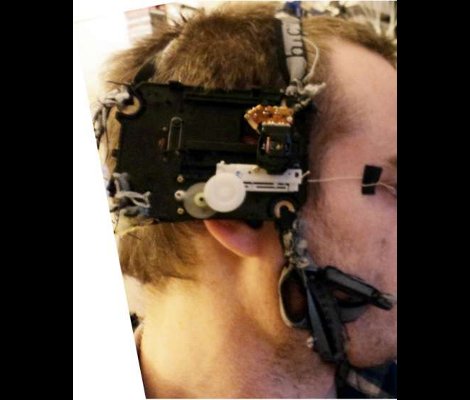
No, really. He is aware of all the thoughts that come and go, but he wanted to know what was going on in his brain below his conscious thought stream. Armed with a MindFlex headset and a Teensy, he set out to decode what really was going on inside his head.

He spent a month crawling 35 million Google profiles, downloading each user’s pictures into a MySQL database. The Teensy was attached to the MindFlex sensor board, and collects all of the headset’s output over a serial connection.

His experiment consisted of flashing each of the profile pictures on his monitor for one second, recording 2 of the 11 available brainwave channels from the MindFlex. These values were then plotted out so that he could visualize the “Attention” and “Meditation” values captured by the headset. At the end of the day he discovered, interestingly enough, that looking at dogs relaxed him the most!

We would love to see what correlations could be drawn from his collected data, and what sorts of “hidden” thoughts are coursing through others’ brains. It could certainly end up being a double-edged sword, uncovering subconscious biases and other such things, but it’s an incredibly intriguing experiment to say the least.

Be sure to check out the video below of the experiment in progress.

Continue reading “MindFlex Watches As You Judge Others By Sight Alone”

Barcode Tattoo Has A Lot Of Thought Put Into It

This bar code tattoo was sent into us by [Lifespan]. Before going under the needle, [Lifespan] didn’t care much for tattoos. After seeing this video he realized that a tattoo could have dynamic content through domain redirection.

[Lifespan] spent a lot of time going over the different styles of 2D bar codes. QR codes were deemed ugly because of the three large squares in the corners. An EZ Code, like the one in his YouTube inspiration, are a proprietary format that must be read with a ScanLife app. He eventually settled on a Data Matrix bar code because of its open format and ubiquity in business and industry. To make the tattoo dynamic, [Lifespan] made the tattoo point to 5id5.com. With a little bit of smart phone wizardry, that domain can be redirected to any URL in a moments notice.

Like all well-planned tattoos, he found himself a very good artist to do the piece. [Connor Moore] managed to ink some skin at 15 dpi, which was a little risky, but the results came out great. While it’s not scarification via a laser cutter, barring fading this tattoo is technologically future proof.

Controlling Muscles With High Intensity Magnetic Pulses


ben_krasnows_transcranial_magnetic_stimulation

We’re not quite sure what’s going on with our fellow hackers lately, but they all seem quite interested in finding inventive ways to scramble their brains. [Ben Krasnow] has put together a pair of videos detailing his experiments in transcranial magnetic stimulation, a process that looks like it would go quite nicely with the Brainwave Disruptor we showed you just yesterday.

Instead of building a coil gun with a set of supercapacitors he had on hand, [Ben] decided to build a magnetic coil that can be used to stimulate his brain through his skull. Once his capacitor bank is charged, a high current pulse is sent through the coil held against his head. This pulse generates a strong magnetic field in the coil, which in turn produces neuron stimulation in his primary motor cortex.

Be sure to watch both videos embedded below, as the first one mostly covers the theory behind his experiments, while the second video gives us the goods.

[Ben’s] day job involves working with professional grade TMS devices, so he has some experience with this technology. Before you try this on your own, be sure that you are doing this safely, because a misdirected pulse of 1700 volts to the head does not sound like a fun time at all.

Continue reading “Controlling Muscles With High Intensity Magnetic Pulses”

Shock Yourself To Better Health!

cranial_electrotherapy_stimulation_rig

Flickr user [n Bryan] has been keeping busy lately, trying his hand at developing some cranial electrotherapy stimulation instruments for home use. While visions of [Peter Venkman] electrocuting hapless college students initially came to mind, this sort of therapy is not the same thing, nor as painful as what is depicted in the film.

Cranial electrotherapy stimulation relies on small currents which are pulsed along a patient’s skull at specific bioactive frequencies. It is believed that these treatments can have positive responses on the nervous system, and in fact has been approved by the FDA for certain ailments such as insomnia and anxiety. [n Bryan’s] rig is controlled by a PIC 16F88, which generates both the carrier and pre-programmed bioactive frequencies used in electrotherapy sessions.

As with all things that involve strapping electrodes to your head, take caution if you plan on replicating his work in any way, shape or form. With that said, we’d be willing to give it a shot.

[via BuildLounge]

Blow Your Mind With The Brainwave Disruptor

rich_decibles_brainwave_disruptor

Whether you believe in it or not, the science behind brainwave entrainment is incredibly intriguing. [Rich Decibels] became interested in the subject, and after doing some research, decided to build an entrainment device of his own.

If you are not familiar with the concept, brainwave entrainment theory suggests that low-frequency light and sound can be used to alter brain states, based on the assumption that the human brain will change its frequency to correspond to dominant external stimulus. [Rich’s] device is very similar to [Mitch Altman’s] “Brain Machine”, and uses both of these methods in an attempt to place the user in an altered state of mind.

[Rich] installed a trio of LEDs into a set of goggles, wiring them along with a set of headphones to his laser-cut enclosure. Inside, the Brainwave Disruptor contains an Arduino, which is tasked with both generating light patterns as well as bit-banged audio streams.

Well, how does it work? [Rich] reports that it performs quite nicely, causing both visual and auditory hallucinations along with the complete loss of a sense of time. Sounds interesting enough to give it a try!

DIY Propeller-based ECG

propeller_ecg

[Ray] likes to build all sorts of Propeller-based projects, but one of the more interesting items we came across was this DIY ECG. While we have covered other DIY electrocardiograms before, he left the breadboard behind and put together a nicely done PCB for his build.

The ECGs design should be pretty familiar to anyone that has seen our ECG coverage in the past. The user places his thumbs on the large built-in pads, which allow the circuit to sense the electrical signals produced by heart’s contractions. These small electrical impulses are then amplified using an AD627 instrument amplifier before being further amplified via a dual op-amp.

The amplified signal is filtered and then fed into the Propeller’s ADC, which displays the user’s heart rhythms via an LED. The data can also be fed into a computer via an optoisolated serial connection.

[Ray] lays out a litany of warnings and precautions that should be followed before downloading his schematics and firmware. We have to echo those warnings, as it doesn’t take a large well-placed shock to disrupt the heart.

Bluetooth Morse Code Keyboard For The Disabled

The team a Zunkworks wanted to build a device for people who can’t normally use a keyboard and mouse. The Bluetooth Morse code keyboard is what they came up with. This build gives the user full control over the keyboard and mouse using a single button or a sip & puff interface.

Continue reading “Bluetooth Morse Code Keyboard For The Disabled”