A Pill Reminder Box To Be Proud Of

Not satisfied with the traditional daily pill boxes, [Ryan] set out to build his own. According to his article, these particular pills had to be taken every three days, and he wanted a solution that required “zero effort.” Although one might question whether his solution actually took this amount of effort, the build came out very well.

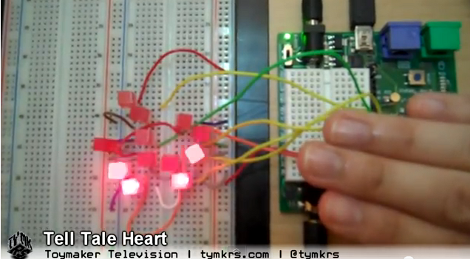
The result is a box that reminds one to take a pill from one or two bottles using a blinking LED. When the pill bottle is picked up, consumption is assumed and the timer is reset. The main components consist of an Arduino, real time clock, and a battery backup.  Additionally, two picture frames are used to form the project enclosure along with some LEDs and other assorted hardware to finish everything.

This project combines some basic electronics hacking and programming with a very nice looking cover. The results are a very clean looking build with a good write up. For another example of a well finished project with great pictures, check out this N64 portable build.

Did you get the tickets? To what? The gun show.

Detecting Muscles With Electromyography

The folks at Advancer Technologies just release a muscle sensor board with a great walk through posted on Instructables describing how this board measures the flexing of muscles using electromyography.

Using the same electrode placement points as the remote controlled hand we covered earlier, the muscle is measured by sensing the voltage between the muscle and its tendon. The result is a fairly fine-grained sensing of the output – more than enough to provide some analog control for a project.

The board itself is relatively simple – an INA106 differential amp is used to sense if a muscle is flexing or not. This signal is then amplified and rectified, after which it can be connected to the analog input of your favorite microcontroller. The video demo shows the board connected to a Processing app running from an Arduino, but it wouldn’t be hard to adapt this towards remote Nerf sentry turret controlled by your biceps.

Check out the video after the break to see the muscle sensor board in action.

Continue reading “Detecting Muscles With Electromyography”

PossessedHand Controls Hand With Electrical Stimuli

[Emi Tamaki], [Miyaki Takashi] and [Jun Rekimoto] at the University of Tokyo came up with a device called the PossessedHand that electrically stimulates muscles to train someone to play a the koto, a Japanese stringed instrument.

The PossessedHand ‘triggers’ individual fingers with precisely placed electrodes. Sixteen joints in the hand can be controlled independently by placing one electrode on the muscle that controls the joint and a ground electrode on the tendon of that muscle. Users of the PossessedHand reported no pain from the device when 30 Volts were sent though the electrodes.

The paper (PDF warning) goes into detail about the reactions of the users of the PossessedHand. While a few subjects thought the PossessedHand was scary, many enjoyed it – one subject even thought it was possible to fly a helicopter without training. While this isn’t downloading a rotary wing licence into your brain like The Matrix, the PossessedHand did prove to be a useful tool for learning the fingering for the koto. You can see a video of the PossessedHand in action in the New Scientist story.

[via New Scientist]

A Prosthetic Arm That Doesn’t Cost An Arm And A Leg.

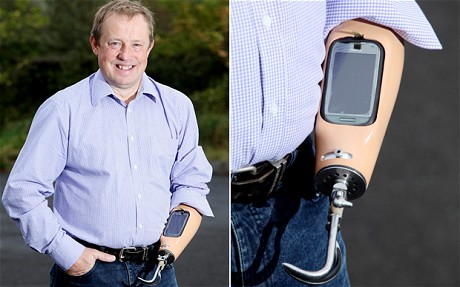
After a motorcycle accident that cost him is arm [Martin] and his son [Luke] chose not to give up. They used their considerable mechanical skills to create a replacement robotic arm which allowed Martin to start doing some of the simple things he had been unable to do with the prosthetic he was originally fitted with. There are not a lot of details but it seems the arm has 2 degrees of freedom with a claw manipulator, controlled via chin controls to free up his other arm. For anyone interested in similar projects you should check out the Open Prosthetics Project. There is a short video after the break which tells Martin’s story. If you don’t have an arm, build one, seems perfectly reasonable to us. Nice work guys! We look forward to seeing the next version.

Continue reading “A Prosthetic Arm That Doesn’t Cost An Arm And A Leg.”

Diagnosing Diseases Like MacGyver

pancratitis_test

If you ever watched MacGyver as a kid, you know that given any number of random objects, he could craft the exact tool he would need to get out of a sticky situation. If he ever made his way into the medical research field, you could be sure that this test for Acute Pancreatitis would be among his list of accomplishments.

Designed by University of Texas grad student [Brian Zaccheo], the Acute Pancreatitis test seen in the image above looks as unassuming as it is effective. Crafted out of little more than foil, jello, and milk, the test takes under an hour to diagnose patients while costing less than a dollar.

The test works by checking the patient’s blood for trypsin, an enzyme present in high concentrations if they are suffering from pancreatitis. Once a few drops of the patient’s blood is placed on the gelatin layer of the test, it is left to sit for a bit, after which sodium hydroxide is added. If elevated trypsin levels are present, it will have eaten through the gelatin and milk protein, creating a pathway for the sodium hydroxide to reach the foil layer. If the foil is dissolved within an hour, a circuit is formed and a small LED lights up, indicating that the patient has acute pancreatitis.

The test really is ingenious when you think about it, and will be a huge help to doctors practicing in developing countries, under less than ideal working conditions.

[via PopSci via Gizmodo]

EEG-assisted Hand Control

ipsihand

[Sam Fok], an engineering student at the Washington University School of Engineering wrote in to share a project he and his classmates [Raphael Schwartz, Mark Wronkiewicz, Charles Holmes, Jessica Zhang, Nathan Brodell, and Thane Somers] have been working on as their entry in the 2011 RESNA Student Design Competition. Their project, IpsiHand, is designed to help rehabilitate those who have suffered a stroke or other Traumatic Brain Injury (TBI).

Most motor functions in the body are controlled by the opposite hemisphere of the brain, a process called contralateral motor control. When a patient suffers from TBI, they often lose control over some portion of the body opposite the injury. Recent studies have shown however, that while most motor control is contralateral, hand movements also create ipsilateral brain activity. This means that the uninjured side of the brain can effectively control both hands, with a bit of mechanical assistance.

Their process uses an Emotiv Epoch EEG headset, which we have discussed before, to monitor the patients’ brain for activity. The data is sent wirelessly to a computer which processes the data, singling out ipsilateral brain waves. The computer then actuates a modified hand orthosis to control grasping in real time.

We think their work is fantastic, and the team’s creation has a wide array of applications in the field of therapy and assisted living. We wish them luck in their competition, and hope to see this technology put to good use in the future.

Teaching Children To Walk Using Video Games

team_equiliberator

Medical conditions that prevent individuals from being able to walk are difficult to handle, even more so if the patient happens to be a child. Shriner’s hospitals treat a good number of children suffering from cerebral palsy, spina bifida, or amputations. They are always looking for creative treatment methods, so their Motion Analysis Laboratory looked to some Rice University undergrads for help. They asked the group of engineers to design a system that would make physical therapy a bit more fun, while helping encourage the children along.

The team recently unveiled their project, called the Equiliberator. The game system incorporates a series of five Wii balance boards situated between a pair of pressure-sensitive handrails. The platform communicates with a computer via Bluetooth, registering the patient’s movements as he or she moves along the path. The software portion of the system consists of a monster-slaying game which requires the child to step on a particular section of the pathway to dispose of the oncoming enemies.

The game is designed to get more difficult as the child’s balance and coordination improve, encouraging them with an ever growing bank of points as they progress. The final goal of the project is to enable the pressure sensitive handrails to determine how much the child is relying on them for balance, offering in-game incentives to walk with as little support as possible.

We love seeing hacks like this which not only entertain, but truly help people in the process. Kudos to the team at Rice University – they have done a fantastic job here.

Continue reading to see a quick video describing the Equiliberator in the designers’ own words.

[via MedGadget]

Continue reading “Teaching Children To Walk Using Video Games”