The Ultimate Low-cost Dev Board

We see a lot of microcontroller dev boards here at Hackaday, so much that we’re jokingly considering changing our name to Board a Day. These devices – from Arduinos to Arduino-compatible boards, very, very small boards, to extremely powerful ARM devices – are a great way to learn about the wonders of controlling electricity with code. There’s a problem, though: if you’re teaching a class on programming microcontrollers, giving each student a $20 board is nearly out of the question.

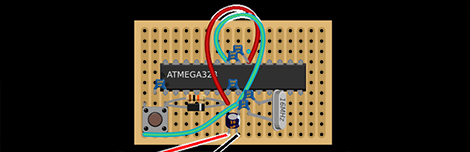
This is where the shrimp comes in. It’s a very, very minimal Arduino-compatible circuit meant to control all the pins on an ATMega328. The components only cost about £1.40 ($2.25 USD) when bought in volume, making it perfect for teaching a class or workshop on the Arduino and giving each student a circuit to take home.

The basic circuit is just an ATMega328 – the same microcontroller used in the Arduino Uno – with a few caps, resistors, and a 16 MHz crystal. It’s a very bare-bones system, but once built and programmed provides all the functionality of a $25 Arduino.

Like all microcontroller platforms, there’s the chicken-and-egg problem of actually programming the device. The Shrimp team is using a CP2102 USB to UART bridge to program each shrimp. Not an inexpensive part, but it is of course possible to only have one serial bridge for each workshop.
LED Fun And Light Painting With The PyMCU

pymcu-led-pov-writing

Recently [Richard] at [pyMCU] was nice enough to send me one of their units to try out. As featured here before, this little board allows you to control physical things using your computer and the Python programming language. After evaluating it and making a LED blink, there were a couple other LED projects I wanted to try.

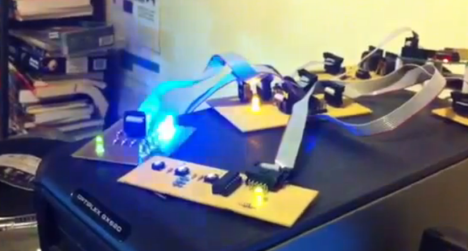
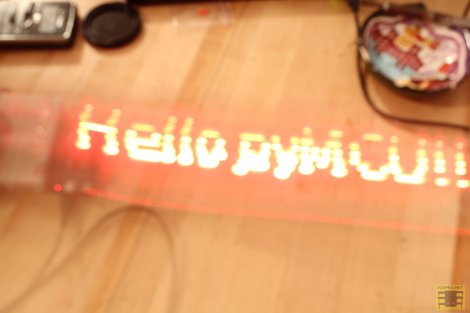
The first idea was to make a LED chaser. This was quite simple, using a little code and plugging in a few LEDs. From this, since you can make the LEDs chase each other, then in the right sequence it should be able to be used to display images using long-exposure photography. Be sure to check out the video after the break of this 10 LED chaser/light bar being assembled.

The results of this LED light bar experiment were really cool, writing some simple text and image with 10 LEDs. Considering the low component count, this is one of the simplest light bar builds that we’ve seen. Programming was simple as well, since the computer using Python does all the processing of the drawing as well as physically turning the LEDs on and off. Of course this setup isn’t without its limitations, having to be connected to a computer being the most obvious. Continue reading “LED Fun And Light Painting With The PyMCU”

Skittles Sorting Machine Sorts Skittles, Keeps The Band Happy

In 1982, Van Halen had the biggest stage show around. Their rider – a document going over the requirements for the show – reflects this. In the middle of the requirements for the lighting and sound rigs, Van Halen placed a rather odd request; one (1) bowl of M&M, (ABSOLUTELY NO BROWN ONES). The theory being if the request for no brown M&Ms wasn’t followed, the lighting and sound rigs probably weren’t up to spec either.

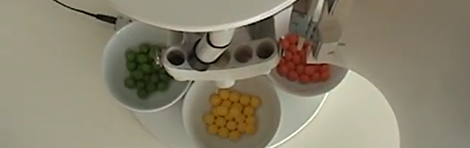
It’s not M&Ms this time (they wouldn’t fit in the machine), but [egenriether] came up with a seriously clever solution for sorting Skittles by color. Why? We have no idea, other than, ‘just because.’

The build details are a little scant, but we know [egenriether] used a BASIC Stamp 2 for the electronics portion of the build. To sort the Skittles by color, a TAOS RGB color sensor reads the red, green, and blue values for each Skittle and actuates a servo that guides each piece of candy into its respective bowl.

It’s a very, very cool, if completely useless build. Still, we’re thinking it could be put to use if [egenriether] is ever backstage setting up before the band arrives.

Videos after the break. Thanks [Andrew] for sending this one in.

Continue reading “Skittles Sorting Machine Sorts Skittles, Keeps The Band Happy”

Capacitive Touch Business Card

[Jay Kickliter] sent in his latest electronic business card. This time, his goal was to make it much cheaper so he could actually afford to give it away. He did pretty well considering the two week timeline he mentions. This card is using an MSP430 with the capsense library to light up some LEDs any time the card is handled. While he states that it is much cheaper than his last, it is still around $8 a card, so he won’t be tossing these into everyone’s hands.  He does point out though that it is always helpful to have hardware to show off at a hardware interview, and an electronic business card does that job very well.

As usual, you can read more details and download the files at his blog.

ATmega1284 As An 8-voice 32 KHz Synthesizer

A couple of things strike us about this 8-voice 32 kHz synthesizer. First is the cleanliness of the prototype. As you can see, each part has plenty of room on its own board and all are interconnected by 10-pin IDC ribbon connectors. But you’ll have to see the video after the break to enjoy the impressive sound that this puts out. You’ll hear it play the Super Mario Bros. theme; it does it with passion!

To get audio from the digital microcontroller [Mike] built his own R2R digital to analog converter. The resistor ladder is built from sixteen resistors, which feed a rail-to-rail amplifier. The sound is mono but the playback is polyphonic thanks to the work done by the ATmega1284. It is reading MIDI commands coming in from an external controller (we assume it’s the computer on which the hardware is sitting). The chip’s 128 KB of Flash memory leave plenty of room to store samples, which are selected from a lookup table based on the MIDI data. If more than one sample is to be played the chip averages the data and sets the 8-bit output port accordingly.

Continue reading “ATmega1284 As An 8-voice 32 KHz Synthesizer”

Tell Us What Development Board You Love

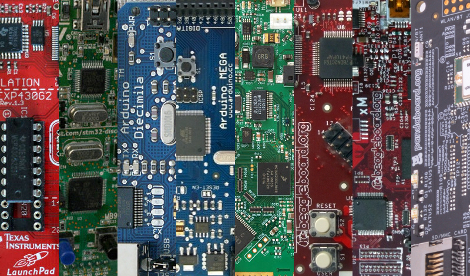
Back in 2011 we did a short roundup of some popular development boards.  We promised a follow up at some point, and that time is near.  We would really like to make this a fairly comprehensive list and there are always suggestions sent in after the article that we overlooked.

This time, we’re asking that you tell us what dev boards you prefer and why. Either reply in the comments or email us directly at boards@hackaday.com. We’ll round up all of your suggestions and bring you the “development board brakedown for 4th quarter 2012”.

Please keep in mind that we can’t possibly know everything about every single board out there, so if there’s some special feature of a board that you love, be sure to let us know!

A PIC Powered Pair Of Electronic Dice

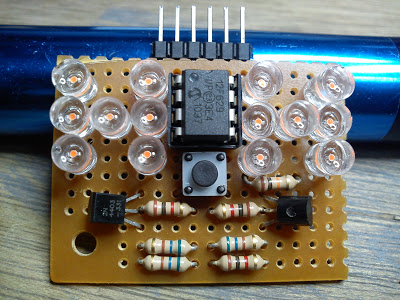
[Timothy] is honing his microcontroller skills with this electronic dice project. In addition to giving him an opportunity to work on some code, the use of an 8-pin chip provides a design challenge for driving the twelve pips and providing a user input.

The project started off with some $4 strings of LED Christmas lights. He promptly disassembled the strands, each yielding 100 LEDs. The microcontroller he chose to work with is a PIC 12F629. It’s DIP8 package provides six I/O pins to work with. When examined closely you will find that the pips on a die are always present in pairs with the exception of the center pip. This means that only four pins are needed to drive one die. You can see a pair of transistors above; one is a PNP, the other an NPN. These are both driven from the same uC line, which toggles between the pair of die. This accounts for 5 of the available pins, with the sixth monitoring the push button.