Impersonating FBI Agents And People Who Can Solder

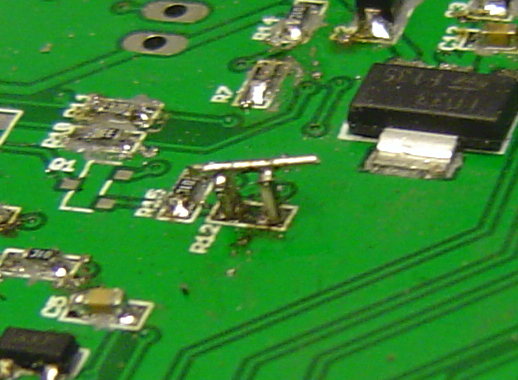
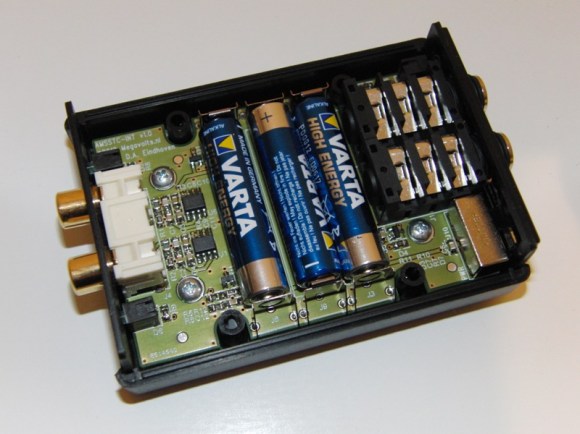
[Dale Botkin], [N0XAS], is a competent designer for the amateur radio crowd and has a part-time business on the side selling a few kits. As anyone who owns a business, works in retail, or simply interacts with the general population will know, eventually you’ll have to deal with one of those customers. [Dale]’s latest horror story (here’s the coral cache but that doesn’t seem to be working either) comes from someone who bought a little repeater controller. You’re looking at this customer’s handiwork above. It gets worse.

After this customer completely botched an assembly job, he contacted [Dale] for some technical assistance. [Dale] graciously accepted a return and received the above mess of solder, wires, and parts. Then an email disputing the Paypal charge arrived. The customer wanted a refund for the original kit and the cost of shipping it back.

Oh, but it gets better. After posting this story, [Dale] received yet another email from an FBI agent demanding that his original post be taken down. The email from the FBI came from a Czech domain, so of course this is a totally legit demand.

So there’s your, “worst customer ever” story from the world of kit electronics. The assembly is impressively bad, even for something that was ‘professionally installed by an electrician’, but mail fraud and impersonating federal officials just takes this over the top.


Quick note: any doxxing in the comments will be deleted, so just don’t do it.

Ambient Computer Noise Leaks Your Encryption Keys

[Daniel, Adi, and Eran], students researchers at Tel Aviv University and the Weizmann Institute of Science have successfully extracted 4096-bit RSA encryption keys using only the sound produced by the target computer. It may sound a bit like magic, but this is a real attack – although it’s practicality may be questionable. The group first described this attack vector at Eurocrypt 2004. The sound used to decode the encryption keys is produced not by the processor itself, but by the processor’s power supply, mainly the capacitors and coils. The target machine in this case runs a copy of GNU Privacy Guard (GnuPG).

During most of their testing, the team used some very high-end audio equipment, including Brüel & Kjær laboratory grade microphones and a parabolic reflector. By directing the microphone at the processor air vents, they were able to extract enough sound to proceed with their attack. [Daniel, Adi, and Eran] started from the source of GnuPG. They worked from there all the way down to the individual opcodes running on the x86 processor in the target PC. As each opcode is run, a sound signature is produced. The signature changes slightly depending on the data the processor is operating on. By using this information, and some very detailed spectral analysis, the team was able to extract encryption keys. The complete technical details of the attack vector are available in their final paper (pdf link).

Once  they had the basic methods down, [Daniel, Adi, and Eran] explored other attack vectors. They were able to extract data using ground fluctuations on the computers chassis. They even were able to use a cell phone to perform the audio attack. Due to the cell phone’s lower quality microphone, a much longer (on the order of several hours) time is needed to extract the necessary data.

Thankfully [Daniel, Adi, and Eran] are white hat hackers, and sent their data to the GnuPG team. Several countermeasures to this attack are already included in the current version of GnuPG.

A Weird Kind Of Printer

printer

[Benjamin] is just putting the finishing touches on his home-made, paper-stabbing, needle-printer!?

From a distance, it looks like the bare bones of a regular inkjet printer, but it’s not. Instead of an ink-head it features a needle — It’s kind of like a dot-matrix (hole-matrix?) printer. He’s using it for silk-screening masks, which we have to admit, must be pretty handy — it certainly makes soldering SMT’s less scary! It could also be used for embossing or even braille printing.

The frame of the printer is laser cut out of clear plastic, and two Nema 17 steppers drive the X & Y axes. A simple solenoid actuator provides the needle-stabby action. He’s controlling the whole thing using an Arduino, and sending the data to it using a call-and-response protocol to avoid any data losses. It was built for just shy of $200, which was his original goal for the project.

Check it out after the break!

Continue reading “A Weird Kind Of Printer”

Thermochromic Imaging

F1XEKFDHPBPOP21.LARGE

[clarii_d] is currently finishing up her thesis project on thermochromic pigment to silkscreen receipts. The idea behind it is that when a receipt is touched, part of it fades revealing a hidden message.

As you can guess, thermochromic paint is a type of substance that changes color when introduced to heat — or in this case, fades altogether. Remember when mood rings were all the rage? Same thing.

In her project she is using silkscreening to transfer text onto the back of receipt paper using regular ink. Once dried, she silkscreens an image over top of the message, this time using a thermochromic pigment. The result is a slightly obscured image, but after holding it for a few seconds, it disappears and only the text remains.

Color-changing anything is a bit gimmicky, but we think [clarii_d’s] project is a pretty cool and unique application of it. A few years ago we shared another interesting project utilizing thermochromism; a color-changing clock face that utilized the heat given off by resistors!

Snowden Immortalized As Bond Villain In Edge-Lit Acrylic Poster

snowfall_smaller

[Wilywyrm] needed to come up with a final project for art class that commented on a social issue. Healthcare, schmealthcare, he said, and busted out this movie poster about the NSA spying scandal instead.

The circuit uses three extended-duty astable 555 timers to control the brightness of the 5050 RGB common-anode LED strips that run up the sides of the 24″ x 12″ x 1/4″ acrylic panels. Each of the three panels was laser-engraved at 600 DPI on an Epilog laser engraver and features a different aspect of the poster. There’s one for Snowden, one for Daniel Craig, and one for the text.

[Wilywyrm] tied the color channels together in the first panel to output white light. He used red for the second panel and blue for the third. A complete list of parts with build notes is available on his Google Drive. [Wilywyrm]’s notes include improvement ideas, like making all the RGB strips color-adjustable with more 555s or a microcontroller and timers.

Perhaps [Wilywyrm] could get into the clear whiteboard business after college.

Roboxotica (Barbot Festival In Vienna)

minecraft-cocktailbot--verse-publications

Just this past week was this year’s Roboexotica 2013! The annual event was the world’s first and is perhaps the finest festival of cocktail serving robotics out there!

Founded 15 years ago in San Francisco, Roboexotica brings together scientists, hackers, and artists from all around the world to build the most awesome drink dispensing technologies. It’s also an opportunity to discuss innovation, science fiction, and the world of robotics to come — after utilizing some of the robots of course!

The photo above is of one of the popular bots from this year — it’s called the Minecraft Cocktailbot. It dispenses the liquor out of its floppy drive, but only when you control it from inside a game of Minecraft!

More of the barbots present at Roboxotica can be found on the main site. We think our second favorite is the Bunnybot. It defecates peanuts — the mightiest of all  in pellet-form bar food.

Stick around after the break to see the Minecraft Cocktailbot in action!

Continue reading “Roboxotica (Barbot Festival In Vienna)”

Steampunk Battleship Complete With Steam Engine!

steampunk fortress

The photo above doesn’t do this huge and whimsical Steampunk Battleship justice. It’s an amazing project that took its creator, [Ed Ross], over 2500 hours to complete.

Called Barnum’s Dream, it was said to be originally commissioned by Queen Victoria as a ship for the Crimean war, and was the largest paddle wheel steam warship ever built. It was then retrofitted with a massive train carriage to be used in the Franco-Prussian war (that’s right, on land!).

The model is just over 4 feet long and just under 4 feet tall. Aside from the steam engine (which was modified) it was completely build by hand. Almost all of the mechanical linkages and powered by the internal steam engine. The level of detail that went into this is absolutely awe-inspiring. 

If you enjoyed the background history of the ship, there’s a delightful tale of the ship’s apparent origins on [Ed’s] blog which is thoroughly enjoyable. Make sure to check it out after watching the video after the break.

Continue reading “Steampunk Battleship Complete With Steam Engine!”