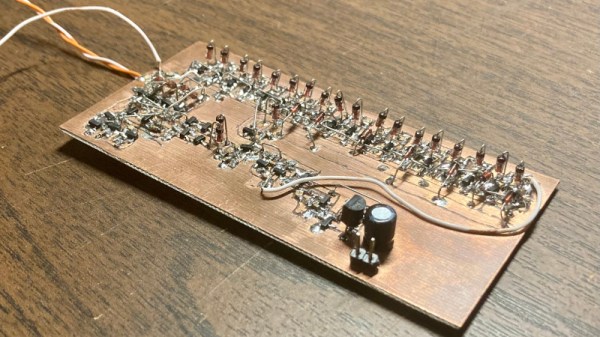
The crank/keying assembly

Hacking A Guitar Into A Hurdy-Gurdy Hybrid With 3D Prints

If you’re looking for a long journey into the wonderful world of instrument hacking, [Arty Farty Guitars] is six parts into a seven part series on hacking an existing guitar into a guitar-hurdy-gurdy-hybrid, and it is “a trip” as the youths once said. The first video is embedded below.

The Hurdy-Gurdy is a wheeled instrument from medieval europe, which you may have heard of, given the existence of the laser-cut nerdy-gurdy, the electronic midi-gurdy we covered here, and the digi-gurdy which seems to be a hybrid of the two. In case you haven’t seen one before, the general format is for a hurdy-gurdy is this : a wheel rubs against the strings, causing them to vibrate via sliding friction, providing a sound not entirely unlike an upset violin. A keyboard on the neck of the instrument provides both fretting and press the strings onto the wheel to create sound. 

[Arty Farty Guitars] is a guitar guy, so he didn’t like the part with about the keyboard. He wanted to have a Hurdy Gurdy with a guitar fretboard. It turns out that that is a lot easier said than done, even when starting with an existing guitar instead of from scratch, and [Arty Farty Guitar] takes us through all of the challenges, failures and injuries incurred along the way. 

Probably the most interesting piece of the puzzle is the the cranking/keying assembly that allows one hand to control cranking the wheel AND act as keyboard for pressing strings into the wheel. It’s key to the whole build, as combining those functions on the lower hand leaves the other hand free to use the guitar fretboard half of the instrument. That controller gets its day in video five of the series. It might inspire some to start thinking about chorded computer inputs– scrolling and typing?

If you watch up to the sixth video, you learn that that the guitar’s fretting action is ultimately incompatible with pressing strings against the wheel at the precise, constant tension needed for good sound. To salvage the project he had to switch from a bowing action with a TPU-surfaced wheel to a sort of plectrum wheel, creating an instrument similar to the thousand-pick guitar we saw last year.

Even though [Arty Farty Guitars] isn’t sure this hybrid instrument can really be called a Hurdy Gurdy anymore, now that it isn’t using a bowing action, we can’t help but admire the hacking spirit that set him on this journey. We look forward to the promised concert in the upcoming 7th video, once he figures out how to play this thing nicely.

Know of any other hacked-together instruments that possibly should not exist? We’re always listening for tips. 


When Is A Synth A Woodwind? When It’s A Pneumatone

Ever have one of those ideas that’s just so silly, you just need to run with it? [Chris] from Sound Workshop ran into that when he had the idea that became the Pneumatone: a woodwind instrument that plays like a synth.

In its 3D printed case, it looks like a giant polyphonic analog synth, but under the plastic lies a pneumatic heart: the sound is actually being made by slide whistles. We always thought of the slide whistle as a bit of a gag instrument, but this might change our minds. The sliders on the synth-box obviously couple to the sliders in the whistles. The ‘volume knobs’ are actually speed controllers for computer fans that feed air into the whistles. The air path is possibly not ideal– there’s a bit of warbling in the whistles at some pitches– but the idea is certainly a fun one. Notes are played by not blocking the air path out the whistle, as you can see in the video embedded below.

Since the fans are always on, this is an example of a drone instrument, like bagpipes or the old hacker’s favourite, the hurdy gurdy. [Chris] actually says in his tip– for which we are very thankful– that this project takes inspiration not from those projects but from Indian instruments like the Shruthi Box and Tanpura. We haven’t seen those on Hackaday yet, but if you know of any hacks involving them, please leave a tip.

Continue reading “When Is A Synth A Woodwind? When It’s A Pneumatone”

OpenMIDIStomper Makes Sure Your Gear Does What Your Foot Says

If you’re a solo musician, you probably have lots of gear you’d like to control, but you don’t have enough hands. You can enlist your feet, but your gear might not have foot-suitable interfaces as standard. For situations like these, [Nerd Musician] created the OpenMIDIStomper.

The concept is simple enough—the hardy Hammond enclosure contains a bunch of foot switches and ports for external expression pedals. These are all read by an Arduino Pro Micro, which is responsible for turning these inputs into distinct MIDI outputs to control outboard gear or software. It handles this via MIDI over USB. The MIDI commands sent for each button can be configured via a webpage. Once you’ve defined all the messages you want to send, you can export your configuration from the webpage by cutting and pasting it into the Arduino IDE and flashing it to the device itself.

We’ve featured some great MIDI controllers over the years, like this impressive parts bin build.

Continue reading “OpenMIDIStomper Makes Sure Your Gear Does What Your Foot Says”

Building A Piezo Noise Box

The humble piezo element is often used as little more than a buzzer in many projects. However, you can do more with them, as [Something Physical] demonstrates with their nifty piezo noise box. Check out the video (and audio) below.

The construction is simple enough, attractive in its own way, with a rugged junk-assembly sort of style. The video starts out by demonstrating the use of a piezo element hooked up as a simple contact microphone, before developing it into something more eclectic.

The basic concept: Mount the piezo element to a metal box fitted with a variety of oddball implements. What kind of implements? Spiralled copper wires, a spring, and parts of a whisk. When struck, plucked, or twanged, they conduct vibrations through the box, the microphone picks them up, and the box passes the sound on to other audio equipment.

It might seem frivolous, but it’s got some real value for avant-garde musical experimentation. In particular, if you’re looking for weird signals to feed into your effects rack or modular synth setup, this is a great place to start.

We’ve seen piezos put to other percussive uses before, too.

Continue reading “Building A Piezo Noise Box”

A piano is pictured with two hands playing different notes, G outlined in orange and C outlined in blue.

AI Piano Teacher To Criticize Your Every Move

Learning new instruments is never a simple task on your own; nothing can beat the instant feedback of a teacher. In our new age of AI, why not have an AI companion complain when you’re off note? This is exactly what [Ada López] put together with their AI-Powered Piano Trainer.

The basics of the piano rely on rather simple boolean actions, either you press a key or not. Obviously, this sets up the piano for many fun projects, such as creative doorbells or helpful AI models. [Ada López] started their AI model with a custom dataset with images of playing specific notes on the piano. These images then get fed into Roboflow and trained using the YOLOv8 model.

Using the piano training has the model run on a laptop and only has a Raspberry Pi for video, and gives instant feedback to the pianist due to the demands of the model. Placing the Pi and an LCD screen for feedback into a simple enclosure allows the easy viewing of how good an AI model thinks you play piano. [Ada López] demos their device by playing Twinkle Twinkle Little Star but there is no reason why other songs couldn’t be added!

While there are simpler piano trainers out there relying on audio cues, this project presents a great opportunity for a fun project for anyone else wanting to take up the baton. If you want to get a little more from having to do less in the physical space, then this invisible piano is perfect for you!

A C-shaped wooden frame is shown surrounding a circular tongue drum. The wooden frame holds eight black adjustable arms, at the ends of which are mounted solenoids, positioned just above the surface of the drum.

Giving A Drum MIDI Input With Lots Of Solenoids

As far as giving mechanical instruments electronic control goes, drums are probably the best candidate for conversion; learning to play them is challenging and loud for a human, but they’re a straightforward matter for a microcontroller. [Jeremy Cook]’s latest project takes this approach by using an Arduino Opta to play a tongue drum.

[Jeremy]’s design far the drum controller was inspired by the ring-shaped arrangement of the Cray 2 supercomputer. A laser-cut MDF frame forms a C-shape around the tongue drum, and holds eight camera mount friction arms. Each friction arm holds a solenoid above a different point on the drum head, making it easy to position them. A few supports were 3D-printed, and some sections of PVC tubing form pivots to close the ring frame. [Jeremy] found that the the bare metal tips of the solenoids made a harsh sound against the drum, so he covered the tips of six solenoids with plastic caps, while the other two uncoated tips provide an auditory contrast.

The Arduino Opta is an open-source programmable logic controller normally intended for industrial automation. Here, its silent solid-state relays drive the solenoids, as [Jeremy]’s done before in an earlier experiment. The Opta is programmed to accept MIDI input, which [Jeremy] provided from two of the MIDI controllers which we’ve seen him build previously. He was able to get it working in time for the 2024 Orlando Maker Faire, which was the major time constraint.

Of course, for a project like this you need a MIDI controller, and we’ve previously seen [Jeremy] convert a kalimba into such a controller. We’ve seen this kind of drum machine at least once before, but it’s more common to see a purely electronic implementation.

A man is shown performing a wheelie on a red bicycle in a classroom. In the background, a projector is displaying a phone screen running an indistinct app.

An Adaptive Soundtrack For Bike Tricks

If you’ve put in all the necessary practice to learn bike tricks, you’d probably like an appropriately dramatic soundtrack to accompany your stunts. A team of students working on a capstone project at the University of Washington took this natural desire a step further with the Music Bike, a system that generates adaptive music in response to the bike’s motion.

The Music Bike has a set of sensors controlled by an ESP32-S3 mounted beneath the bike seat. The ESP32 transmits the data it collects over BLE to an Android app, which in turn uses the FMOD Studio adaptive sound engine to generate the music played. An MPU9250 IMU collects most position and motion data, supplemented by a hall effect sensor which tracks wheel speed and direction of rotation.

When the Android app receives sensor data, it performs some processing to detect the bike’s actions, then uses these to control FMOD’s output. The students tried using machine learning to detect bike tricks, but had trouble with latency and accuracy, so they switched to a threshold classifier. They were eventually able to detect jumps, 180-degree spins, forward and reverse motion, and wheelies. FMOD uses this information to modify music pitch, alter instrument layering, and change the track. The students gave an impressive in-class demonstration of the system in the video below (the demonstration begins at 4:30).

Surprisingly enough, this isn’t the first music-producing bike we’ve featured here. We’ve also seen a music-reactive bike lighting system.

Thanks to [Blake Hannaford] for the tip!