Need Hackable Melodies? Here’s The TETRIS Theme And More

[Robson Couto] started to get interested in musical projects and as a side effect created downloadable code with simple notation for a good variety of themes, songs, and melodies. They are all for the Arduino and use only the built-in tone() function, but don’t let that distract you. If you look past that, you’ll see that each sketch is a melody that consists of single notes and durations; easily adapted to other purposes or simply used as-is. After all, [Robson] wanted the source of each tune to be easily understood, easily modified, and to have no external dependencies.

All that may sound a bit like MIDI, but MIDI has much more in common with hardware events than music notation because it includes (among other things) note starts and note ends as separate elements. Converting MIDI into a more usable format was a big part of a project that fed Bach music to a neural network and got surprisingly good results.

When doing music projects, sometimes having a recognizable melody represented very simply as notes and durations with only one note at a time can be an awfully handy resource, and you can find them on GitHub. There’s a brief video of the Tetris theme (actual name: Korobeiniki) being played after the break.

Continue reading “Need Hackable Melodies? Here’s The TETRIS Theme And More”

[Fran] Is Helping Santa Slay This Year

We know at least one person who ought to make Santa’s ‘nice’ list this year. [Fran] was probably near the top of it already, but sending Santa a handmade greeting card with a fully-functioning guitar amp inside will probably make him rewrite her name in glitter, or silver Sharpie.

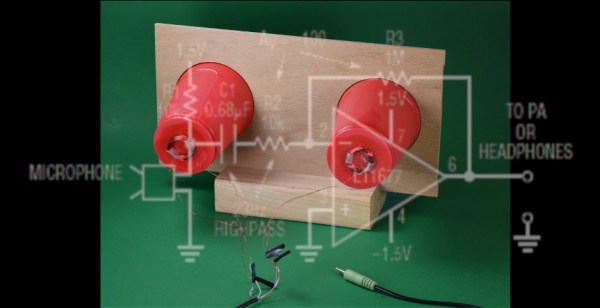
This stocking stuffer-sized amp is based around the LM386 and the bare minimum components necessary to make it rock. Everything is dead-bug soldered and sandwiched between two pieces of card stock. The first version with a single 386 sounded okay, but [Fran] wanted it louder, so she added another stage with a second 386. [Fran] glued the rim of the speaker directly to the card so it can act like a cone and give a better sound than the speaker does by itself.

All Santa needs to rock out is his axe and a small interface made of a 1/4″ jack and a 9 V wired to a 3-pin header that plugs into the card. He can take a break from Christmas music and let some of those cookies digest while he jams. Be sure to check out the build video after the break if you want to stay off the ‘naughty’ list.

Want to make your own musical greeting card? If you can program an ATtiny85, you won’t need much more than that to send a smile. If visual art is more your thing, 3D print them a 2D picture.

Continue reading “[Fran] Is Helping Santa Slay This Year”

Bottle Organ Breakdown

A keen-eyed commenter pointed us to a homemade bottle organ that plays like a piano. The complexity gets turned up with foot-powered bellows and custom keys, but the magic of [Mike] and [Simon Haisell]’s garage-built instrument is not lost in the slightest. We also have the video below the break and there is a bottle organ performance by [Coyote Merlot].

The working concepts are explained well in the video, and that starts with the bellows. In the first few seconds of the video, we see an organist swaying as he plays, and it would be accurate to say the music moves him. The wobbling is to pedal a couple of levers that squeeze a pair of air sacs and slide under wheels that look like a hardware store purchase. The spring-return mechanism is a repurposed bungee cord and you know we dig that kind of resourcefulness. Each bellow valve is made with traditional leather flaps of the type that predate bungee cords and camera phones. These air pumps inflate a big reservoir in the back that provides continuous pressure to a manifold where each of the thirty-six keys control a valve responsible for one bottle. The pair built every wooden part we mentioned with the explicit purpose of creating this organ.

Continue reading “Bottle Organ Breakdown”

Programmable Wrist Synth Pushes The Envelope

Synths are a ton of fun no matter how good or bad they sound. Really, there are no bad-sounding ones, it’s just that some are more annoying to listen than others to if you’re not the one making the beep boops. [Clem] had built a tiny LDR-based synth into a watch case a few years back and took it to many a Maker Faire, where it delighted and annoyed until it ultimately broke.

Naturally, it was time to make a new version that’s more capable. Whereas the first one was Atari-punk-console-meets-light-Theremin, this one has a bunch of inputs and can be programmed on the fly to record and play back bendable tones. It’s driven by an Arduino MKR, and the inputs are managed by an impressively squash bug-wired shift register. [Clem] used beefy switches this time in the hopes that this one will last longer. We think the slide pots are a great touch, as are the candy-colored knobs printed in PMMA.

Our favorite part is that [Clem] took advantage of the random states the microcontroller pins are in when it’s first powered on. If you don’t want to program any notes, you can use the ones generated at boot and just play around with those. Be sure to check out the build video after the break.

We’ve seen our share of synths, but few as delicious-looking as KELPIE from this year’s Hackaday Prize.

Continue reading “Programmable Wrist Synth Pushes The Envelope”

DIY Music Controllers For Raging With Machines

[Tristan Shone], aka Author & Punisher, found a way to make industrial music even heavier. This former mechanical engineer from Boston crafted his one-man band in the university fab labs of Southern California while pursing an art degree. He started machining robust custom MIDI controllers that allow him to get physical while performing, instead of hunching over tiny buttons and trying to finesse microscopic touch pad-style pitch sliders.

Starting about ninety seconds into the video after the break, [Tristan] explains his set up and walks through each of his handmade controllers, all of which are built on Arduinos and Raspberry Pis.

Our favorite is probably Grid Iron, because it looks like the most fun. Grid Iron is a rhythm controller that works by running back and forth and side-to-side over a grid of machined textures that act like speed bumps. A spring-loaded stylus picks up the textures, and an encoder translates them to sound. Eight buttons along the 3D-printed pistol grip let [Tristan] make changes on the fly.

Tired of twiddling tiny knobs, [Tristan] made Big Knobs, a set of three solid aluminum knobs that look to be 3-4″ in diameter. These are assigned jobs like delay and filter, and their weight combined with ball bearings allows them to spin almost indefinitely while [Tristan] injects other sounds into the mix.

[Tristan] has made a few custom microphones to make the most of his voice. One is a trachea mic made from four piezos strapped to his throat that picks up every possible vocal utterance and other guttural sounds quite nicely. The other is an 8-pack of mics built into a curved metal box. He can assign a different effect to each one and do things like turn a breathy scream into the sounds of swelling cymbals.

There are more machines not covered in the video, and you can read about those on [Tristan]’s site. In a bonus video after the break, [Tristan] discusses a trio of pneumatically-driven mask controllers he made.

Don’t have a machine shop at your disposal? Dig out that fidget spinner and get moving on your own MIDI controller.

Continue reading “DIY Music Controllers For Raging With Machines”

Guitar Effect Built From An Old Record Player

With little more than a gutted record player, a light bulb, and the legendary 555 timer IC, [Jacob Ellzey] has constructed this very slick optical tremolo effect for his guitar. By modulating the volume of the input signal, the device creates the wavering effect demonstrated in the video after the break.

The key is a vinyl record with large tabs cut out of it. As the record spins, these voids alternately block and unblock a small incandescent bulb. A common GL5537 photoresistor, mounted on the arm that originally held the player’s needle, picks up the varying light levels and passes that on to the electronics underneath the deck. An important note here is that different spacing and sizing of the cutouts will change the sound produced by the effect. [Jacob] has already produced a few different designs and plans on experimenting with more now that the electronics are completed.

Under the hood there’s a voltage divider and low gain amplifier connected to the photoresistor, and also a 555 timer circuit that’s driving the incandescent bulb. Once he was done fiddling with them, the circuit was moved to a neat little protoboard. A pair of potentiometers mounted through the side of the record player allow for adjusting the depth of the effect itself, as well as the output volume. Naturally, there’s also an external foot pedal that allows keying the effect on and off without taking your hands from the guitar.

As is usually the case, everything was going well on this project until the final moments, when [Jacob] found that the circuit and bulb were both browning out when powered from the same transformer. As a quick fix, he gutted a Keurig and used its transformer to drive the light bulb by itself. With independent power supplies, he was ready to rock.

Of course this isn’t the first time we’ve seen a piece of consumer electronics modified into a guitar effect, but if you’re looking for something a bit more built for purpose, there’s plenty of high-tech options to keep you busy.

Continue reading “Guitar Effect Built From An Old Record Player”

Sara Adkins Is Jamming Out With Machines

Asking machines to make music by themselves is kind of a strange notion. They’re machines, after all. They don’t feel happy or hurt, and as far as we know, they don’t long for the affections of other machines. Humans like to think of music as being a strictly human thing, a passionate undertaking so nuanced and emotion-based that a machine could never begin to understand the feeling that goes into the process of making music, or even the simple enjoyment of it.

The idea of humans and machines having a jam session together is even stranger. But oddly enough, the principles of the jam session may be exactly what machines need to begin to understand musical expression. As Sara Adkins explains in her enlightening 2019 Hackaday Superconference talk, Creating with the Machine, humans and machines have a lot to learn from each other.

To a human musician, a machine’s speed and accuracy are enviable. So is its ability to make instant transitions between notes and chords. Humans are slow to learn these transitions and have to practice going back and forth repeatedly to build muscle memory. If the machine were capable, it would likely envy the human in terms of passionate performance and musical expression.

Continue reading “Sara Adkins Is Jamming Out With Machines”