Building A Rocket To Launch Your Project Into Space

At Hackaday, we’re familiar with projects that say they’re exploring space. Most of the time, these are high altitude balloons that ascend up to 100,000 feet. Sure, this is very, very high, but it’s only about 1/3rd of the way to lower limit of what can be called space at 100 km or 62 miles. Now, we’re seeing the first steps towards embedding Arduinos, cameras, and other goodies into the celestial spheres with the NE-1 Rocket, a project by [Jonathan McCabe] in Madison, Wisconsin.

The goal of the NE-1 rocket is to launch a 5kg payload into a suborbital trajectory to a height of 120 kilometers. From there, the payload – be it an electronic, biological, or simple imaging experiment – will experience a few minutes of weightlessness before falling back to Earth under a parachute.

Getting into space without the help of a government space agency has been done a few times before, mostly with solid-fuel rockets. [Jonathan]’s system uses a liquid-fueled engine, fed with nitrous oxide as the oxidizer and a secret self-pressurizing liquid fuel. These are fed into an engine that uses a ‘cold wall vortex’ to cool the engine instead circulating fuel around the combustion chamber as in traditional engines.

[Jonathan] has already done a few static tests with a half-scale engine, and he already has a lot of the very hard-to-source components in his lab. It’s a promising project. It falls right in line with the ‘Hackaday Space Program’ idea we’ve been kicking around, and we’d be more than happy to see this project get off the ground

Making S’mores With 50,000 Volts

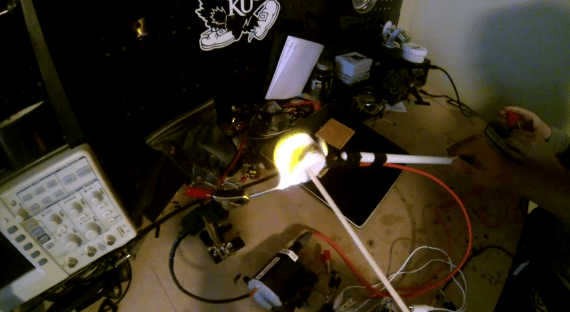
[Skyy] sent us a video of him cooking s’mores with an electric arc. He’s using a flyback transformer with a zero voltage switching (ZVS) driver. This produces about 50 kV, which is more than enough to toast the marshmallow.

ZVS is a technique that triggers the semiconductor switches when they have zero voltage across them. This ensures that there’s minimal heat created by the switches, since they are not interrupting any current at the time they are toggled. ZVS is also used in lighting dimmers to switch off power without creating interference.

If you’re interested in the details, there’s a great tutorial on building the driver. If you’re interested in learning how it works, check out this simulation video.

[Skyy] admits that his setup isn’t terribly safe since it uses a breadboard, which isn’t rated for the high voltages and currents. Keep in mind that these circuits could kill you. After the break, watch a marshmallow fry in a 50 kV arc.

Continue reading “Making S’mores With 50,000 Volts”

Have You Failed Hard Enough To Be On Hackaday?

hackaday-fail-announcement

There’s so much more to be discovered when your projects just don’t want to work. Grinding out the bugs, getting past roadblocks, and discovering gotchas is where real hacking know-how comes from. But most people aren’t motivated to document their failures. We want to change that.

We want to roll out a new weekly feature that showcases failure… well documented failure. But we need YOU to give up the goods. Write about your failed experience on your blog, post it to our project forums with [FAIL] in the title, or you can just write everything in an email and send it to us. Which ever way you choose, you’ll need to tip us off that you’d like to make it to the front page (come on, it’s not bragging since it didn’t even work!). If you already know of well documented project fails send in those links too even if they’re not your projects.

Make sure you include at least one descriptive image — snapshots, diagrams, schematics, screencaps, anything that tells the story is fair game. To show you what we’re after here’s a few of our favorite failed projects:

We’d like to point out that all of these projects are interesting ideas that show off missteps along the way. We will not be trashing on your skills as a hacker, but instead celebrating the lessons learned and hearlding the sharing of ideas from otherwise doomed projects.

Hello From SupplyFrame – Your New Evil Overlords !

A couple of weeks ago one of our engineers woke up and read that HackADay was going up for sale. His first reaction was much the same as most regular readers of HackADay, he was worried and concerned that a site that he has read daily for years was going to be sold to someone who would promptly carve it up and ruin it. So he bumped it up the chain here at SupplyFrame and we decided that HaD would be a good fit for us and so we made an offer and here we are!

Continue reading “Hello From SupplyFrame – Your New Evil Overlords !”

Well That’s Finally Over With

HaD

When the owner of the site wanted to sell Hackaday you guys wanted a Kickstarter to crowdfund the purchase and keep it in the community. I obliged and started a crowdfunding campaign. All things must pass, and I got an email from the owner, [Jason]:

Looks like a nice showing but we won’t hit even 100k
I guess we tried…. I have two solid offers from really cool folks. Will keep you posted.

Yes, that’s right, we’re finally done with the crowdfunding campaign. The end time for the campaign is now set for Monday at noon – you can’t actually delete Indiegogo campaigns – and I’m very, very doubtful it will be funded by then.

I have two words for those who supported Hackaday and this crowdfunding campaign: thank you. It’s astonishing we raised what we did without the infrastructure, licensed business, and non-profit status that would make Hackaday really cool. You guys believe in the future of Hackaday, and I’m very thankful for that.

As for the people who vomited vitriol against me in the comments of the crowdfunding announcement, I also have two words for you.

Even though the dream of a Hackaday owned by the community is dead now, I’m extremely confident we’ll find a better home for Hackaday that will allow us to keep moving forward and allow us to do some really cool things we’ve been thinking about for a while. I’ve spoken with a few of the possible future owners, and let me assure you they’re cool people. No, we won’t be doing grants for builds, but I assure you Hackaday will come out of this better than how it went in.

TL;DR: We didn’t quite get to the best of all possible universes, but things are going to be better than how they were before. Everything’s cool, don’t freak out. We’ll tell you stuff when we know more.

MSP430 Alarm Clock Project

msp430-bedside-alarm-clock

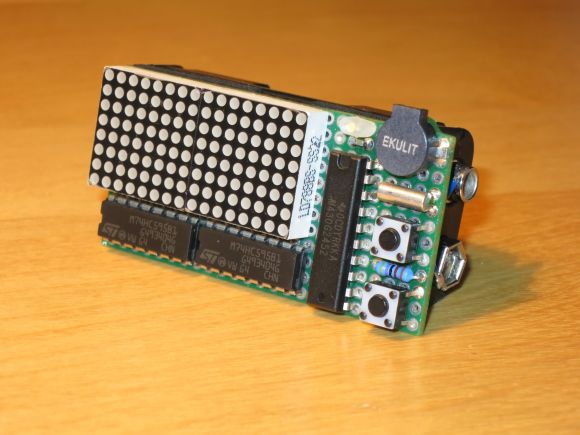
[Markus] turn his breadboard LED matrix tinkering into an alarm clock which wakes him each morning.

Don’t be fooled by how clean his assembly work is. That’s not a fabbed PCB, it’s a hunk of green protoboard which a lot of point-to-point soldering on the back side. It’s driven by the MSP430 G2452 which is oriented vertically in this image. The two horizonal ICs are 595 shift registers which drive the LED modules.

We already mentioned the cleanliness of his assembly, but there’s one other really cool design element. On the back of the unit is what looks like a battery holder for two AA cells. He’s using just one Lithium Iron Phosphate battery (3.2V) which is in the upper of the two cavities. This let him cut the lower part of the holder at an angle to act as a stand for the clock.

Don’t miss the video which walks us through the user interface. It has what you’d expect from an alarm clock. But there is a really bright white LED which mimics a sunrise clock and it does more than just buzz one note when the thing goes off.

Continue reading “MSP430 Alarm Clock Project”