DrummerBot Joins The Jam Session When Your Bandmates Are Busy

drummerbot

It seems that more often than not, [Steffest] finds himself inspired to rock out on his guitar without a percussion section to back him up. Like any enterprising hacker/musician would be wont to do, he built a robotic drummer to join in when he got the urge to play.

His DrummerBot is driven using an Arduino, which is tasked with controlling the 8 servo motors that the bot has at its disposal. The bot’s drum set is composed of a variety of items from fan motors to pot lids and more. [Steffest] wanted the ability to produce the maximum variety of sounds possible, so most of the servo motors are driven in two directions allowing the bot to strike more than one item with each “arm”.

[Steffest] is a big fan of interfacing physical objects with a web interface, so he built a simple HTML based sequencer that allows him to program the robot from his phone. Once the sequencer is programmed, the DrummerBot can be launched into action with the simple press of a button.

[Steffest] says that the bot works pretty well, but the sound is a bit raw if you hear it live. A little Ableton Live post-processing goes a long way to smooth things out however, as you can see in the video below.

[Thanks, Wesley]

Continue reading “DrummerBot Joins The Jam Session When Your Bandmates Are Busy”

We Don’t Need No Stinkin’ Packages!

DIP, SOIC, BGA, MLF or QFP?  None, so it seems.

This morning I received an email from Texas Instruments. Normally, these things go right into the spambox but this one was a bit unique. You can now buy some of TI’s IC’s without any packaging. Yup, just trays full of silicon squares. From TI’s point of view miniaturization has reached a point where that extra 0.1″ of PCB space is now too valuable to give to a piece of worthless plastic, and bonding micro-small wires to a silicon die is a feat that any manufacturer can preform with great accuracy, reliability and speed.

Whether this is a new paradigm in manufacturing or a premature April fool’s joke, if this process catches on smartphones just went from being almost unrepairable to 100% unrepairable, and ipod nanos might just start playing back 1080p video. It’s awesome and scary at the same time.

Now, are they crazy, or just ahead of their time? Tell us what you think.

Build An Elevator Controller, Gain A Friend For Life

diy-elevator-controller

[Michael Ruppe] was working one day when a man named [Kevin] approached him for a bit of help with a project. It just so happened that [Kevin] was in the middle of constructing a DIY residential elevator and he needed assistance putting a control board together.

[Kevin] had no problem casting a forklift ram into his basement slab, nor installing a submersible pump in a custom-made hydraulic pit, but wiring up the controls for the device was just not something he was comfortable with. [Michael] was more than happy to lend a hand, and over the next couple of months the pair got things running nicely.

Instead of relying on a microcontroller, [Michael] built a control board that uses little more than a handful of relays and microswitches to get the job done – It’s certainly not hard to appreciate the controller’s simplicity.

It’s stories like these that remind us just how much the hacker community is willing to help out complete strangers with any task, big or small – you guys rock!

Stick around to see a short demo video [Michael] shot, showing the elevator in action.

Continue reading “Build An Elevator Controller, Gain A Friend For Life”

10,000 Posts

According to our CMS calculations (we use WordPress), this is Hackaday’s ten-thousandth published posts. We meant to build a confetti cannon, but we were too busy looking for interesting projects to feature multiple times per day.

We’d like to thank everyone who documents their projects to share what they’ve been up to in basements, garages, or hackerspaces with the ecosystem of hackers around the world. We hope that every time you publish a build log or project summary you think about sending us a link. We’re also grateful for those who find intriguing blog or forum posts and send in a tip even though it’s not their project (we wholeheartedly encourage it).

Our contributors and editors deserve kudos. Over the years a growing band of Hackaday alumni have helped keep the front page of Hackday a place you can count on for interesting uses for otherwise everyday things. You’ve heard many of their names, like [Philip Torrone], [Eliot Phillips], and [Caleb Kraft]. But most of what you see on the front page is the result of the writers sifting through tips and scanning a laundry list of RSS feeds to find new and interesting projects and project ideas. Their contribution is what keeps the front page fresh and new, but we continue to use the royal ‘we’ in our posts because it’s the project being featured that is paramount.

And finally we thank the regular readers, whose participation keeps the lights on, and whose comments build a community. Many started out as lurkers, inspired by the projects featured here until the point that they take the plunge and blink their first LED. The threads in the comments section of each post are the evolutionary ooze that often leads to the next amazing build. Keep reading, keep commenting constructively, and we’ll see you all back here for our 16,383rd post when we fill up these digits with ones.

Thank you.

Rain Barrel Irrigation System Keeps Your Plants Fed When You’re Too Busy

sprinkler-controler

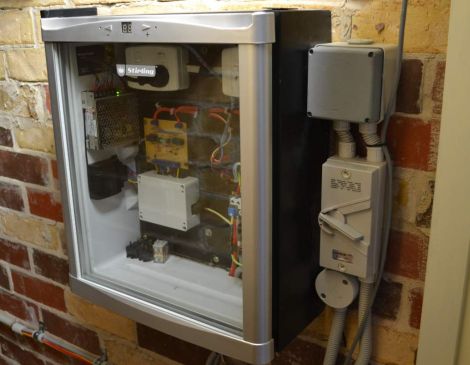
[Kyle Gabriel] moved into a house with a nice tract of land behind it, but due to his busy schedule he had yet to plant the garden he so desperately wanted. He worried that his hectic life and busy hours would lead to accidentally neglecting his garden, so he built a water collection and automated irrigation system to ensure that his plants never went without fresh water.

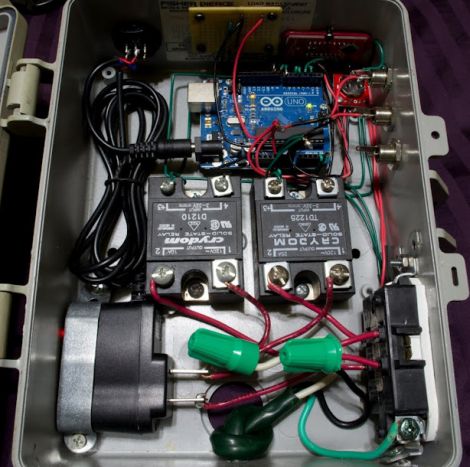
The system is fed by two large 55 gallon barrels that collect rain from his gutters. A 1/2 HP well pump is used to pressurize the collected water, which is then dispensed throughout his garden by a sprinkler. [Kyle’s] system is run from a small control box where an Arduino is used to control the pump’s schedule. At a predefined time, the Arduino turns the pump on, while monitoring the system for potential problems.

If the system starts running low on water, the Arduino triggers the valve on his spigot to open, keeping the water level above the pump inlet pipe. He also keeps an eye on pump’s outlet pressure, indefinitely disabling it before a blockage causes the pump to cycle repeatedly.

He says that the sprinkler system works quite well, and with his modular design, he can add all sorts of additional functionality in the future.

Collecting Radon Data In The Name Of Science And Safety

radon-data-collector

When [Chris Nafis] built an addition onto his historical home he found that a Radon problem, previously mitigated with plenty of concrete, seemed to rear its ugly head yet again. He eventually resigned himself to installing a Radon fan and detector – the latter of which offered no way to store measurement data. He wanted to get a better feel for the short and long-term Radon measurements in his house, in hopes of finding some correlation between temperature, moisture levels, and the total amount of Radon emitted from the ground.

To do this, he disassembled a pair of Radon detectors located in different parts of his house, each of which he wired up to an Arduino. Using his oscilloscope to determine which PCB leads controlled the different LED segments on the displays, he quickly had the Arduinos scraping measurement data from the sensors. [Chris] figured the best way to keep track of his data was to do it online, so he interfaced the microcontrollers with Pachube, where he can easily analyze his historical readings.

An additional goal he set for himself is to trigger the Radon fan only when levels start rising in order to save a little on his electric bill. With his data logging operation in full swing, we think it should be a easy task to accomplish.

[Aaron] Shows Us What Life Would Be Like If [Bob Vila] Started Hacking Headphones

construction-headphones

[Aaron Horeth] had a pair of headphones that had seen better days, and before he tossed them out, he realized that he could use them to build a set of custom cans. He had always wanted a pair of headphones with a detachable cord to prevent damage when tripped over, and thought that his old set would be the perfect donor.

He swung by his local hardware store to peruse their collection of construction earmuffs, eventually finding a set that looked decent and didn’t cost an arm and a leg. Using construction earmuffs as the framework for his headphones gave him the durability he was looking for with the added bonus of being designed to deaden extraneous noise. Once he got them home he pulled the drivers from his old set of headphones installing them into the earmuffs, but not before he wired them up to support a breakaway input cable.

There’s no doubt that the modifications are simple, but we imagine they come in pretty handy when tinkering around the shop.