The Pirate Bay Aims For The Clouds…literally

tpb

There is no shortage of government and entertainment-related agencies chomping at the bit to shut down the Pirate Bay for good. While the group has not suffered a permanent service ending raid like [Kim Dotcom] and the Megaupload crew, they are always thinking up novel ways to ensure that the site can endure whatever law enforcement throws at them.

In a recent blog post, representatives from the group unveiled plans to put their front line servers in the clouds, courtesy of custom-made autonomous drones called “Low Orbit Server Stations.” The project is in its infancy, but the general idea is to mount small computers like the Raspberry Pi on GPS-controlled drones kept aloft 24×7 (presumably) using solar energy. These drones would communicate with clients on the ground via radio transmitters which they state can provide a “100Mbps node up to 50km away”.

Calling the claims grandiose would be an understatement, but then again the Pirate Bay has proven to be a difficult organization to quash in any substantial way, so only time will tell.

[via The Daily What – Thanks, roboman2444]
When Console Modders Face Off, Only Good Things Happen

sega-multi-gen

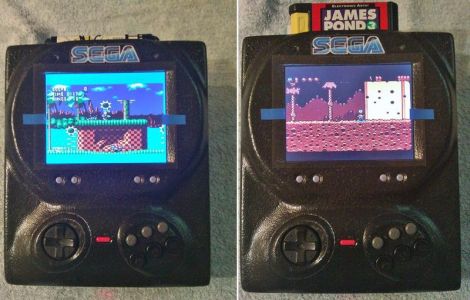
We really love when friendly competition leads to excellent hacking. Not too long ago, we showed you a nicely done Sega Genesis portable put together by console hacker [Downing] who challenged fellow hacker [EVIL NOD] to a build off. The two were hacking Sega consoles, [Downing’s] for personal use, while [EVIL NOD] was working on a commissioned build.

As you might have guessed, [Downing] finished first, but that doesn’t mean [EVIL NOD’s] console is anything but spectacular. His Sega Multi Gen is a portable Genesis console modified to play both NTSC and PAL games. It features a large 5” PSOne screen as well as the guts from an official 6-button Genesis game pad. The case was vacuum formed by [Downing], and is another example of his fine workmanship. The console looks as if it’s had the controller melted right into its face – a design that is sure to give you the authentic feel of sitting in front of your TV mashing away at the buttons.

Check out the video below to see an unboxing video that [EVIL NOD] put together before sending the console out to its new owner.

Continue reading “When Console Modders Face Off, Only Good Things Happen”

A Full Auto PVC Battery Gun

full-auto-battery-gun

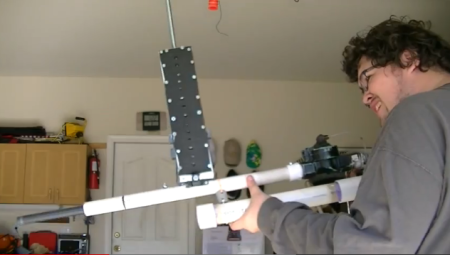
So what’s better than a battery gun? A full auto pneumatic battery gun of course!  [ukilliheal], decided to build one of these, and show us the results in his video after the break.  After turning the gun on, this contraption shoots at a pretty impressive rate of fire (although, apparently not as fast as some of his other experiments).  Apparently batteries can do a pretty fair amount of damage to a cardboard target as shown around 1:20. [ukilliheal] apparently thinks this is pretty hilarious, but we wouldn’t want to be on the other end of this device!

Although details on this build are fairly slim in this video, [ukilliheal’s] other videos should provide some clues, especially those where he explains how to make a full auto paintball gun.  If the same technique is used, a piston reloads the chamber using a homemade valve that releases pressure when it gets too high.  Electronics could also be used, but keeping everything mechanical will allow for the batteries to be used solely as ammuntion.

[youtube http://www.youtube.com/watch?v=A6Gs2mKNjV0%5D

If full-auto guns aren’t your thing, why not check out this bolt-action miniature pneumatic spud gun!

altoids-pocket-projector

DIY Film Projector Fits In The Palm Of Your Hand

DSLRs aside, the price of digital cameras these days can make it easy to consider just tossing your old one out when it breaks. [Leonidas Tolias] had another idea, and with a few broken cameras he had on hand he constructed a slick little pocket-sized projector.

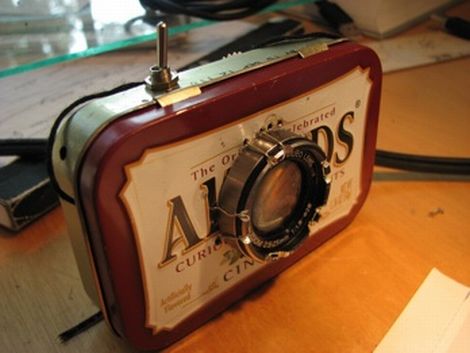
The project started out as a pair of lenses from busted cameras and an Altoids tin in which he mounted them. The larger lens from a video camera was installed on the exterior of the tin, while the smaller of the two was mounted inside. Bits from disposable cameras were used to create a set of film reels, which he supports with some hand cut scrap aluminum. He made some test photo slides by printing some images on transparency paper, which he can cycle through using a film advancement rig he built out of string and a couple of gears.

While you won’t be using this projector for your next boring PowerPoint presentation, it does work pretty well as you can see in pictures on [Leonidas’] site.

[Thanks, Taylor]

Kid-friendly RFID Media Center Playlist Control

rfid-dreambox-control

While young children have the tiny hands and fingers that most hackers/tinkerers wish they possessed from time to time, their fine motor skills aren’t always up to par when it comes to operating complicated electronics. People are always looking for ways to make their home entertainment systems accessible to their kids, and [Humpadilly] is no exception. Much like some of the other hacks we’ve seen this week, he has devised a way for his little ones (1 and 2 years old) to control his Dreambox Media Player using RFID, which seems to be the go-to technology for this sort of thing.

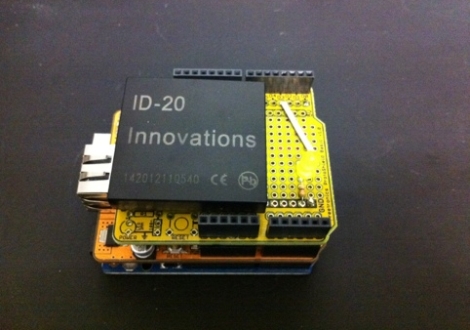
His RFID remote consists of three major components aside from the media player itself. An Arduino runs the show, and is connected to both an Ethernet shield and a breakout board fitted with an ID-20 RFID reader module. The Ethernet shield allows the Arduino to talk to his Dreambox over a telnet connection, while the RFID reader does what you would expect.

The device is in its infancy at the moment, and while [Humpadilly] hasn’t published a ton of details about the actual RFID devices he is using to control the system, he says that more details and improvements are forthcoming. In the meantime, you can check out his code here.

A Simple Touch Interface For Music Player Daemon And More

mpd-controller

[Andrew] recently got the authorization to install Linux on his work PC, and he was looking for a way to control his music without relying on keyboard shortcuts to do so. Additionally, he wanted an unmistakable visual cue when he received messages in Pidgin, so he decided to build an external input/notification box.

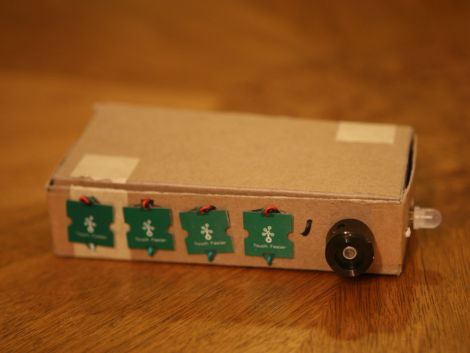
The control box, quite literally, is a cardboard box in which [Andrew] crammed some components he got way back when from the crew at Seeed Studio. A Seeeduino serves as the brains of his control panel, interfacing with his PC over USB. He uses a set of 4 touch sensors and a potentiometer to control the MPD, allowing him to easily switch tracks, pause his music, control the volume, and lock his computer with a simple touch. A side-mounted RGB LED lights green to show that the system has received his commands successfully, pulsing a bright blue whenever a message arrives via Pidgin.

While the case isn’t exactly pretty, it is small, recycled, and takes up very little desk space. [Andrew] says that it works great, and he has made his code available on github if anyone is interested in using it.

Reverse Engineering Old PDA Software

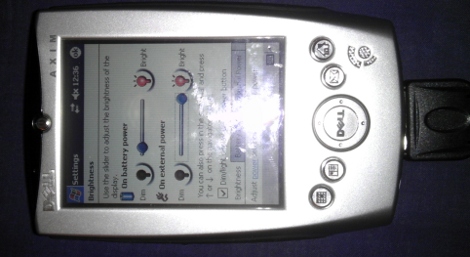
[Troy Wright] acquired a lot of twenty broken Dell Axim PDAs. This type hardware was quite popular a decade ago, but looks archaic when compared to a modern cell phone. That’s why he was able to get them for a song. After a bit of work he managed to resurrect eight of the units, but was dismayed to find there’s no published method for controlling the back light from software. For some reason this is a deal-breaker for his project. But he knew it was possible because there are some apps for the device which are able to set the back light level. So he found out how to do it by reverse engineering the software.

The trick is to get a hold of the code. Since it’s not open source [Troy] used IDA, a graphical disassember and debug suite. He had some idea of what he was hunting for as the Windows CE developer documentation does mention a way to directly control the graphical hardware independently from the display driver. A few hours of pawing through assembly language, setting break points, and testing eventually led him to the solution.