
Bang-banging Your Way To A Perfect Cake

bang-bang-oven-control

[Rob Spanton’s] house is equipped with a rather cheap oven, which was discovered while his roommate tried using it to bake part of a wedding cake. If someone took a shower during the baking process, a large portion of unit’s gas pressure was diverted to the boiler, causing the oven to shut off completely. This is obviously not a good situation for baking cakes, so the housemates decided to construct a makeshift controller to keep temperatures in line.

They started by installing a pulley on the oven’s knob, which is connected to a small motor via a long rubber belt. The other end of the belt connects to a small motor, which is controlled by a Pololu 18v7 motor controller. A K-type thermocouple monitors the oven’s temp, feeding the data through a MAX6675 converter to (presumably) [Rob’s] computer.

Since they were in a bit of a time crunch, [Rob] and his roommate [Johannes] decided the best way to keep the oven at a steady temperature was via bang-bang control. While you might imagine that cranking the gas knob between its minimum and maximum settings repeatedly wouldn’t be the ideal way to go about things, their solution worked pretty well. The cake came out perfectly, and the maximum temperature swing throughout the entire baking process was only 11.5°C – which is pretty reasonable considering the setup.

Portable Electronic Drum Kit Made From Plastic Bowls

portable-drum-kit

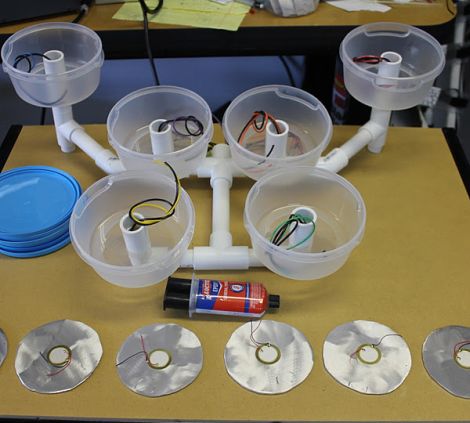
[Ian Cole’s] son is learning to play the drums on an electronic drum set, and he wanted a way to continue practicing during his frequent visits to his grandparents’ house. [Ian] had picked up a Spikenzielabs “Drum Kit Kit All-Inclusive” (DKKAI) earlier this summer, and set out to build an easily transportable drum set.

The DKKAI comes with an ATmega168-based board and a set of piezos that can be used to register hits. It was up to [Ian] to provide the rest of the kit, so he set off to IKEA in search of cheap, durable drum heads. He returned with a handful of 1/2 Liter plastic bowls, which he mounted on a PVC pipe drum stand.

The piezos were mounted on thin aluminum discs, which were in turn glued to the back side of the bowl lids. The piezos were wired to the DKKAI kit via the PVC tubing, with the signals ultimately fed into an iPad running Garage Band. [Ian] says that his portable drum set works quite well, and although there are some things that require changing, his son is very happy with his new practice set.

Check out the video below to see the portable drum kit in action.

Continue reading “Portable Electronic Drum Kit Made From Plastic Bowls”

Give Yourself A Sixth Sense On The Cheap

sixth-sense-magnetic-ring

Hackaday regular [Mikey Sklar] is no stranger to body modifications. He enjoys tweaking his body in ways that help him with day to day tasks, including a ruler tattoo on his arm and an RFID chip embedded in the web of his hand. Lately, he has been toying around with a less invasive means of getting a better feel for magnetic fields in his surroundings.

Turned on to magnetic rings by a friend, he now wears an epoxy-coated rare earth ring every day, changing the way he interacts with the world. He says that besides the obvious ability to tell when he’s near iron-heavy material, he can also feel cell phone calls, as the speaker draws the ring closer while producing sound.

He says that holding the electric cord of his tea kettle gave him the biggest start, making him feel as if he had been electrocuted, minus the actual shock.

While it’s not the most high-tech hack, [Mikey] is quite happy with the “sixth sense” this reasonably price ring has been able to provide – we just might have to try it out ourselves.

led-light-wall

Hackerspace Light Wall Plays Video At 30 Fps

The folks at The Quad Cities Collaboration and Hackerspace (QC Co-Lab) were trying to find something to build for their first big project, and had to look no further than the wall for inspiration. The north end of their facility is home to a huge 15×17 glass block wall that happens to face a well-traveled roadway.

They decided that turning the wall into a huge LED display would be a great way to attract attention from passers-by, so they picked up some GE Color Effects lights and got down to business. Once they found out that the technical college next door was putting on an open house, the race was on to get the light display assembled as quickly as possible to maximize their exposure.

The team mounted the 255 LEDs in vacuum-formed reflective cones, which were attached to wooden frames before being installed behind the glass wall. An Arduino drives the entire display at a smooth 30 frames per second, a task they say tests the very limits of the board’s capabilities.

They finished the job in time for the open house, and as you can see in the video below, the display looks great.

Nice job QC-Co-Lab!

Continue reading “Hackerspace Light Wall Plays Video At 30 Fps”

Best Of Hackaday – 2011 Edition

2011 was an interesting year here at Hackaday. We have about 24% more viewers now than we did last year. We started producing our own video content and we have shown some pretty interesting projects in our daily posts. In this post, we are gathering together the best of the best.

Our #1 post for the year with 175,000 views is about a 1 megawatt laser pulse pistol. Not only does this build work but it also looks cool. It’s definitely one to take a look at.

Coming in with 157,000 views is a post about how to insert your logo into a QR code. This one was done by our own [Brian Benchoff] and was a runaway success from the first week that we posted it.

In third place with 151,000 views is a post that could help you if you are trying to pick a development board to learn a new processor with. This post breaks down the various development boards available at the time of its writing into three different categories organized by price.

In fourth place with 114,000 views is one about an unique lock composed of color changing buttons. Your pass code is a series of colors instead of digits in an ordinary code lock. This build fits behind a standard wall plate so that it can be mounted cleanly using off-the-shelf hardware from the hardware store.

Wrapping things up at fifth place is a post describing how you can download books from Google using an utility called Google Book Downloader. We have no idea of the legality of this one. The original link is down but it seems that it is still available elsewhere on the internet.

Knockoff Game Controller Makes A Fine Remote Shutter Release

remote-shutter-release

[Duncan Murdock] received a Canon DSLR camera for Christmas and wanted a remote shutter release to go along with it. Since nary a store was open on Christmas, he was pretty much out of luck. Scrounging around in his parts drawer, he found all sorts of goodies waiting to be reused, including a knockoff Wii nunchuck.

He pulled the original cable from the nunchuck and replaced it with an old telephone wire, attaching a 2.5mm plug to the end. The plug goes directly into his camera’s control port, allowing him to trigger the auto focus and shutter mechanisms with the push of a button.

We like the idea of a junk controller being recycled for use in a camera, though we think it has far more potential than being used as a simple wired trigger. If both the nunchuck and camera were fitted with some sort of wireless interface (Bluetooth, IR, etc), we think it would make a great addition to any hobby photographer’s kit.

Video Series Shows How To Build Your Own Solar-charged R/C Lawnmower

rc-solar-lawnmower

As winter is officially upon us, we’re pretty sure that the last thing most of you are thinking about is mowing your lawn. We would argue that it’s actually the ideal time to do so – that is, if you are interested in automating the process a bit.

[Robert Smith] has spent a lot of time thinking about his lawn, wanting a way to sit back and relax while doing his weekly trimming. He set off for the workshop to build an R/C electric lawnmower, and thoroughly documented the process in order to help you do the same.

On his web site, you will find a series of videos detailing every bit of the solar charged R/C lawnmower’s construction, taking you through the planning phases all the way to completion. [Robert] has provided just about anything you could possibly need including parts lists, schematics, code, and more.

If the short introductory video below has you interested, be sure to swing by his site for everything you need to build one of your own.

Continue reading “Video Series Shows How To Build Your Own Solar-charged R/C Lawnmower”