33 Node Beowulf Cluster Built With Raspberry Pi

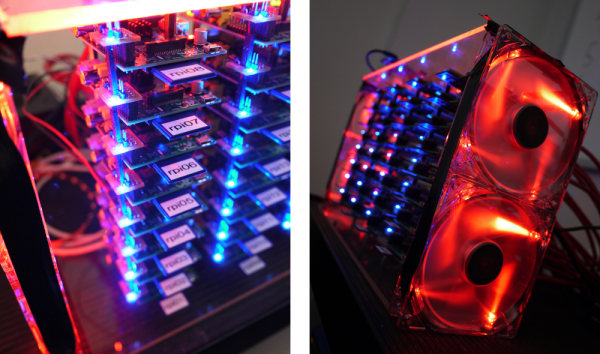
Not only did [Josh Kiepert] build a 33 Node Beowulf Cluster, but he made sure it looks impressive even if you don’t know what it is. That’s thanks to the power distribution PCBs he designed and etched. In addition to injecting power through each of the RPi GPIO headers they host an RGB LED which is illuminated in blue in the images above.

Quite some time ago we saw a 64-node RPi cluster. That one used LEGO pieces as a rack system to hold all of the boards. But [Josh] used stand-offs to create the columns of hardware which are suspended between top and bottom plates made out of acrylic. The only thing that’s unique about each board is the SD card and that’s why each has a label on it that identifies the node. These have been flashed with almost identical images; the host name and IP address are the only thing that changes from one to the next. They’ve been put in order physically so that you can quickly find your way through the rack. But functionally this doesn’t matter… put the card in any RPi and it will automatically identify itself on the network no matter where it’s located in the rack.

Don’t miss the demo video where [Josh] explains the entire setup.

Continue reading “33 Node Beowulf Cluster Built With Raspberry Pi”

Turning A Phone Into A Media Center Remote

IMG_2061

[Kees] wanted a remote for an XBMC audio system. He had a classic T65 Dutch telephone in one of his project boxes and thought this phone with the addition of a Raspberry Pi he could have a functional media remote with classic lines and 70s styling.

Each of the digits on the phone were wired up to a small solderless breadboard. With a handful of resistors, [Kees] set up a simple pull up/pull down circuit feeding in to his Raspi’s GPIO input.

With a short Python script, [Kees] managed to map the buttons to XMBC’s play/pause, volume up/down, next, and previous commands. There were a few buttons left over, so those were mapped to online radio stations, playlists, and a strange setting known only as ‘moo’. We’re not sure what that button does, but you can see the other functions of this XMBC phone remote in action in the video below.

Continue reading “Turning A Phone Into A Media Center Remote”

ATX Raspi Is A Smart Power Source For Raspberry Pi

One aspect of the Raspberry Pi that has always challenged us is the power supply. It was a great idea to power the board from a standard micro-USB port because economy of scale makes phone chargers (even in the 1A range necessary for stable operation of the RPi) cheap and easy to acquire. The thing we miss is the ability to power the device on and off using the built-in hardware. The quandary has given rise to many different solutions, and the ATX Raspbi smart PSU is one of the better ones we’ve come across. It’s a nicely packaged take on the PIC-based version we saw earlier in the year.

The device is a small PCB that acts bridge between the micro-USB power supply and the RPi board. It offers several breakout headers, one of which is used for a power button. The button is monitored by a microcontroller that switches the on-board relay accordingly. But it won’t just kill the power when you want to shut down. It first signals one of the RPi GPIO pins, causing the OS to execute a shutdown script. It then monitors the RPi for the shutdown tasks to finish before cutting the power.

Continue reading “ATX Raspi Is A Smart Power Source For Raspberry Pi”

Controlling A Terminal With Google Voice

sms

For how awesome Google Voice is, we’re surprised we haven’t seen this before. [Steve] is using Google Voice to run commands on just about any Linux box.

Google Voice doesn’t have an official API, and existing unofficial APIs weren’t up to snuff for [Steve]’s project. He ended up writing his own that checks his unread message inbox every minute and looks for new text messages beginning with the phrase, ‘Cmd’. If a series of checks pass – the text coming from a known phone number and a proper terminal command – the command runs and sends the a text back indicating success or failure.

While [Steve] probably won’t be playing nethack or Zork via SMS anytime soon, we can see this being very useful for a Raspi home automation task. Just send a text message and a properly configured Linux box can open your garage door, turn on the lights, or even start a webcam.

Homebrew GPS Gets ±1 Meter Resolution With A Raspberry Pi

GPS

We’ve been following the work of [Andrew Holme] and his homebrew GPS receiver for a while now. A few years ago, [Andrew] built a four-channel GPS receiver from scratch, but apparently that wasn’t enough for him. He expanded his build last year to track up to eight satellites, and this month added a Raspberry Pi for a 12-channel, battery-powered homebrew GPS receiver that has an accuracy of about 3 feet.

The Raspi is attached to an FPGA board that handles the local oscillator, real-time events, and tracks satellites automatically. The Pi handles the difficult but not time-critical math through an SPI interface. Because the Pi is attached to the FPGA through an SPI interface, it can also load up the FPGA with even more custom code, potentially turning this 12-channel receiver into a 16- or 18-channel one.

An LCD display attached to the FPGA board shows the current latitude, longitude, and other miscellaneous data like the number of satellites received. With a large Li-ion battery, the entire system can be powered for about 5 hours; an impressively portable GPS system that rivals the best commercial options out there.

Old LED Marquee Turned Embedded Video Player

driving-led-marquee-with-rpi

[Sprite_TM] is was sent an old LED Marquee by an anonymous fan of his hacking projects. The display isn’t full color, but it’s large — 224 by 48 pixels — and he figured he could render some okay images with the bi-color diodes. In the end, he replaced the controller and turned it into a video player.

The original system work well enough, but the 100 MHz 486 industrial style PC that drove the display seems a little comical these days. After giving it a spin and testing out how it drives the display [Sprite] hooked up an FTDI chip and managed to get it playing video from his computer. Above you can see part of the opening sequence of The Simpsons.

Now that he had learned its secrets he set out to give it an embedded controller. His first attempt was with a Carambola board which he’s worked with before. That proved to be a little slow for all the pixel data he was pushing so he upgraded to a Raspberry Pi and never looked back. You can see the demo video after the jump.

Continue reading “Old LED Marquee Turned Embedded Video Player”

Hackerspace Security System Brings RFID, Video Feedback, And Automatic Doors

rfid-hackerspace-door-lock

[Will] has been hard at work on a replacement system for his Hackerspace’s RFID door lock. The original is now several years old and he’s decided to upgrade to a much more powerful processor, adding some bells and whistles along the way.

The control box seen above is the exterior component of the system. It’s a telephone service box like you’d find on the back of most houses in the US. They had a few of these lying around and they are a perfect choice because… well… they’re meant to be locking enclosures that brave the elements. [Will] made the jump from an Arduino which has run the locks for the last three years to a Raspberry Pi board. This gives him a lot of extra power to work with and he took advantage of that by adding a vehicle backup LCD screen for visual feedback. You can see it giving the ‘Access Granted’ message he used during testing but the demo video after the break shows that they plan to do some image scripting to display a head shot of the RFID tag owner whenever a tag is read.

There are several other features included as well. The system Tweets whenever a tag is read, helping the members keep tabs on who is hanging out at the space right now. It also patches into a sliding door which one of the members automated using a garage door opener motor.

Continue reading “Hackerspace Security System Brings RFID, Video Feedback, And Automatic Doors”