Wiimote Controlled RPi Robot

Wiimote RPi Robot

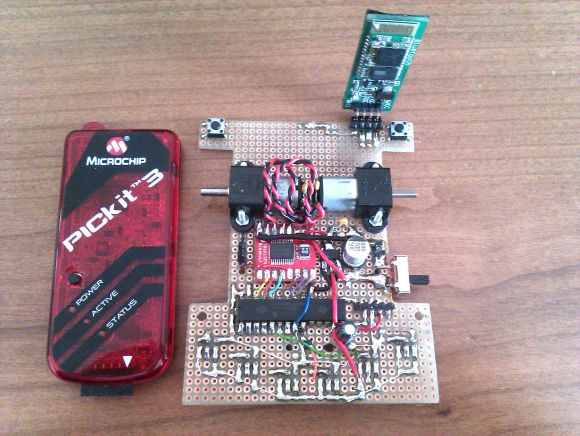
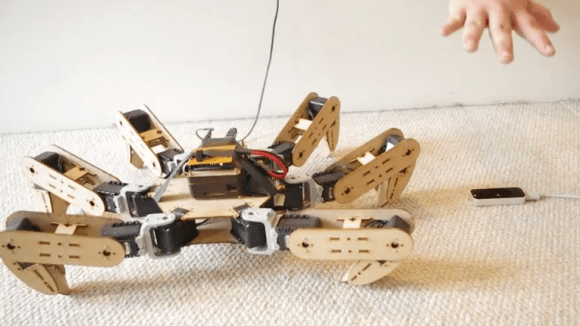
[Brian] has brought together a powerful collection of hardware to build a robot. The end goal is to have a robot that’s controlled by a Wiimote.

The Wiimote communicates over Bluetooth with a Raspberry Pi, which is running a Python script. This script uses the CWiid Python module to communicate with the controller, and [Brian] has detailed instructions on getting the Wiimote working with a RPi. The RPi controls an ATmega based development board over SPI, which drives an h-bridge to control the two DC motors that move the robot.

[Brian]’s code for this could be helpful for anyone looking to control their RPi with a Wiimote. Since Wiimotes and Bluetooth dongles are fairly cheap nowadays, this is a great way to drop in wireless control to any RPi project, or even to control your media center from the couch.

After the break, check out a video of the build in action

Continue reading “Wiimote Controlled RPi Robot”

Street Art Bot

Street Art Bot

For the Deconstruction decentralized hackathon, “The FABricators” from Fab Lab Tulsa built a Street Art Bot. The robot drives around and dispenses liquid chalk in a pattern to make sidewalk art.

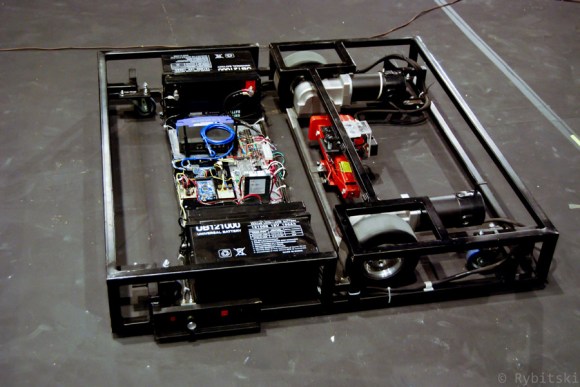
The FABricators’ robot is based on an electric wheelchair platform. Attached to the base is the hardware for dispensing chalk, which is controlled over wifi. The operator drives the robot around the area to chalk, and chalk is deposited in the right pattern.

In order to ensure the art is chalked correctly, the robot’s software needs to know where the robot is at all times. This is done using a camera mounted above the area and a fiduciary marker that localizes the robot. The tracking is done using the reacTIVision library.

The robot was built to be expandable, and in the future they want to add multiple colors, or even multiple robots printing simultaneously.  After the break, check out a video overview of the project.

Continue reading “Street Art Bot”

3D Printed HOG Drive

3d-printed-hog-drive

Here’s a 3D printed Hemispherical Omnidirectional Gimballed Drive system which you can make at home. That’s a mouthful which is why it is commonly referred to as a HOG drive. Never heard of one? Well you need to keep up with your Hackaday because about 20 months ago we featured this amazing robot project that uses one. The design is a tricycle orientation with the HOG drive as the only powered ‘wheel’. But it’s not really a wheel, it’s a half-sphere (a hemisphere which is not pictured above but attaches to the motor spindle) which can provide thrust in any direction depending on which way the motor is spinning a how the gimbal bracket is oriented.

Unfortunately [Dan] isn’t showing off a vehicle that is powered by the device just yet. But from what we’ve seen in the demo after the jump it is fully functional. His target project for the system is a line-following robot which we hope to post as a follow-up when he reaches that goal.

Continue reading “3D Printed HOG Drive”

A Remote-controlled, Autonomous Kite Generates Power

kite

Generating power from wind is easy – just stick a windmill on a pole and attach a generator. That’s not particularly cool, though, so [Adrien] and his team from his senior design project are using an autonomously controlled kite to generate power

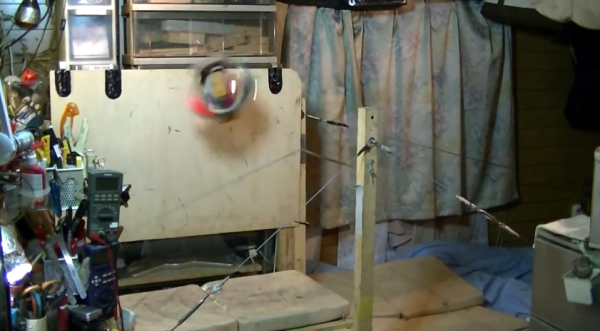
The basic idea of generating electricity from a kite is to fly it around in figure-eights while unwinding the kite line from a spool. The very strong forces on the kite lines can be used to drive a generator which provides power for reeling the kite back in at a lower angle of attack. You can check out [Adrien]’s kite power theory page for a few more details on how this works.

Right now, [Adrien] and his team have a basic rig set up to generate power and are flying the kite via a joystick. Updates are coming, and you can check out the video of their RC kite in action after the break.

Continue reading “A Remote-controlled, Autonomous Kite Generates Power”

An Awesome, Futuristic, All-in-one Robot Chassis

bot

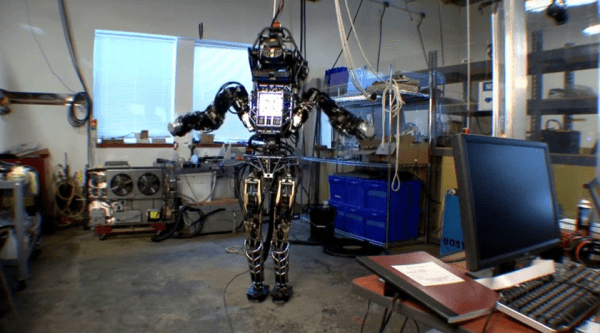
No matter how many advances in electronics we find, we’re constantly surprised at the lack of progress in robot chassis. Sure, it should be a simple task to make a capable robot that looks cool, but aside from the Veter project team, no one else seems to be advancing the state of robot mechanics.

We’ve seen robotic chassis and hardware from the Veter team before, and this new version brings a whole lot more to the table. While the camera. GPS, compass, and ultrasonic sensors are the same from the previous build, there’s a whole lot more software inspired by [Sebastian Thrun]’s autonomous car class to make this build a little more capable.

While the Veter team is using a Beagleboard for their on-board computer, it should be possible to change the hardware over to a more economical Raspberry Pi. Even then, it won’t be a cheap build, but we doubt you’ll find a better robotics platform for less.

Roomba Becomes Data Center Robot

robot

Running a data center takes a lot of work, and even making sure the ambient temperature for hundreds of boxes is in the proper range is an arduous task. When faced with the prospect of installing hundreds of temperature sensors in an EMC data center, [Vivek] had a better idea: put just a few sensors on a robot and drive around the racks. With the right software, it’s a breeze to automate the process and build a near real-time temperature monitoring solution for a huge data center.

The data center robot is based on a iRobot Create, basically a Roomba without a vacuum. Attached to the robot is a netbook, Arduino, and a PVC mast housing three temperature sensors and a USB webcam.

Using the floor of the data center for navigation, the robot canvasses the racks sending temperature data back to a server via WiFi. From there, the temperatures can be graphed to make sure the racks aren’t too hot or too cold.

You can check out a video of the robot in action after the break.

Continue reading “Roomba Becomes Data Center Robot”

3d Printed Hexapod Robot

3d-printed-hexapod

This hexapod was made almost entirely via 3d printing (translated). The parts that you need to supply include a few fasteners to make connections, twelve servo motors, and a method of driving them. As you can see in the video after the break, all those parts come together into a little robot that functions quite well. The only thing that we think is missing are some grippy feet to help prevent slipping.

[Hugo] calls the project Bleuette. It is completely open source, with the cad files and source code available on his Github repository. There is additional information in the wiki page of that repo. This gives us a good look at the electronic design. He’s controlling the legs with an Arduino, but it’s all dependent on his own shield which features a PIC 18F452 to take care of the signals used to drive all of the servo motors. The board also has some peripherals to monitor the current draw and regulate the incoming power.

Continue reading “3d Printed Hexapod Robot”