A Hexapod Robot Made From Scrap

radial-robot

Many if not most good hacks come from scrap or unused parts, but this hexapod robot takes it to a new level. [Helmut] wrote in to tell us about his ‘bot built from discarded electronics. As with most of the little walkers that we’ve featured here, this robot features some basic obstacle avoidance with a sensor array on the head unit.

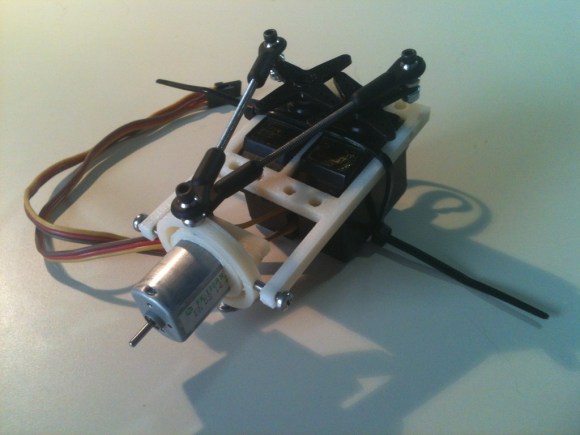
The way the head controls this robot is really the interesting thing about this setup.Rather than send a signal to tell servo motors to walk in a certain gait, the head physically tilts in the direction that it should go. Although it’s somewhat hard to tell, it appears that a driving motor in the head assembly pushes a sort of camshaft down into the body. This is then mechanically coupled to the legs causing it to walk in the correct direction.

Be sure to check out the videos after the break, featuring narration by a computer in English, or by a human in German if you happen to sprechen sie Deutsch. Continue reading “A Hexapod Robot Made From Scrap”

Retrotechtacular: A 1983 Walking Robot Called ODEX-1

odex-1

ODEX-1 is called the first commercial walking robot in this video from 1983. Of course you will quickly recognize this as a hexapod. It’s hard to get over the fact that what was so advanced at the time can now be built at home relatively inexpensively.

As with most of these retrotectacular posts the presentation is a big part of the fun. The audio track right at the beginning of the video expresses the shock at seeing such an advanced robot walking through the building (it’s coming right for us?!). The trends in engineer garb are also on display. ODEX-1 is being heralded as the solution to mechanized travel in an environment full of ladders and stairways. Apparently it can get traverse the stairs, but you’d better be ready to wait a while for it to get anywhere. See for yourself in the video after the break.

Continue reading “Retrotechtacular: A 1983 Walking Robot Called ODEX-1”

Bird Buggy Soothes A Screeching Parrot

bird

[Andrew] has enjoyed the company of [Pepper] the parrot for more than a decade, but the screeching of a bird in the next room is something you just don’t get used to. [Pepper] gets very lonely some times, and short of having someone carry him around on a shoulder, there’s not much that will calm this parrot down. [Andrew] had the idea of allowing [Pepper] to wander around the house with the help of a mobile platform. Thus was born the Bird Buggy, a parrot-controlled vehicle built just for [Pepper].

The buggy itself is a basic two-wheel drive platform driven with a small beak-compatible joystick mounted just forward of [Pepper]’s perch. With this system, it’s possible for [Pepper] to follow [Andrew] through the house. [Andrew] wanted to make sure [Pepper] couldn’t drive into walls or table legs, so a suite of sensors on the front stops the buggy whenever an object is detected.

One very cool feature of the bird buggy is its ability to drive itself to a recharging station. It does this with the help of a webcam and OpenCV and a pair of markers just behind the charging port. When the Beagleboard on the buggy sees the green and yellow markers for the charging port align, it knows its directly in front of the charging port.

You can see [Pepper] driving his new whip around after the break, along with a very cool demo of the bird buggy docking with its charging port.

Continue reading “Bird Buggy Soothes A Screeching Parrot”

RC Car Transforms Into RC Robot

Transformer

After nearly 30 years since the first episode of Transformers aired, someone has finally done it. A company named Brave Robotics out of Japan has created a true transformer robot that is half remote control car and half remote control bipedal robot.

According to the Brave Robotics’ site, this creation is the result of more than 10 years. In 2002, the first version of the Transform Robot was completed – a relatively simple affair that transformed but couldn’t walk or drive. Over the last 10 years, the prototypes have seen incremental improvement that included a drive system for the wheels, a steering mechanism, and even the ability to move its’ arms and shoot plastic darts.

Surprisingly, you can actually buy one of Brave Robotics’ transforming robots for ¥1,980,000 JPY, or about $24,000 USD. A little pricy but we’re sure we’ll see a few more transforming robots in the future.

Check out a few more videos of the Brave Robotics transform robot after the break.

Continue reading “RC Car Transforms Into RC Robot”

Simplifying Fabrication Of Soft Robots

Soft robots are a peculiar wing of technology. They don’t use frames and motors for locomotion, but as the name implies they are made of soft materials. They move by pumping fluid — it could be air or liquid — in and out of bladders that push or pull against the body itself. [Matthew] points out that fabricating soft robots has traditionally been a time-consuming and difficult task. He’s trying to make it easier by 3D printing molds into which soft robots can be cast. This way the parts can be designed in CAD, converted to a mold design, and pushed to a 3D printer.

The object with which he’s been testing the technique functions like an octopus tentacle. The image at the bottom left illustrates the internal structure, with rings separated to allow the appendage to flex, and tubes running parallel to the appendage to provide the force needed to bend it. Above that image you can see one of the molds that was used, and the final product is on the right. The video after the break shows a demonstration of this bending left and right as air is pumped in using the bulb of a blood pressure cuff (or Sphygmomanometer for those paying attention).

Continue reading “Simplifying Fabrication Of Soft Robots”

Dyson Engineers’ Hacks Traverse Robot Obstacle Course

2012-dyson-challenge

These guys are all engineers who are employed by Dyson. They’re holding remote control creations made from Dyson parts. This time around the object of the challenge was to build a bot based on a the Dyson ball and race it through an obstacle course.

This sort of thing is right up our alley, but unlike the last time Dyson engineers shrugged off the daily grind to hack their own hardware, this doesn’t show off nearly enough of the festivities. Sure the pair of videos embedded after the break make a great trailer for the event, but we would love to have seen 90 seconds devoted to each of the entries. Alas, you do get to see most of the winning unit’s obstacle course run which includes a distance route, navigating through rough terrain, and negotiating a high path where falling off the edge is a real threat.

Maybe the engineers themselves will post details about their own builds like the contestants in Sparkfun’s autonomous vehicle contest do.

Continue reading “Dyson Engineers’ Hacks Traverse Robot Obstacle Course”

Pixar-style Lamp Project Is A Huge Animatronics Win

pixar-lamp-animated-procedurally

Even with the added hardware that lamp still looks relatively normal. But its behavior is more than remarkable. The lamp interacts with people in an incredibly lifelike way. This is of course inspired by the lamp from Pixar’s Luxo Jr. short film. But there’s a little bit of most useless machine added just for fun. If you try to shut it off the lamp shade is used to flip that switch on the base back on.

[Shanshan Zhou], [Adam Ben-Dror], and [Joss Doggett] developed the little robot as a class project at the Victoria University of Wellington. It uses six servo motors driven by an Arduino to give the inanimate object the ability to move as if it’s alive. There is no light in the lamp as the bulb has been replaced by a webcam. The image is monitored using OpenCV to include face tracking as one of the behaviors. All of the animations are procedural, making use of Processing to convey movement instructions to the Arduino board.

Do not miss seeing the video embedded after the break.

Continue reading “Pixar-style Lamp Project Is A Huge Animatronics Win”