LED Displays May Get Vertical Integration

If you zoom into the screen you are reading this on, you’d see an extremely fine pattern of red, green, and blue emitters, probably LEDs of some kind. This somewhat limits the resolution you can obtain since you have to cram three LEDs into each screen pixel. Engineers at MIT, however, want to do it differently. By growing thin LED films and sandwiching them together, they can produce 4-micron-wide LEDs that produce the full range of color, with each color part of a vertical stack of LEDs.

To put things in perspective, a standard TV LED is at least 200 microns across. Mini LEDs measure upwards of 100 microns, and micro LEDs are the smallest of all. A key factor for displays is the pitch — the distance from the center of one pixel to the center of the next. For example, the 44mm version of the Apple Watch has a pitch of around 77 microns. A Samsung Galaxy 10 is just over 46 microns.  This is important because it sets the minimum size for a high-resolution screen, especially if you are building large screens (such as when you build custom video walls (see the video below for more about that).

Continue reading “LED Displays May Get Vertical Integration”

Behold A Microscope That Sees By Squashing Things Into It

“Look with your eyes, not your hands” is something many of us have heard while growing up, but that doesn’t apply to the touch-sensitive microscope [Steve Mould] got to play with.

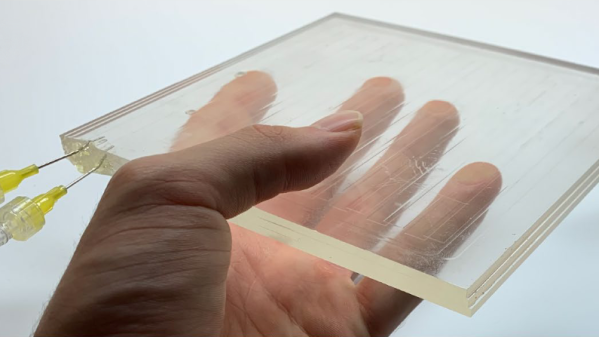
Gel pad removed, exposing lens and multi-directional lighting.

The wand-like device is made by Gelsight, and instead of an optical lens like a normal microscope, it sports a gel pad on the sensing end. By squashing an object into the gel, the device is able to carefully illuminate and image the impression created. By taking multiple images lit from different angles, a lot of information can be extracted.

The result is a high-resolution magnification — albeit a monochromatic one — that conveys depth extremely well. It’s pretty neat clearly seeing tiny specks of dust or lint present on surfaces when [Steve] demonstrates imaging things like coin cells.

Many a hacker knows that the devil is in the details when it comes to executing an idea. Even so, the basic principles of the Gelsight seem simple enough and possibly within the realm of inspired DIY in the same way that we saw a CNC gantry and USB microscope repurposed as an optical comparator.

Watch the Gelsight in action in the video below, embedded below the page break.

Continue reading “Behold A Microscope That Sees By Squashing Things Into It”

Electron Microscope Conversion Hack

Some of you probably know this already, but there’s actually more than one kind of electron microscope. In electronics work, the scanning electron microscope (SEM) is the most common. You hit something with electrons and watch for secondary electron emissions. However, biologists more often use a TEM — a transmissive electron microscope — which passes electrons through a sample to image it. [Breaking Taps] built a small device to convert his SEM into a TEM.

One key idea is that in a SEM, the beam’s position on the target is the only thing that matters. Any secondary electron detected is a result of that spot’s composition, no matter where you collect them. Common detectors pick up back-scattered electrons bouncing back toward the electron source.  There are also low-energy electrons bouncing off in random directions, depending on the topology of the target.

The slow electrons can be attracted by a single detector that has a strong positive charge. TEM  doesn’t detect secondary electron emissions. Instead, it passes electrons through a target and collects the ones that pass through a very thin sample using a screen that glows when electrons hit it.

The idea, then, is to create a STEM-SEM device. There’s a sample holder and an angled reflector that shoots electrons passing toward the SEM’s detector. The back-scatter detector is not used, and a shield prevents the detector from seeing secondary emissions from the target itself.

You can buy these, but they are well over $1,000, so in true hacker fashion, [Breaking Taps] made his own.  You could, too, but you’d need a pretty good machine shop and — oh yeah — a scanning electron microscope.

While we have seen some home labs with electron microscopes, you need some high-tech vacuum and high-voltage gear, so it isn’t too common. Armed with a STEM, you can even see the shadows of atoms.

Continue reading “Electron Microscope Conversion Hack”

Detecting Machine-Generated Content: An Easier Task For Machine Or Human?

In today’s world we are surrounded by various sources of written information, information which we generally assume to have been written by other humans. Whether this is in the form of books, blogs, news articles, forum posts, feedback on a product page or the discussions on social media and in comment sections, the assumption is that the text we’re reading has been written by another person. However, over the years this assumption has become ever more likely to be false, most recently due to large language models (LLMs) such as GPT-2 and GPT-3 that can churn out plausible paragraphs on just about any topic when requested.

This raises the question of whether we are we about to reach a point where we can no longer be reasonably certain that an online comment, a news article, or even entire books and film scripts weren’t churned out by an algorithm, or perhaps even where an online chat with a new sizzling match turns out to be just you getting it on with an unfeeling collection of code that was trained and tweaked for maximum engagement with customers. (Editor’s note: no, we’re not playing that game here.)

As such machine-generated content and interactions begin to play an ever bigger role, it raises both the question of how you can detect such generated content, as well as whether it matters that the content was generated by an algorithm instead of by a human being.

Continue reading “Detecting Machine-Generated Content: An Easier Task For Machine Or Human?”

RF Spectrometer Sees Inside

Spectrometry is a well-known technique or, more correctly, a set of techniques. We usually think of it as the analysis of light to determine what chemicals are producing it. For example, you can tell what elements are in a star or an incandescent based on the spectrum of light they emit. But you can also do spectroscopy with other ranges of electromagnetic radiation. [Applied Science] shows how to make an RF spectroscope. You can see the video below.

An oscilloscope-resident function generator creates a signal that he feeds to an amplifier because you need a fair amount of power going out. However, you also need to sense a very tiny amount of power coming back, and that requires a special circuit that will block high-power signals while passing low-level signals.

Continue reading “RF Spectrometer Sees Inside”

Toxic Telescope Makes You Mad As A Hatter

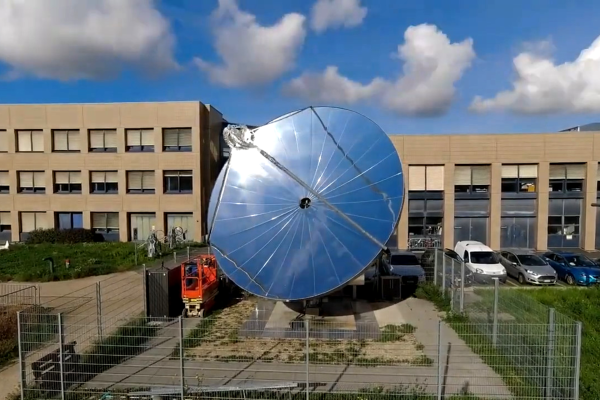
[Hank Green] posted an interesting video about the first liquid mirror telescope from back in the 1850s. At the time, scientists were not impressed. But, these days, people are revisiting the idea. The big problem with the early telescope is that it used mercury. Mercury is really bad for people and the environment.

The good thing about a liquid scope is that you can pretty easily make a large mirror. You just need a shallow pool of liquid and a way to spin it. However, there are downsides. You need to isolate the liquid from vibrations and dust. Another downside is that since gravity makes the shape of the mirror, these telescopes only go one way — straight up.

Continue reading “Toxic Telescope Makes You Mad As A Hatter”

A cartoon vehicle is connected to two wires. One is connected to an illustrated Li anode and the other to a γ-sulfur/carbon nanofiber electrode. Lithium ions and organic carbonate representations float between the two electrodes below the car. A red dotted line between the electrodes symbolizes the separator.

Lithium Sulfur Battery Cycle Life Gets A Boost

Lithium sulfur batteries are often touted as the next major chemistry for electric vehicle applications, if only their cycle life wasn’t so short. But that might be changing soon, as a group of researchers at Drexel University has developed a sulfur cathode capable of more than 4000 cycles.

Most research into the Li-S couple has used volatile ether electrolytes which severely limit the possible commercialization of the technology. The team at Drexel was able to use a carbonate electrolyte like those already well-explored for more traditional Li-ion cells by using a stabilized monoclinic γ-sulfur deposited on carbon nanofibers.

The process to create these cathodes appears less finicky than previous methods that required tight control of the porosity of the carbon host and also increases the amount of active material in the cathode by a significant margin. Analysis shows that this phase of sulfur avoids the formation of intermediate fouling polysulfides which accounts for it’s impressive cycle life. As the authors state, this is far from a commercial-ready system, but it is a major step toward the next generation of batteries.

We’ve covered the elements lithium and sulfur in depth before as well as an aluminum sulfur battery that could be big for grid storage.