The 2022 Hackaday Prize Hack Chat Kicks Things Off

The 2022 Hackaday Prize is on, and we’ve already seen some incredible submissions by folks who believe their idea just might have what it takes to make the world a better place. But as with all contests, it’s good to understand all the rules before you get too involved. We promise nothing’s hidden in the fine print, but we certainly don’t fault anyone who wants to make sure.

Which is why Majenta Strongheart, Head of Design and Partnerships at our parent company Supplyframe, stopped by this week’s Hack Chat to answer any and all questions the community had about this global hardware design challenge. A lot of ground was covered in an hour, with Majenta making sure everyone’s questions and concerns were addressed to their satisfaction. After all, with a residency at the Supplyframe DesignLab and a total of $125,000 in prize money up for grabs, we want to make sure everyone’s got the facts straight.

So what burning questions did the Hackaday community have about this year’s Prize? Several people wanted to know more about the themes of sustainability, circularity, and climate crisis resiliency. For example, what exactly does circularity mean in this context? While Challenge #2 “Reuse, Recycle, Revamp” most clearly exemplifies the idea, Majenta explained that this time around the judges will be giving particular consideration to ideas that limit the extraction of raw materials and the production of waste.

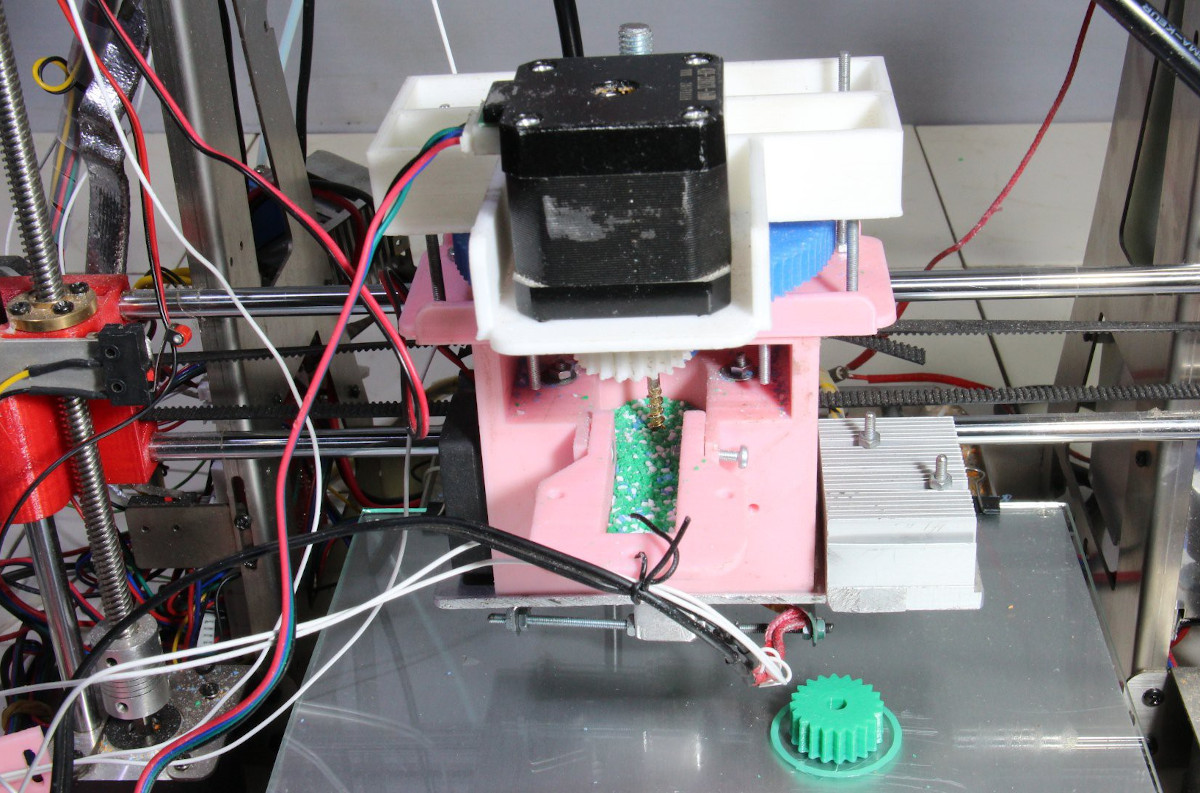
For a practical example, 2022 Hackaday Prize judge James Newton pointed to the direct granule extruder designed by Norbert Heinz. The project, which took 5th place last year, allows waste plastic to easily be repurposed in a desktop 3D printer. This includes objects which the printer itself produced, but for whatever reason, are no longer desired or needed. This “life-cycle” for printed objects, wherein the same plastic can be printed over and over again into new objects, is a perfect encapsulation of circularity within the context of this year’s prize.

Others were looking for clarification on the contest rules. Specifically, there was some confusion about entering existing projects into the competition. Did it have to be a completely new idea? What if you’d already been working on the project for years, but had never shown it publicly before? Not to worry — existing projects can absolutely be entered into the 2022 Hackaday Prize. In fact, even if the project had already been entered into the Hackaday Prize previously, it’s still fair game.

But there is an important caveat: to be eligible for this year’s Prize, the project MUST be documented on a new Hackaday.io page. Additionally, if it’s a project that has previously been entered into a Hackaday contest, you’ll have to show that it is “significantly different from when previously entered and show meaningful development during the course of the Contest“, as stated in the official rules. In layman’s terms, it means that anyone who tries to submit and old and outdated Hackaday.io page into the competition will find their entry disqualified.

Towards the end of the Chat, Erin Kennedy, a Hackaday Prize veteran that readers may know better as “Erin RobotGrrl” brought up the subject of mentors. In previous years, hardware luminaries like Andrew “Bunnie” Huang and Mitch Altman were made available to offer advice and guidance to the individuals and teams behind the Prize entries. While very proud of this effort, Majenta explained that at least for now, Mentor Sessions are on hold until that aspect of the program can be retooled. The main issue is figuring out the logistics involved; planing video calls between several groups of busy folks is just as tricky as it sounds. That said, bringing the Mentor Sessions back for 2022 isn’t completely out of the question if there’s enough interest from the competitors.

We appreciate Majenta taking the time to directly answer questions from the community, and hope that those who had their questions or concerns addressed during the Chat will ultimately decide to toss their hat into the ring. With a worthy goal and plenty of opportunities to win, we sincerely want to see as many people as possible get their entries in before the October 16th deadline. If you’re ready to take the next step, head over to the Contest page and show us what you’ve got.


The Hack Chat is a weekly online chat session hosted by leading experts from all corners of the hardware hacking universe. It’s a great way for hackers connect in a fun and informal way, but if you can’t make it live, these overview posts as well as the transcripts posted to Hackaday.io make sure you don’t miss out.

FlowIO Takes Top Honors In The 2021 Hackaday Prize

FlowIO Platform, a modular pneumatics controller for soft robotics and smart material projects, took home Grand Prize honors at the 2021 Hackaday Prize. Aside from the prestige of coming out on top of hundreds of projects and bragging rights for winning the biggest hardware design challenge on Earth, the prize carries an award of $25,000 and a Supplyframe DesignLab residency to continue project development. Four other top winners were also announced at the Hackaday Remoticon virtual conference on Saturday evening.

In a year full of challenges, this year’s Hackaday Prize laid down yet another gauntlet: to “Rethink, Refresh, and Rebuild.” We asked everyone to take a good hard look at the systems and processes that make the world work — or in some cases, not work — and reimagine them from a fresh perspective. Are there better ways to do things? What would you come up with if you started from a blank piece of paper? How can you support and engage the next generation of engineers, and inspire them to take up the torch? And what would you come up with if you just let your imagination run wild?

And boy, did you deliver! With almost 500 entries, this year’s judges had quite a task in front of them. Each of the five challenges — Refresh Displays, Rethink Work-From-Home Life, Reimagine Supportive Tech, Redefine Robots, and Reactivate Wildcard — had ten finalists, which formed the pool of entries for the overall prize. And here’s what they came up with.

Continue reading “FlowIO Takes Top Honors In The 2021 Hackaday Prize”

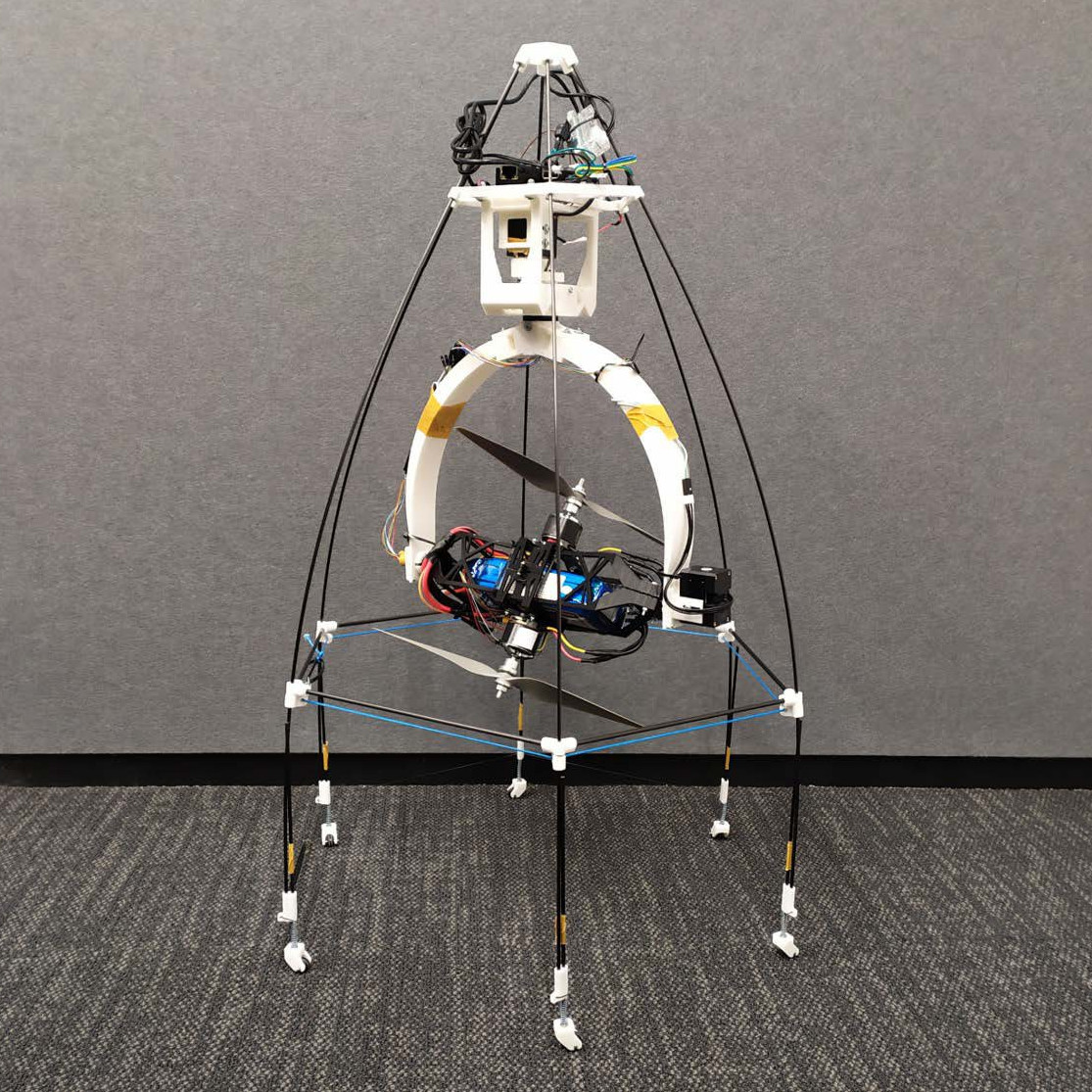
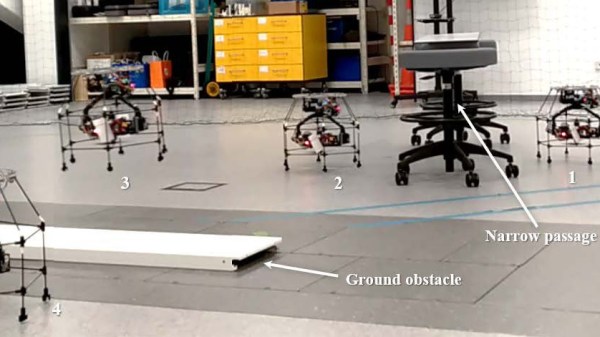
Omnirotor flies over obstacles with its gimballed, caged, coaxial rotors.

Gimballed Omnirotor Goes Over Great Obstacles

What can drive on the ground, hop in the air, and continuously move its coaxial rotor assembly without ever having to reset its position? The answer is [New Dexterity]’s Omnirotor All-Terrain Platform.

Although still very much a prototype, the video below the break shows that the dexterity claimed by Omnirotor isn’t just a lot of hype. Weaving through, around, and over obstacles is accomplished with relative ease by way of a coaxial rotor configuration that’s sure to turn some heads.

Omnirotor flies over obstacles with its gimballed, caged, coaxial rotors.
Omnirotor’s unique design lends to its agility

While not novel in every aspect, the Omnirotor’s strength comes from a combination of features that are fairly unique. The coaxial rotors are fully gimballed, and as such can be moved to and from any direction from any other direction. In other words, it can rotate in any axis infinitely without needing to return to a home position. Part of this magic comes from a very clever use of resources: The battery, speed controllers, and motors are all gimballed as one. This clever hack avoids the need for large, heavy slip rings that would otherwise be needed to transmit power.

Adding to the Omnirotor’s agility is a set of wheels that allow the craft to push itself along a surface, presumably to decrease power consumption. What if an obstacle is too difficult to drive around or past? The Omnirotor takes to the air and flies over it. The coaxial rotors are caged, protecting them from the typical rotor-snagging dangers you’d expect in close quarters.

[New Dexterity] has Open Sourced the entire project, with the Omirotor design, Firmware, and even the benchmarking platform available on Github so that others can share in the fun and iterate the design forward even further.

You might also enjoy this tetrahedron based omnirotor, or another omnirotor that knows how to play fetch. Really.

Continue reading “Gimballed Omnirotor Goes Over Great Obstacles”

A 3D-printed maypole braider can produce woven tubes of rope, yarn, or whatever you've got. Al dente spaghetti strands, maybe.

3D-Printed Braiding Machine Will Show You The Ropes

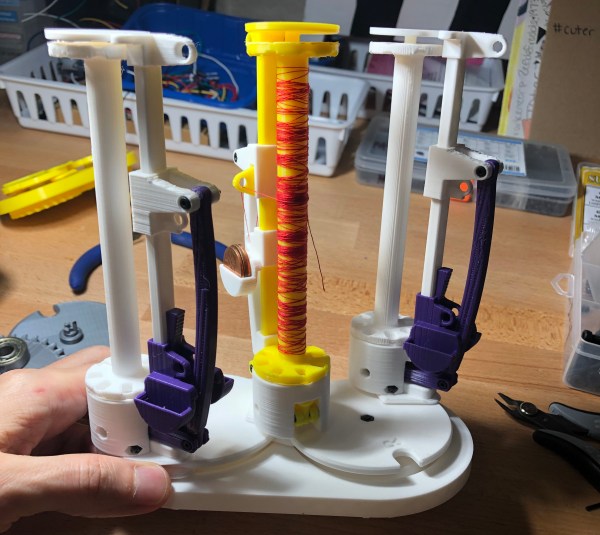
A maypole braider, aka a circular braider, is a type of horn gear braider that makes braided tubes, like one of those woven finger traps or that lovely bit of gutted paracord that’s jazzing up your otherwise boring DIY USB cable. They are called so because the action mimics the motion of a group of maypole dancers bobbing and weaving around each other in an intricate choreography that results in an equally intricate pole decoration job.

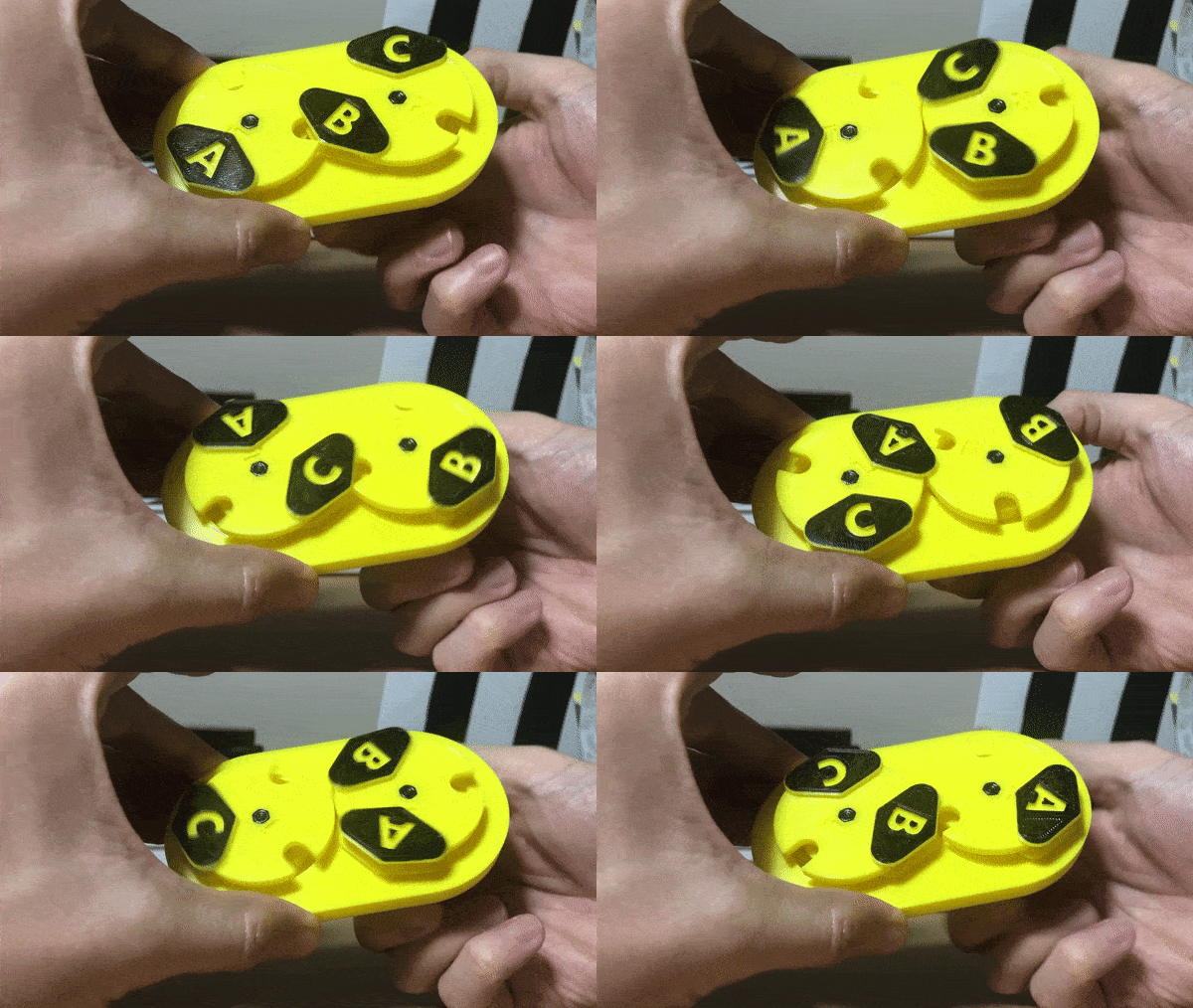
A 3D-printed model showing the motion of a maypole braider. Maypole braiders like [kmatch98]’s are responsible for all kinds of ropes, cords, and other braided goods like fly-fishing lines. They use three or more bobbins, each loaded up with a single strand of yarn.

One of the most important parts of braiding anything, including hair, is maintaining tension on the braid as you go. Here, each bobbin rides inside a bobbin carrier, which performs a number of tasks — it holds the bobbin in place, releases yarn when it’s supposed to, and maintains tension on the yarn while skating a figure eight around the track.

This mesmerizing machine consists of spur gears, a frame with a figure 8 track, a pair of horn gears, and a foot — a guide on the bottom of the bobbin that rides along in the track. Early on, [kmatch98] made a fidget spinner version to visualize the basic function. He studied pictures of commercial bobbin carriers and managed to not only reverse engineer them, but improve the design by eliminating one of the two springs and replacing it with gravity. The remaining spring is used for the bobbin release.

Surprisingly, this isn’t the first plastic braiding machine we’ve featured. Here’s one made of freakin’ LEGO.

Here Are The Ten Finalists For The Hackaday Prize Wildcard Challenge

Each phase of the 2021 Hackaday Prize challenged designers to reimagine traditional solutions within various fields, from robotics to assistive devices. But for the Reactivate Wildcard, the fifth and final Challenge of this year’s Prize, this theme of Rethink, Refresh, Rebuild could be applied on anything the entrant wanted. Today we’re pleased to announce the ten Wildcard projects that have been selected to win $500 and move onto the finals. Who will win the top spot this year? We’ll find out during Hackaday Remoticon in just a few weeks!

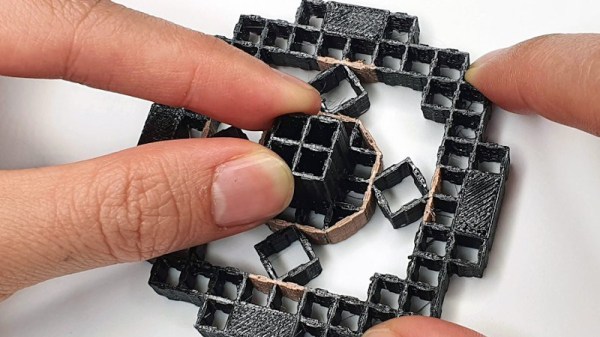
The MetaSense project is a perfect example of how new technology can be used to rethink what we generally consider to be a solved problem. This project leverages multi-material 3D printing to produce conductive cells which vary their capacitance in response to physical deformation. With some clever geometry, these cells can be chained together to produce single-part devices which can stand in for traditional toggle switches, joysticks, pressure sensors, and even accelerometers.

Speaking of 3D printing, the Direct Granules Extruder project imagines a future were desktop printers are no longer limited to using rolls of manufactured filament. The key is a robust extruder design that can grind up plastic pellets fast enough to feed them directly into the hotend of a conventional 3D printer. This not only means a considerable operational savings, as raw plastic pellets are much cheaper than filament by weight, but would potentially allow for printing with more exotic plastic blends and even recycled materials.

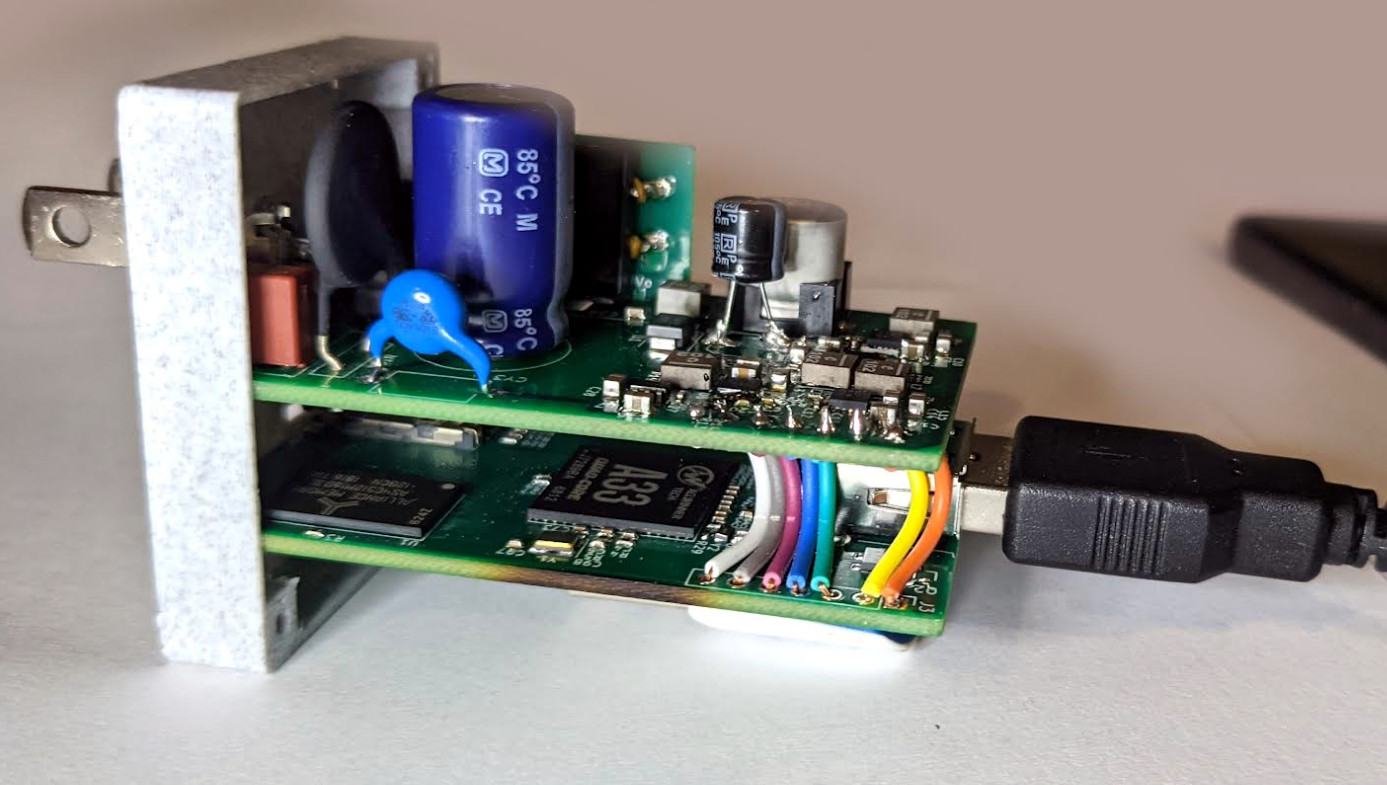
Some of the projects even made us rethink what’s possible for the individual hacker. The WiFiWart utilizes a miniature single-board Linux computer that was designed and built from the ground up by a single person, using only free and open source software. Whether it’s that this penetration testing gadget has packed a full Linux computer and two WiFi adapters into a box the size of a phone charger, or the fact that it’s been done by a dedicated hacker with free tools, you can’t help but come away impressed with this one.

Wild For Wildcard

With nearly 100 projects submitted for the Reactivate Wildcard challenge, this was clearly a theme that resonated with the Hackaday community. As always, it was extremely difficult to narrow this down to the ten finalists below:

Whether or not they made the Finals this year, the complete list of Reactivate Wildcard entries contains an incredible array of fascinating concepts that are well worth browsing through. If any of them particularly catch your eye, why not strike up a conversation with the creator in the comments and see if you can’t help out? There’s always next year.

Tiny Open Hardware Linux SBC Hides In Plain Sight

There was a time, not quite so long ago, when a computer was a beige box that sat on your desk. Before that, computers were big enough to double as desks, and even farther back, they took up a whole room. Today? Well today it’s complicated. Single-board computers (SBCs) like the Raspberry Pi put a full desktop experience in the palm of your hand, for a price that would have been unfathomable before the smartphone revolution increased demand for high-performance ARM chips.

But compared to the tiny open hardware Linux SBC that lives inside the WiFiWart, even the Raspberry Pi looks massive. Developed by [Walker] as a penetration testing tool, the custom computer is housed in an enclosure designed to make it look like a traditional (if a bit large) USB phone charger. In fact, it doesn’t just look like a USB charger, it actually is one. The internal power supply is not only capable of converting AC into the various DC voltages required to run the miniature Linux box, but also features a USB port where you can plug in your phone to charge it.

For the infosec folks in the audience, the applications for the WiFiWart are obvious. Just plug this thing in somewhere inconspicuous, and you’ve got a foot in the door. The dual WiFi interfaces mean you can connect to a target network on one card and use the second to spin up a fake access point or exfiltrate data. Plus with a quad-core Cortex-A7 ARM processor running at 1.2 GHz and a healthy 1 GB of DDR3, you’ll have enough power to run many security tools locally.

But of course, nothing keeps you from using the WiFiWart for non-security purposes. That’s what has us particularly excited, as you can never have enough open hardware Linux boards. Especially ones this tiny. Removed from its wall charger disguise, the brains of the WiFiWart could be used for all kinds of projects. Plus, not only is the final design open source, but [Walker] made sure to only use free and open source tools to create it. Keeping his entire workflow open means it will be easier for the community to utilize and improve upon his initial design, which in the end, is the whole idea behind the open hardware movement and efforts such as the Hackaday Prize.

This Really Really Is Your Last Chance To Enter The 2021 Hackaday Prize (Really!)

Oh, walnuts! How can we already be at the end of the last round? 2021 has been a time warp and now we are staring down the final day to enter the Reactivate Wildcard challenge of the Hackaday Prize. You must enter by 7 AM Pacific time on Wednesday or it’s too late!

Of course the good news is that the topic is wide-open. Wildcard is for all the things that didn’t fit in the first four entry challenges. If it’s a good idea, if it’s a build that really matters, it should be entered!

The ten winning projects from this round will each get $500 cash prizes, and be shuttled on to the final round. All 50 finalists will have until November 7th to hone their offerings, at which point our slate of expert judges will pick the most interesting and impactful for the $25,000 grand prize and four other top prizes.

And how, you ask, will you find out who won? The Hackaday Prize Ceremony will be held online on November 20th during the Hackaday Remoticion. So your assignment today is to warm up that keyboard, mouse, and smartphone camera to get your project entered right away! Step two is to grab your ticket to Remoticon for a weekend of wonderful talks, great people, and an inspiring lineup of hardware builds that made this year’s Hackaday Prize truly shine.

Wondering what kind of stuff makes a great Wildcard entry? Majenta Strongheart has you covered in her latest video roundup below.

Continue reading “This Really Really Is Your Last Chance To Enter The 2021 Hackaday Prize (Really!)”