An All Lead Screw 3D Printer You Can Build Yourself

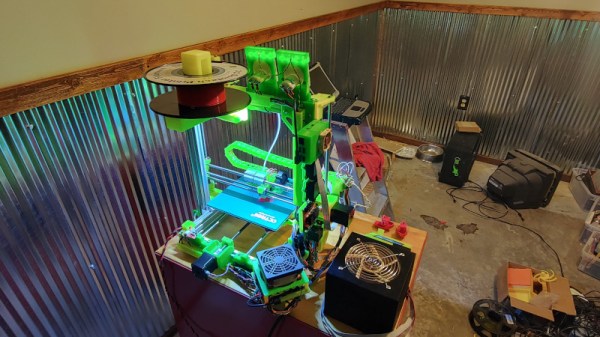
There was a time when the curious hardware hacker  had to build their own 3D printer, because commercial models were so expensive as to be unaffordable except by well-funded institutions. We’re fortunate then to live in an era in which a good quality off-the-shelf machine can be had without breaking the bank, but that is not to say that home-made 3D printers are a thing of the past. Instead the community of rapid prototyping experimenters continue to push the boundaries of the art, and from that we all benefit. An example comes from [Morgan Lowe], whose 3DLS lead screw driven 3D printer joins the freely downloadable designs to be found on Thingiverse.

If at first sight you think it looks a little familiar, you are correct, as it takes its frame design from the popular AM8 metal frame upgrade for the Anet A8 off-the-shelf printer. It draws heavily from other A8 upgrades, and brings in some parts such as the extruder and bed from the Creality Ender3. This is the beauty of incremental open source, and the result is a belt-free printer that does a decent-looking Benchy on the bench, and as a party piece manages to print a slightly more hairy little plastic boat when suspended at 45 degrees by a rope from the ceiling.

When dipping a toe into the world of home made 3D printers it’s interesting to take a look into some of the earlier Hackaday RepRap posts, and see how far we’ve come.

Maker Therapy Joins The Fight Against COVID-19

We love talking about makerspaces here at Hackaday. We love hearing about the camaraderie, the hacks, the outreach, the innovation, everything. Even more, we love seeing all the varying forms that makerspaces take, either in the hacks they create, the communities they reach out to, and especially their unique environments.

Recently, we came across Maker Therapy, a makerspace right inside a children’s hospital. Now, we’ve heard about hospital makerspaces here on Hackaday before, but what makes Maker Therapy particularly unique is it’s the first hospital makerspace that gives patients the opportunity to innovate right in the pediatric setting.

Inspired by patients and founded by Dr. Gokul Krishnan, Maker Therapy has been around for a few years now but recently popped up on our radar due to their unique position on the frontlines of the COVID-19 pandemic. As a makerspace located right inside a hospital, Maker Therapy is in the unique position to be the hospital’s very own rapid prototyping unit. Using 3D printing and other tools, Maker Therapy is able to make face shields and other important PPE right where they are needed the most.

Here at Hackaday, we salute and give our eternal gratitude to all the health care professionals fighting for our communities. Maybe some of your hacks and other designs could be used by initiatives like Maker Therapy? Until then, stay home and stay safe Hackaday. The only way we’ll get through this is together.

Printed Brain Implants Give New Meaning To Neuroplasticity

3D printing has opened up a world of possibilities in plastic, food, concrete, and other materials. Now, MIT engineers have found a way to add brain implants to the list. This technology has the potential to replace electrodes used for monitoring and implants that stimulate brain tissue in order to ease the effects of epilepsy, Parkinson’s disease, and severe depression.

Existing brain implants are rigid and abrade the grey matter, which creates scar tissue over time. This new material is soft and flexible, so it hugs the wrinkles and curves. It’s a conductive polymer that’s been thickened into a viscous, printable paste.

The team took a conductive liquid polymer (water plus nanofibers of a polystyrene sulfonate) and combined it with a solvent they made for a previous project to form a conductive, printable hydrogel.

In addition to printing out a sheet of micro blinky circuits, they tested out the material by printing a flexible electrode, which they implanted into a mouse. Amazingly, the electrode was able to detect the signal coming from a single neuron. They also printed arrays of electrodes topped with little wells for holding neurons so they can study the neurons’ signals using the electrode net underneath.

This particular medical printing hack is pretty far out of reach for most of us, but not all of them are. Fire up that printer and check out this NIH-approved face shield design.

What Day Is It?

With much of the world staying at home at the moment, keeping track of our sanity and the day of the week is a bit of a challenge, especially without the normal daily routine to hold onto. To help with one of these problems, [phreakmonkey] has built a Day Clock. As the name suggests, it’s only purpose is to show what day of the week it is.

Avery simple device, the two main components are a servo and a Wemos D1 Mini, the popular ESP8266-based dev board. Using the NTPtimeESP library, it gets day of the week from the internet, and moves the servo to indicate the current day on a 3D printed face. Most readers should be able to whip one up in an hour or two, which can help keep sane in these interesting times.

For another Corona clock, check out [Elliot Williams]’ version that helps with keeping domestic peace. If you want to do something to combat the spread of the current epidemic, you can build a few face shields, make your idle computer available for Folding@Home or sew a few masks. Every bit helps.

Flexible Build Platforms Work For FDM, How About SLA?

Flexible steel sheets as the foundation for build platforms are used to great advantage in FDM 3D printers. These coated sheets are held flat by magnets during printing, and after printing is done the sheet (with print attached) can be removed and flexed to pop the prints free. This got [Jan Mrázek] thinking. He was pretty sure the concept could extend to the build platform on his Elegoo Mars resin printer. With a flexible build platform, troublesome prints could be more easily removed, so he non-destructively modified his printer to have a similar system. [Jan] is clear that this is only a proof of concept, but the test results were good! He printed several jobs that were known to be trouble, and they were all a piece of cake to remove.

[Jan]’s mod consists of a 3D printed, two-piece unit that encapsulates the normal build platform and contains a few strong magnets. A thin sheet of steel sticks flat to this new piece, held in place by the magnets within, and becomes the new build platform. After a print is done, the sheet is removed and [Jan] reports that its flexibility is a big help in removing otherwise troublesome prints, such as the 3D printed solder stencil we covered recently.

[Jan] provides his CAD model but doesn’t really recommend using it for anything other than development work. Results were promising, but there are a number of drawbacks to the prototype. For one thing, it makes the build platform thicker and the Z-axis limit switch needs to be physically lowered in order to zero the unit. Also, the thicker build platform means the volume of resin the build tank can hold is reduced. Still, the idea clearly has merit and shows there absolutely is value in hardware having a hackable design.

Compliant Quadruped Legs Using Servos

Walking robots that move smoothly are tricky to build and usually involve some sort of compliant leg mechanism — a robot limb that can rebound like natural physiology for much better movement than what a stiff machine can accomplish. In his everlasting quest to build a real working robot dog, [James Bruton] is working on an affordable and accessible Mini Robot Dog, starting with the compliant leg mechanism.

The 3D printed leg mechanism has two joints (hip and knee), with an RC servo to drive each. To make the joints compliant, both are spring-loaded to absorb external forces, and the deflection is sensed by a hall effect sensor with moving magnets on each side. Using the inputs from the hall effect sensor, the servo can follow the deflection and return to its original position smoothly after the force dissipates. This is a simple technique but it shows a lot of promise. See the video after the break.

A project can sometimes develop a life of its own, or in the case of [James]’s OpenDog, spawn experimentally evolving offspring. This is number four, and it’s designed  to be a platform for learning how to make a quadruped walk properly, and to be simple and cheap enough for others to build. We’re looking forward to seeing how it turns out.

If you missed it, also check out this robot’s weird sibling, self-balancing Sonic.

Continue reading “Compliant Quadruped Legs Using Servos”

A Practical Dual-Arm SCARA 3D Printer

We see a lot of 3D printers here at Hackaday, but as over the years the 3D printer has moved from being an exciting item in its own right to being an everyday tool, it’s increasingly rare for us to feature a build of one as a project. It’s especially rare for us to see a 3D printer that isn’t a variation of either an XYZ Cartesian design or a delta printer, but that’s what [bondus] has done with a printer based upon a parallel SCARA mechanism. If SCARA isn’t something you’re familiar with, it’s a design used in the world of industrial robots in which an almost humanoid jointed arm works in two dimensions, with the third being provided by raising or lowering the whole construction. It has the advantage of greater speed than Cartesian designs, at the expense of higher quality joints being required to maintain accuracy of positioning.

This is the second SCARA printer he’s built, and has a sturdy set of aluminium arms and substantial bearings. Drive comes via a pair of belts to some very large pulleys, and calibration is extremely important to ensure that both arms are in exactly the same plane. The curcular bed is on a lead screw that provides the Z axis.

The results are certainly impressive, both is speed and in print quality. We’ve placed a video of it in action below the break. Whether or not SCARA printers improve to the point of being ubiquitous isn’t something we can supply an answer to, but we’ve featured a small number of them in the past. Particularly memorable is this one using an industrial robotic arm.

Continue reading “A Practical Dual-Arm SCARA 3D Printer”