Keypad Input Scanning By A 555 Timer

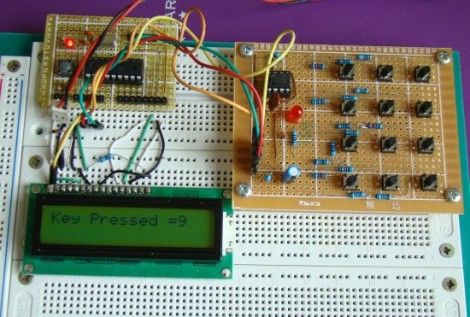
[R-B] designed a 555 timer circuit to scan a keypad. Keypads are common interfaces for small projects and require row and column scanning by a microcontroller. [R-B’s] setup allows you to reduce the number of pins used on the microcontroller to just two. One is an interrupt that is triggered when any of the buttons are pushed, the other reads the frequency from the 555 chip. Each button has its own resistance which alters the frequency of the 555. The microcontroller reads the frequency for 100ms using a timer. The number of timer overflows that occur during that period directly correspond to the button press (five overflows for the numeral 5, zero overflows for the numeral zero).

We usually debounce our button presses for 40 ms, this is more than twice that amount of time but still not a staggering difference. It does make us wonder if you will miss quick button presses? The only really way to know is to try this out yourself. Check out the video after the break and don’t forget to leave a comment with your own experiences in working with the circuit.
Continue reading “Keypad Input Scanning By A 555 Timer”

Earthquake Alert System


[Roteno’s] submission for the 555 timer design contest is an Internet connected earthquake alert system. It monitors the USGS website for earthquake data and plays a tune when an earthquake occurs. The data is available as a feed in the form of a TXT file which is pretty easy to parse using cURL. He chose an LPCXpresso board (which is an ARM development platform that can run a Linux kernel) along with an XPORT module to handle the Ethernet traffic.

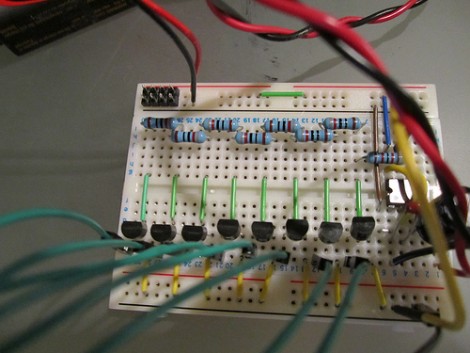
So where does the 555 timer see some action? It is responsible for playing the tone when an earthquake is detected. But playing just one pitch isn’t much fun. Instead, [Roteno] built the circuit above which creates a resistor network switched by a series of transistors. This way he can use GPIO from the microcontroller to choose different pitches. Check out the video after the break to hear the results. At power-up all eight pitches are played as a test, and the alert sound varies in pitch and tempo based on the magnitude of the earthquake.

Continue reading “Earthquake Alert System”

2-bit Full Adder Using Just Thirty Six 555 Timers

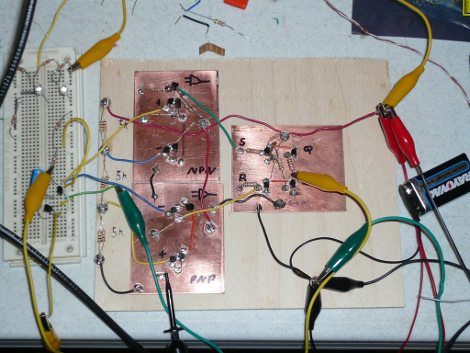
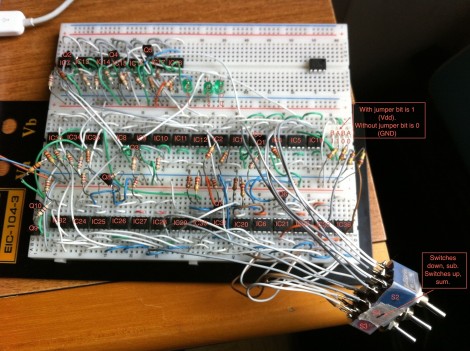
This 2-bit adder was a lot of work to build. It uses a total of thirty-six 555 timers and it does have the option of adding or subtracting numbers. It’s a rather unorthodox use of the part, depending more on the chip as an inverter and taking advantage of the fact that there’s an NPN transistor built into it. [cpu86] did use some PNP transistors to give him the ability to turn off some of the 555’s to get everything working correctly.

He explains the use of two’s complement in the subtracting feature but the process is just touched on very quickly. Luckily there’s a huge eagle schematic available with his project writeup so that you can follow along and really grasp how this thing works. We’ve generated a PNG and embedded it after the break for your convenience. You’ll find it just after the two videos of the device in action.

Continue reading “2-bit Full Adder Using Just Thirty Six 555 Timers”

Analog Robotic Concepts

Everyone’s getting on board with the 555 timer projects. But [Tom] didn’t just come up with one project, he shared a slew of ideas related to analog robotics. They’re center around servo motor control. You can see in the video after the break he has a pleasing way of sharing a lot of details while also making an easy to view demonstration video. He’ll put up a schematic for about one second and then move on, saving those that don’t care about the details by not droning on.

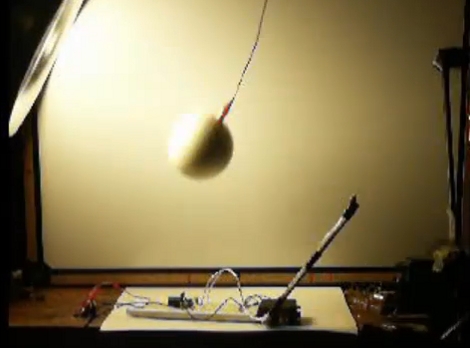
The first schematic that flashes by is the main circuit for controlling the servo motor. The rest of the concepts build from this circuit, using light, sound, flex, and other sensors as inputs. For instance, the setup above is using a light sensor. When the ball blocks the light the servo moves that vertical rod hitting it out of the way. When it swings back the process repeats. It’s striking how lifelike the reactions are, reminding us of insect movements. But this is really just the tip of the iceberg as he’s got a lot of future video ideas that we can’t wait to see.

Continue reading “Analog Robotic Concepts”

555 Inductance Meter

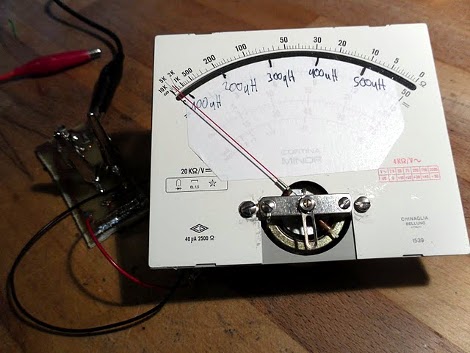
[Apexys] is performing some experiments with switched-mode power supplies and needed to compare the inductance of the coils he was using. His multimeter doesn’t have an inductance testing function, but he does have a 555 timer on hand. He put the 555 and some other parts together to create his own L meter. The writeup includes the theory behind this meter, with an incoming AC source converted to a voltage by an RC network.

Once he’d worked out the design it was time to build the circuit. Instead of printing a circuit board he created what he calls a DCB; Drawn Circuit Board. We’ve got to admit that this was way faster than using toner transfer or soldering point-to-point. We also like his use of an Erlenmeyer flask and a torch to heat the etchant. We don’t make PCBs in the winter because our Cupric Chloride is too cold to use outside but that may change now. The final piece in the puzzle is an analog meter which he pulled from an extra microamp meter he had on hand. Check out the demo after the break.

Continue reading “555 Inductance Meter”

Building A 555 Timer From Discrete Components

The 555 Design Contest shook a whole bunch of really creative circuits out of the trees, hence the 555-heavy content lately. While not technically part of the contest, [esalazar] wanted to know what made the 555 tick, literally! He started working on the project in a circuit simulator, then ultimately ended up building the three main logic blocks inside the familiar timer on pieces of copper-clad board. He’d built a 555 using discrete components.

While this isn’t 100% compatible with the classic 555 IC, it covers the basics pretty well, and [esalazar] gets extra-credit points for embracing the hacker spirit of seeing for himself how stuff works while documenting it well and citing his references.

555 Video Game

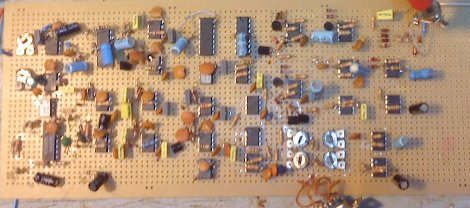
[Thrashbarg] is back up to some 555 timer madness again, this time with his sort of dodge ball video game. Featuring twenty three 555 timers, op amps (the LM324) and atari paddles slightly modded so the pots act as voltage dividers.

Output is on a monochrome composite tv signal, and the game plays like a dodge ball game where the object is to avoid the ball and take out the other player. You can also launch your own ball and deflect the oncoming attack. When hit the defeated player disappears from the screen for 3 seconds and then another round starts.

On a personal note this project hits close to home, as the project I had planned was a 555 based pong game, and just days before the deadline all I have is a wobbly sync generator, so seeing something close to what I had imagined, and working, makes me smile and feel a little better about my mental status.

Check out a short video after the break, and [Thrashbarg’s] previous 555 project, The Synthanola.

Continue reading “555 Video Game”