On Point: The Yagi Antenna

If you happened to look up during a drive down a suburban street in the US anytime during the 60s or 70s, you’ll no doubt have noticed a forest of TV antennas. When over-the-air TV was the only option, people went to great lengths to haul in signals, with antennas of sometimes massive proportions flying over rooftops.

Outdoor antennas all but disappeared over the last third of the 20th century as cable providers became dominant, cast to the curb as unsightly relics of a sad and bygone era of limited choices and poor reception. But now cheapskates cable-cutters like yours truly are starting to regrow that once-thick forest, this time lofting antennas to receive digital programming over the air. Many of the new antennas make outrageous claims about performance or tout that they’re designed specifically for HDTV. It’s all marketing nonsense, of course, because then as now, almost every TV antenna is just some form of the classic Yagi design. The physics of this antenna are fascinating, as is the story of how the antenna was invented.
Continue reading “On Point: The Yagi Antenna” →

A Remotely Tuned Magnetic Loop Antenna

If you are a radio amateur, you may be familiar with the magnetic loop antenna. It’s different from most conventional wire antennas, taking the form of a tuned circuit with a very large single-turn coil and a tuning capacitor. Magnetic loops have the advantage of extreme selectivity and good directionality, but the danger of a high voltage induced across that tuning capacitor and the annoyance of needing to retune every time there is a frequency change.

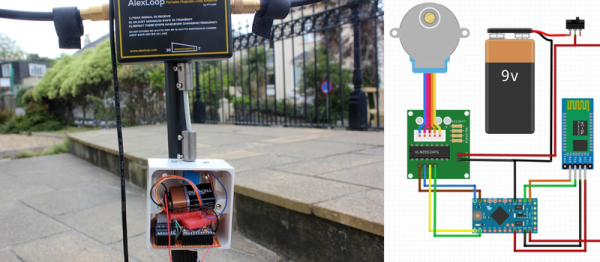
[Oleg Borisov, RL5D] has a magnetic loop, and soon tired of the constant retuning. His solution is an elegant one, he’s made a remote retuning setup using a stepper motor, an Arduino, and a Bluetooth module (translated here). The stepper is connected to the capacitor via a short flexible coupling, and tuning is performed with the help of a custom Android app. We’d be interested to know what the effect of a high RF field is on these components, but he doesn’t report any problems so it must be working.

He’s posted a video of the unit in operation which we’ve posted below the break, if you’ve ever had to constantly retune a magnetic loop you will appreciate the convenience.

Continue reading “A Remotely Tuned Magnetic Loop Antenna” →

ESP32 WiFi Hits 10km With A Little Help

[Jeija] was playing with some ESP32s and in true hacker fashion, he wondered how far he could pull them apart and still get data flowing. His video answer to that question covers the Friis equation and has a lot of good examples of using the equation, decibels, and even a practical example that covers about 10km. You can see the video below.

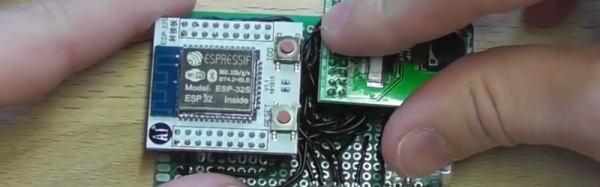
Of course, to get that kind of range you need a directional antenna. To avoid violating regulations that control transmit power, he’s using the antenna on the receiving end. That also means he had to hack the ESP32 WiFi stack to make the device listen only on one side. The hack involves putting the device in promiscuous mode and only monitoring the signals being sent. You can find the code involved on GitHub (complete with a rickrolling application).

Continue reading “ESP32 WiFi Hits 10km With A Little Help” →

RadiantBee Is A Flying Microwave Antenna Calibration System

Many of the projects we link to here at Hackaday have extensive write-ups, pages of all the detail you could need. Sometimes though we happen upon a project with only a terse description to go on, but whose tech makes it one worth stopping for and unpicking the web of information around it.

Such a project is [F4GKR] and [F5OEO]’s RadiantBee, an attempt to use a beacon transmitter on a multirotor as an antenna calibration platform. (For more pictures, see this Twitter feed.) In this case a multirotor has a GPS and a 10 GHz beacon that emits 250 ms chirps, from which the receiver can calculate signal-to-noise ratio as well as mapping the spatial response of the antenna.

The transmitter uses a Raspberry Pi feeding a HackRF SDR and a 10 GHz upconverter, while the receiver uses an RTL-SDR fed by a 10 GHz to 144 MHz downconverter. The antennas they are testing are straightforward waveguide horns, but the same principles could be applied to almost any antenna.

There was a time when antenna design at the radio amateur level necessitated extensive field testing, physical measurements with a field strength meter over a wide area, correlation of figures and calculation of performance. But with computer simulation the field has become one much more set in the lab, so it’s rather refreshing to see someone producing a real-world simulation rig. If you ever get the chance to evaluate an antenna through real-world measurement, grasp it with both hands. You’ll learn a lot.

We’ve covered very few real-world antenna tests, but there is mention in this write-up of a radar antenna test of a measurement session on a football field.

Via Southgate ARC.

Adding An External Antenna To The Raspberry Pi Zero W

Putting a complete WiFi subsystems on a single-board computer is no mean feat, and on as compact a board as the Zero W, it’s quite an achievement. The antenna is the tricky part, since there’s only so much you can do with copper traces.

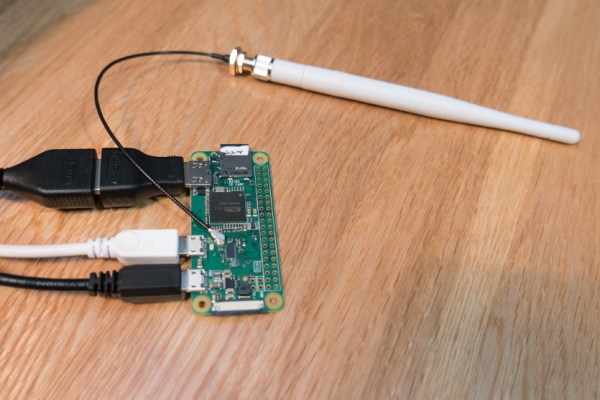
The new Raspberry Pi Zero W’s antenna is pretty innovative, but sometimes you need an external antenna to reach out and touch someone. Luckily, adding an external antenna to the Zero W isn’t that tough at all, as [Brian Dorey] shows us. The Pi Zero W’s designers thoughtfully included solder pads for an ultra-miniature surface-mount UHF jack. The jack pads are placed very close to the long, curving trace that acts as a feedline to the onboard antenna. There’s even a zero ohm SMT resistor that could be repositioned slightly to feed RF to the UHF jack. A little work with a soldering iron and [Brian]’s Pi was connected to an external antenna.

[Brian] includes test data, but aside from a few outliers, the external antenna doesn’t seem to offer a huge advantage, at least under his test conditions. This speaks to the innovative design of the antenna, which [Roger Thornton] from the Raspberry Pi Foundation discussed during last week’s last week’s Hack Chat. Check out the archive for that and more.

Thanks to [theEngineer] for the tip.

Antenna Analyzer Is A Lab In A Box

There was a time when the measure of a transmitting radio antenna was having it light an incandescent bulb. A step up was a classic SWR/Power meter that showed you forward and reflected power. Over the years, a few other instruments have tried to provide a deeper look into antenna performance. However, the modern champion is the antenna analyzer which is a way of measuring vector impedance.

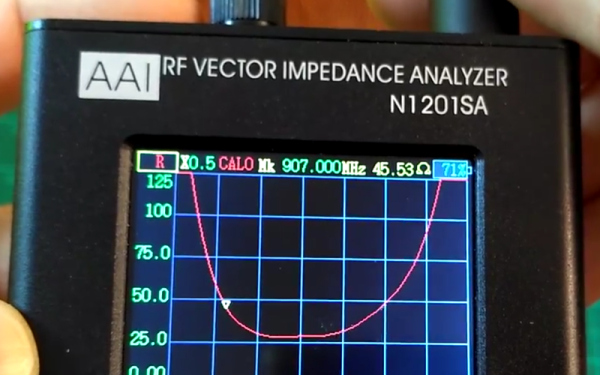
[Captain Science] did a review of an inexpensive N1201SA analyzer. This device is well under $200 from the usual Chinese sellers. The only thing a bit odd is the frequency range which is 140 MHz to 2700 MHz. For some extra money (about $80 or $100 more) you can drop the low-end frequency to just under 35 MHz.

Continue reading “Antenna Analyzer Is A Lab In A Box” →

Loop Antenna Is Portable

We don’t know if [OH8STN] has a military background, but we suspect he might since his recent post is about a “DIY Man Portable Magnetic Loop Antenna.” “Man-portable” is usually a military designation, and — we presume — he wouldn’t object to a woman transporting it either.

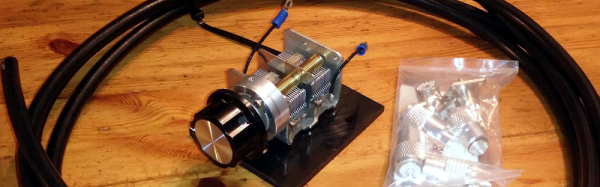
[OH8STN] started with a Chameleon antenna starter kit. This costs about $100 and is primarily a suitable variable capacitor with a 6:1 reduction drive premounted and soldered. Of course, you could source your own, but finding variable capacitors that can handle transmit duty (admittedly, these can apparently handle about 10 W continuous or 25 W on single sideband) can be tricky, especially these days. Although he started with a kit, he did modify the antenna to switch between two different sets of ham radio bands. You can see the antenna in the video below.

Loop antennas aren’t ideal–but neither is any other small antenna. Because the loop is tightly tuned to a particular frequency, it requires retuning for even relatively small frequency changes, even though it can operate on many different frequencies. If you want more technical details, you might enjoy this recent presentation from [W4RAX]. The links at the end are worth checking out, too.

Continue reading “Loop Antenna Is Portable” →