Simple DTMF Decoder Pulls Numbers From YouTube Videos

dtmf_decoder

While many of us have banished land line telephones from our houses, there are still quite a few people who utilize POTS lines today. These analog phone systems use Dual Tone Multi Frequency (DTMF) signals in order to audibly represent all of the keys on a telephone keypad and place calls. [Brad] over at LucidScience decided that it would be useful to have a DTMF decoder on hand, and got busy building one.

His DTMF decoder box uses a CM8870 DTMF decoder chip, which you might assume is all you need to get the job done. This chip performs its duties very well, outputting a 4-bit binary code for each button press it registers, but that doesn’t do a whole lot of good without being able to represent those codes in a meaningful fashion. He first built a breadboard decoder circuit that would light 1 of 16 LEDs depending on the detected button press. This was well and good, but he decided that an Arduino-driven LCD display would work far better.

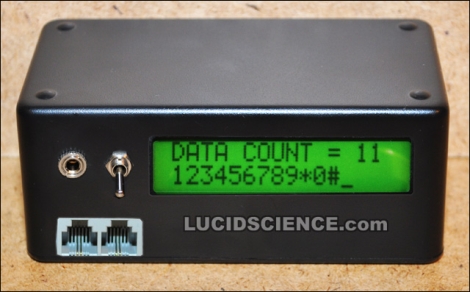
When he was finished, he had a compact decoder box with an LCD display, which accepts input from either an RJ-11 cable or an audio jack. He says that the audio jack is particularly useful for decoding tones from computer audio, such as YouTube clips. [Brad] praises the CM8870 chip, stating that it can pull phone numbers from pretty much any audio or phone signal you throw at it, regardless of quality. We think it would make a great basis for a telephone-based security system, if that was something that appealed to you.

Be sure to stick around to see his DTMF decoder circuit in action.

Continue reading “Simple DTMF Decoder Pulls Numbers From YouTube Videos”

Bluetooth Bot Constructed From Thrift Store Rejects

bluetooth_bot

[John] wrote in to share his latest creation, an Arduino-controlled Bluetooth robot. You might remember him from one of his previous hacks, the Lawnbot 400. This time around, he has decided to scale things down a bit and focus his hacking on small R/C toys.

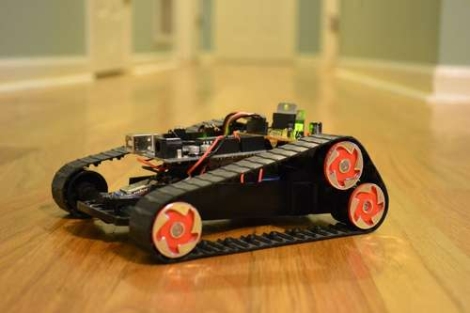
His Bluetooth bot was constructed using a cheap R/C tank he scored at a thrift store for about $1.50. He removed all of the bot’s parts, aside from the frame, the battery compartment, and the motors that drive the treads. He added in an Arduino, which he paired with an Ardumoto shield from SparkFun. The motor shield costs about $25, but he does have schematics available so that you can roll your own if you so desire.

A Bluetooth Mate was added to the car, which allows serial communication with any other Bluetooth device. Once everything was wired up, he paired the robot with his computer and got down to driving it by simply pressing keys on his keyboard.

It looks like a fun little toy to have around, and it seems fairly easy to construct. Check out the videos below of his robot in action, and be sure to check out his code/schematics if you are interested in building your own.

Continue reading “Bluetooth Bot Constructed From Thrift Store Rejects”

R/C Car Controlled By An IPad Or Kinect

ipad_kinect_rc_control

R/C cars can be tons of fun, but sometimes the fun runs out after awhile. [Gaurav] got bored of steering around his R/C car with its remote, so he built an interface that lets him control the car using two different motion-detecting devices.

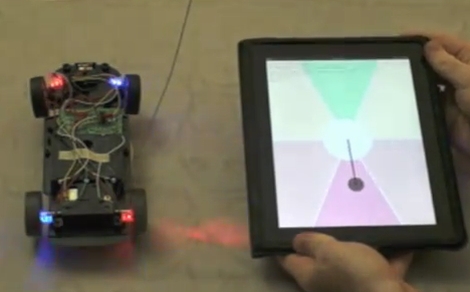
He built an HTML5 application for his iPad, which allows him to steer the car around. As you can see in the video below, the application utilizes the iPad’s tilt sensor to activate the car’s motors and steering depending on where on the screen he has moved the guide marker.

The second steering method he devised uses his Kinect sensor to track his movements. His hand gestures are mapped to a set of virtual spaces similar to those which the iPad uses. By moving his hands through these areas, the Arduino triggers the car’s remote just as it does with the iPad.

The actual remote control interface is achieved by wiring the car’s remote to an Arduino via a handful of opto-isolators. The Arduino is also connected to his computer via the serial port, where it waits for commands to be sent. In the case of the iPad, a Python server waits for commands to be issued from the HTML5 application. The Kinect’s interface is slightly different, with a C# application monitoring his movements and sending the commands directly to the serial port.

Check out the video below to see the car in action, and swing by his site if you are interested in grabbing some source code and giving it a try yourself.

Continue reading “R/C Car Controlled By An IPad Or Kinect”

The ElectroAxé Full-Body Percussion Suit

Carnival in Salvador, Brazil is arguably one of the biggest and craziest parties this world has ever known.  With millions in attendance for what is already an incredible audio and visual display, performers are faced with the daunting task of continually bringing something new and fresh to the masses. One could always add more fireworks or visual displays (never a bad thing), but it will only take you so far. [Kyle McDonald] and [Lucas Werthein]’s answer: The ElectroAxé Full-Body Percussion Suit as demonstrated by Carlinhos Brown at Carnival 2011.

When most people hear the word “axe” as related to music they think of an electric guitar. “Axé” however, refers to a unique Afro-Caribbean fusion genre of music that originated in Salvador in the mid 1980’s and is a favorite at Carnival. [Carlinhos Brown] is a popular Brazilian percussionist and was looking for a creative new way to express himself through his song and dance. Instead of being stuck in one place near his instruments or carrying one or two drums around “marching-band style”, he is now able to move around the stage freely – his body has become his instrument.

In order to make the magic happen, [Kyle] and [Lucas] designed custom laser cut and cnc machined drum pads containing piezo sensors and integrated them with a full-body jump suit. When struck, these sensors send a signal to an Arduino with a Sparkfun Midi Shield housed in a custom enclosure on the performer’s waist. From there the MIDI signal is sent wirelessly and then audio is played through the existing sound system – it appears that a CMD WIDI X-8 wireless MIDI system is employed for the actual wireless transmission.

Although details are somewhat scarce, there are plenty of pictures, (more) available.  You really can’t argue with the results as you watch thousands of people jam along.

Come join in the festivities with video after the break!

Continue reading “The ElectroAxé Full-Body Percussion Suit”

Converting The BlinkM Into The World’s Tiniest Arduino

blinkm_arduino

The BlinkM “Smart LED” is a great little device on its own accord. It allows for complete control of its RGB LED using a built-in microcontroller, enabling the user to do a wide array of things that normally require PWM to accomplish. At just over half an inch square, this little device might also be the smallest Arduino on the market.

The BlinkM packs an ATiny85 micro controller, which allows it to be flashed with the Arduino bootloader thanks to the people over at the [High-Low Tech group at MIT]. They did some tweaking of the Arduino IDE configuration files and incorporated some core library code created by [Alessandro Saporetti] to get the job done – all of which is available on their site.

Once the code is uploaded to the BlinkM, you essentially have a micro Arduino running at 8MHz with a built in LED and 2 I/O lines (5 if you snip off the LED). It’s a great device to have on hand if you feel like a full-fledged Arduino would be overkill in your project.

Stick around to see a video tutorial of the reflashing process.

Continue reading “Converting The BlinkM Into The World’s Tiniest Arduino”

Wireless Luge Timer Levels The Playing Field

wireless_luge_timer

In Colorado, amateur luge competitions are serious business.

Every winter, [Ryan’s] friends dig a long luge track through the many feet of snow that occupies their yard, and have competitive sled races to see who can make it down the giant hill in the least time. They call it the Mario Cup, after one of the participants, not the Nintendo mascot, and they were in desperate need of some timing equipment.

You see, the luge track is several hundred feet long, and they decided that a human armed with a stopwatch is not a good enough means of picking a conclusive winner. A set of three Arduino sensors packed inside plastic food containers were used along with light sensors to track when the luger passed the start, midpoint, and finish lines of the race. XBee radios then transmitted the timing data back to the base station for recording.

The system worked quite well according to the participants, and they look forward to using the system again in the future. Of course, improvements have been planned, including dual timers at each checkpoint to gauge the luger’s speed, as well as a Christmas-tree starting signal like you see at drag races.

Continue reading to see a video below of the luger’s in action, as well as the timer system undergoing some tests.

[via Make]

Continue reading “Wireless Luge Timer Levels The Playing Field”

Nano Sumo Robot Takes On All Comers

nano_sumo_bot

While most Sumo-style robots are fairly sizable, there is a subsection of the Sumo robot movement that focuses on making small robots. Really small robots.

[Patrick] wrote in to share his latest creation, a Nano Sumo robot measuring a scant 1 in. x 1 in. The Nano Sumo is operated by an ATMega 328 micro controller housed on a custom-built PCB. The board was designed to interface directly with the 1A Dual Motor Driver from SparkFun, which provides all of the PWM signaling to the motors for speed control and braking. A small 50mAh Li-poly battery is attached to the robot, which can be charged using 4 AA batteries via a custom charging circuit. The mechanical components of the bot were handled by his friend [Gary], which you can read about here.

As you can see in the video below, the bot does its job pretty well. It does seem like the object detection gets confused every once in awhile, but that can likely be remedied with a few software tweaks.

Check out his page for additional build videos, including the PCB construction and programming processes.

If you’re interested in learning more about Sumo bots, check out this slightly larger robot we covered a short while back.

Continue reading “Nano Sumo Robot Takes On All Comers”