Recycled Sound – An Art Installation Not Lacking Arduinos

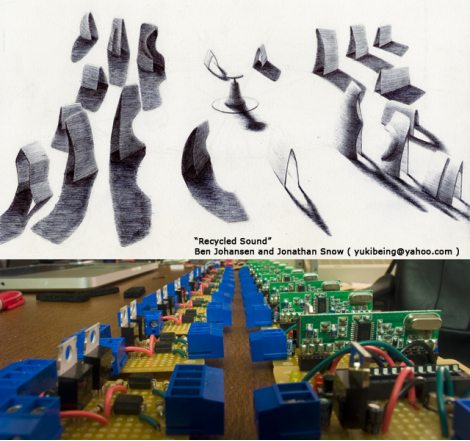
[oakkar7] wrote in to show us [Ben Johansen] and [Jonathan Snow]’s  interactive art installation, Recycled Sound(Website has a virus). The exhibit will premiere  in the TWU Arts Triangle Walking Tour March 25th from 5-7pm.

Currently a work in progress, the final plan is for the outdoor installation to feature a podium in the center with a rotating top, and various islands surrounding. As the podium’s top is rotated the surrounding islands come to life with a variety of light and sound displays which vary depending on how the podium is turned. While the electronics are not recycled, the actual sculptures and music making elements themselves consist of scrap yard parts and factory waste.

The whole display runs off of 12.. yes TWELVE Atmel 328s with Arduino boot loaders! The center podium houses a transmitting circuit consisting of two atmega 328s with Arduino boot loaders sharing a crystal, an hmc 6532 magnetometer breakout board and two RF transmitters.  The Islands each contain a receiving module with, obviously,  an Arduino and RF receiver. The receiving Arduinos connect to opto isolated switching modules for motors and lighting. Check out [Ben]’s blog for in progress shots, code, and build information.

If you are looking to control some 12V motors/lights with your 5V Arduino be sure to check out the pictures in the blog. While we here at Hackaday may be quick to jump into soldering [Ben] follows the proper development progression to the letter. Each aspect is bread boarded, then refined, then transferred to a soldered perf board.

update: His site has some kind of malware going on. None of us noticed it in Firefox, but after complaints we fired up ol IE. Yup, nastyness there. You can go there at the following link if you dare.

More after the jump:

Continue reading “Recycled Sound – An Art Installation Not Lacking Arduinos”

Boom Goes The Dynamite – Murals Made With Precision Explosives

explosive_artwork

[Alexandre Farto] is known for some off the wall art displays, but his newest work takes the phrase literally. Using precisely placed explosive charges, he has been sculpting portraits and other murals on walls in various places around London.

The detail at which he is able to produce these images is incredible, considering he is blowing chunks of plaster and brick from walls to form them. We can only guess as to how much preparation time is required to finish even one of these images, let alone to amass the stunning portfolio he has put together.

He has also recently teamed up with musical artist [Orelha Negra] to produce a cool video of his work as it was being sculpted, which is certainly worth the three minutes it takes to watch. The video, embedded below, is chock full of slow-motion shots of the demolition/sculpting in progress.

If you have a few minutes, be sure to check out his site to take a look at some of his work, we think you will be impressed.

Continue reading “Boom Goes The Dynamite – Murals Made With Precision Explosives”

Pactuator: Mechanical Pac-Man Frame

As a proof of concept for his long term work in progress “The Pac-Machina” (an electro-mechanical reimagining of a Pac-Man cabinet), [Jonathan] needed some way to make a mechanical Pac-Man, flappy jaw and all. After working through a couple different design possibilities, he decided on an interesting setup which includes using a cog with only half its teeth to make the mouth open and close. Unfortunately, NAMCO BANDAI has asked him nicely not to sell these as kits, but he has helpfully included just about all that is required to make one of these from scratch. [Jonathan] even cut and laser etched his own faux-Victorian frame to keep his proof of concept Pac-Man ready until needed for the main project.

RFID Triggered Presentation Box

blasphemous_bible_box

[Lace] needed to build a “box project” for his college art class and figured he could spice things up a bit by adding some electronic components to the mix. His project, dubbed the ‘Blasphemous Bible Box‘ consists of a bible opened up the section of the book of Revelations that discusses the mark of the beast in an old cigar box. The box is normally locked, but has been programmed to unhook an internal latch when he passes the RFID chip embedded in his hand over it. The effect could have been achieved using a simpler circuit, but the enclosed Arduino seems to do the job decently enough. [Lace] has not mentioned if he has considered revising the box any, but a spring-loaded external latch secured with a magnetic lock would make for a nice effect if version 2 was ever built. Adding a servo to slowly open the box as well as including a speaker blaring Carmina Burana – O Fortuna upon opening would be pretty cool as well (hint, hint). We have video of the box in action after the break.

Continue reading “RFID Triggered Presentation Box”

Chroma – Mesmerizing LED Driven Fractal Display

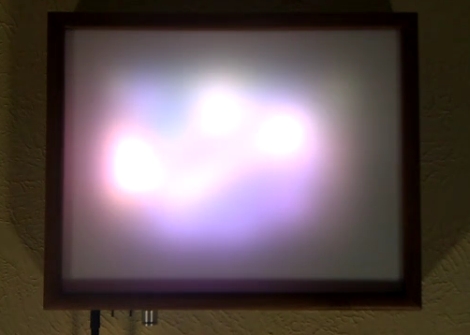
chroma in action

A big fan of generative art, [Andrew Magill] wanted to build an LED display for his wall that constantly displayed images from the Electric Sheep project.  After discounting the possibility of generating these fractals on the fly, he settled on using prerecorded video clips gathered over a year’s time by Electric Sheep users.  With thousands of video clips in hand, he wrote some custom software that enabled him to sequence these 5-second video clips into just over 6 hours of video, which he later downsampled to fit his 24×16 pixel display.

Now that he had some impressive video put together, [Andrew] began designing the LED panels he would use to show off his creation.  After choosing TI TLC5947 drivers to control the LED arrays, he got to work on designing the PCBs, soldering in all of the components, and testing the displays.  Initial testing completed, he wrote some more custom software to direct the individual LED boards from a master controller, and mounted everything in a frosted-glass adorned picture frame.

Be sure to check out mesmerizing video of Chroma in action after the break.

Continue reading “Chroma – Mesmerizing LED Driven Fractal Display”

Make A Knitting Machine Print Pixel Art

[Becky Stern] shows how to take an old electronic knitting machine and interface it with a computer. After seeing the Brother KH-930E knitting machine in the video after the break it looks like the controls function quite like a CNC milling machine. Patterns can be programmed in and stored on a floppy disk. Since we don’t want to use those anymore (unless they’re hacked as an SD card carriage) it is nice to see that this is how the machine is connected to a computer. Using an altered FTDI cable and a floppy-drive emulator written in Python a blank design file can be saved on the knitting machine, manipulated in the computer to add your own pixel art, then loaded back onto the machine for production. At the very least, it’s interesting to watch the knitting happen, but fans of knitted apparel and geek paraphernalia must be salivating by now.

We’ve never given up our dream to transition from Hack-A-Day to Craft-A-Day, this just fuels the fire for that cause.

Continue reading “Make A Knitting Machine Print Pixel Art”

Cellphone Crowd-pleasers

When you start to think about the cellphone waste our society produces it can be quite daunting. How many cell phones have you had in recent years? Now multiply that by five billion cellphone subscribers. [Anthony Goh] and [Neil Mendoza] found something to do with a very minuscule portion of those left-overs; building interactive birds out of the old parts. You’ll have to check out their accomplishments in the video after the break as the image above doesn’t do them justice. Interactivity for the exhibit is provided by an Arduino, which communicates with one working phone via a serial connection. The phone can still make and receive calls, and controls parts from other, less functional cellphones. They can call each other, or receive calls from the audience.

Yes, there is art in garbage. But there’s also a lot of hacks waiting to happen. Take a look at the Nokia cellphone LCD feature and then start scavenging.

Continue reading “Cellphone Crowd-pleasers”