Making A Robot To Serve Some Mean Badminton Shuttlecocks

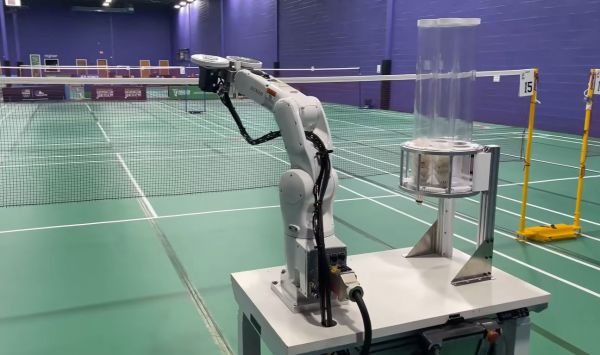
Sometimes regarded as a less violent form of tennis, badminton is still a pretty challenging sport. One which suffers like so many sports from requiring at least two players since magically flying balls and shuttlecocks haven’t been invented yet. After years of tinkering on a shuttlecock serving robot, [Travis Mitchell] hit upon the idea to convert a small industrial robotic arm for the purpose.

The target of this conversion is a positively cute-sized Denso VS050 robotic arm, with Denso helpfully providing a 3D model of the arm as a solid jumping-off point in a CAD project. Here the task of the robotic arm is two-fold: one is to grab a fresh shuttlecock from a hopper with a pneumatic grabber, the other is to feed it into the spinning wheels that grip and launch it. Fortunately [Travis] has a pretty tricked-out workshop available, including the ability to 3D print metal parts, making building the prototype a snap.

After initially thinking of using a Raspberry Pi Pico, he ended up using an ATmega AVR due to the input-output requirements when communicating with the arm. Using a height-adjustable desk as the base, the whole assembly was put together for some testing on the badminton court.

With most of the testing having been done in the shop already, the remaining issue was to determine the best disc material, as the two high-speed discs that grip the shuttlecock must be well-balanced and not stretch too much. Ultimately a 3D printed plastic disc with a silicone strip as gripping surface was found to work pretty well, allowing for the robot to finally start serving its function.

Continue reading “Making A Robot To Serve Some Mean Badminton Shuttlecocks”
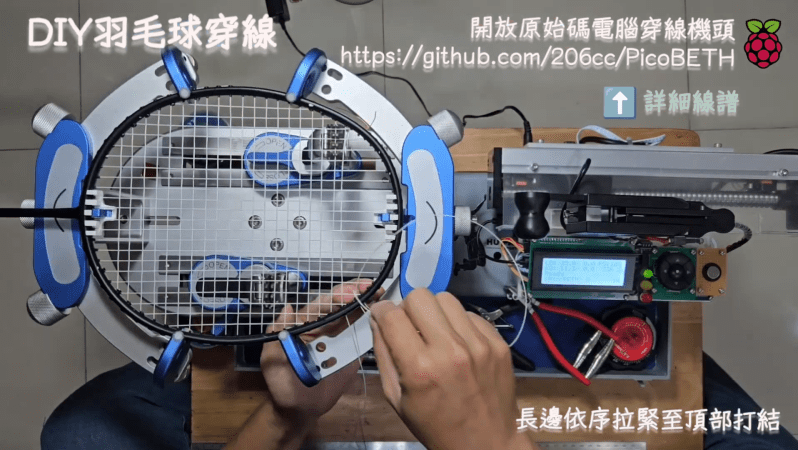
Pi Pico Helps Restring Badminton Rackets

Stringing a badminton racquet is a somewhat complicated job. It needs to be done well if the racquet is to perform well and the player is to succeed. To that end, [kuokuo] built a machine of their own to do that very task. Even better, they’ve made it open source so other hobbyists can benefit from their work.

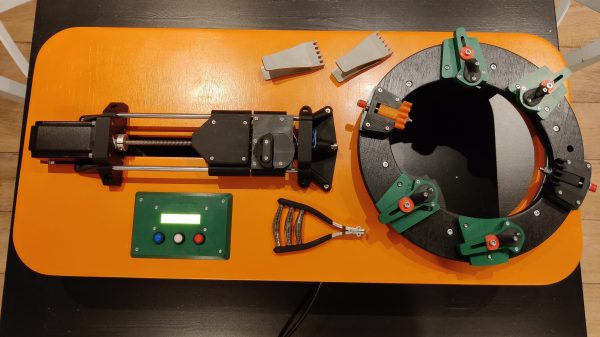
The build is named PicoBETH, which stands for Pico Badminton Electronic Tension Head. It’s based around the Raspberry Pi Pico, as you might imagine. The Pico is charged with controlling the stringing procedure via a stepper motor and lead screw, while using a load cell to measure string tension during the process. A small two-line character LCD serves as the user interface, along with some buttons, LEDs and a buzzer for feedback. The electronic stringing gear is mounted on to a traditional manual drop-weight stringing machine to execute the process faster and more accurately, at least in theory.

Files are on Github for those that wish to explore the build further. It’s not the first stringing machine we’ve featured here, either! Video after the break.
Continue reading “Pi Pico Helps Restring Badminton Rackets”

Badminton String Winder Gets The Tension Just Right

If you want to keep your badminton game at its peak, you’ll need a good racket with a proper set of strings. When an injury kept [Antonie Colin] off the court for a few months, building a restringing machine helped pass the time.

The design is straightforward, using commonly-available motion components and 3D-printed parts. The round assembly at one end is used to hold the racket during the restringing process. A leadscrew mechanism driven by a stepper motor is used to apply tension to the strings, anywhere from 18 lbs to 34 lbs. Strings can also be prestretched if so desired. The stringing process is managed by an Arduino, which uses a loadcell to monitor tension placed on the strings. An LCD screen on the device provides feedback on the process and allows various functions to be selected. Flying clamps are used to hold strings in place during the process, either fitted from above or below the device as needed.

If you find yourself regularly restringing your badminton racket, or you simply don’t trust your local pro shop to do so, you might find this build useful. You might also like to build a shuttlecock launcher for training if your practice partners aren’t available on the regular. Our badminton department is looking rather bare at the moment, so don’t hesitate to send your own nifty hacks in to the tipsline!

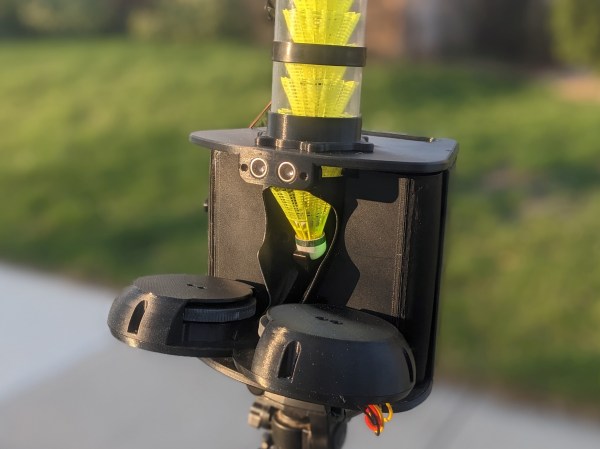
A badminton shuttle launcher loaded with shuttles

Hackaday Prize 2023: Automated Shuttle Launcher Enables Solo Badminton Practice

If you want to get better at your favorite sport, there’s really no substitute to putting in more training hours. For solo activities like running or cycling that’s simple enough: the only limit to your training time is your own endurance. But if you’re into games that require a partner, their availability is another limiting factor. So what’s a badminton enthusiast like [Peter Sinclair] to do, when they don’t have a club nearby? Build a badminton training robot, of course.

Automatic shuttlecock launchers are available commercially, but [Peter] found them very expensive and difficult to use. So he set himself a target to design a 3D-printable, low-cost, safe machine that would still be of real use in badminton training. After studying an apparently defunct open-source shuttle launcher called Baddy, he came up with the basic design: a vertical shuttle magazine, a loading mechanism to extract one shuttle at a time and position it for launch, and two wheels spinning at high speed to launch the shuttle forward. Video after the break. Continue reading “Hackaday Prize 2023: Automated Shuttle Launcher Enables Solo Badminton Practice”

Badminton Inspired Heat Shield Aims To Fly This Year

Badminton is not a sport that most of us think about often, and extremely rarely outside of every four years at the summer Olympics and maybe at the odd cookout or beach party here or there. But the fact that it’s a little bit unique made it the prime inspiration for this new heat shield design, which might see a space flight and test as early as a year from now.

The inspiration comes from the shuttlecock, the object which would otherwise be a ball in any other sport. A weighted head, usually rubber or cork, with a set of feathers or feather-like protrusions mounted to it, contributes to its unique flight characteristics when hit with a racquet. The heat shield, called Pridwen and built by Welsh company Space Forge, can be folded before launch and then expanded into this shuttlecock-like shape once ready for re-entry. It’s unlikely this will protect astronauts anytime soon, though. The device is mostly intended for returning materials from the Moon or from asteroids, or for landing spacecrafts on celestial bodies with atmospheres like Mars or Venus.

With some testing done already, Space Forge hopes this heat shield will see a space flight before the close of 2023. That’s not the end of the Badminton inspiration either, though. It’s reported that this device can slow a re-entering craft so much that it can be caught in a net. Not exactly the goal when playing the sport, but certainly a welcome return home for whichever craft might use this system. Of course, getting down from space is only half the battle. Take a look at this other unique spacecraft that goes up in a fairly non-traditional way instead.

Robomintoner Badminton Bot To Defeat Amateur Humans

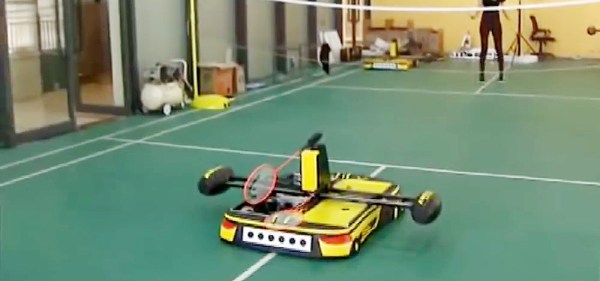
Watching robots doing sports is pretty impressive from a technical viewpoint, although we secretly smile when we compare these robots’ humble attempts to our own motoric skills. Now, a new robot named Robomintoner seeks to challenge human players, and it’s already darn good at badminton.

Continue reading “Robomintoner Badminton Bot To Defeat Amateur Humans”