geochron_world_clock_clone

World Clock Simulates Night And Day

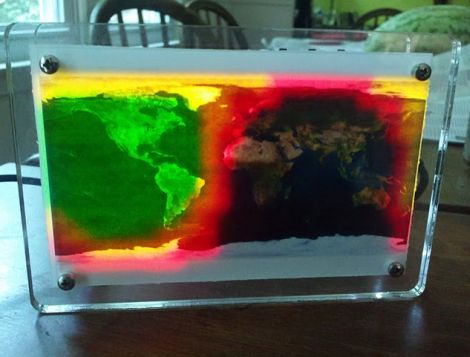
[Justin] always wanted a GeoChron clock, but since they run in the range of several thousand dollars apiece, he was pretty certain he would never have the chance to own one. Undaunted, he figured out a way to build a small version of the clock for himself, and he wrote in to share how it was done.

He first purchased a Wise Clock 3 from FlorinC, but he definitely wasn’t going to use the clock as it was originally intended. Rather than display the time in numbers, he pulled the Wise Clock apart and sandwiched a vellum printout of a world map in between the front face plates. A tweaked firmware image allows him to simulate day and night using the Wise Clock’s LED array. He also programmed the clock to take into account seasonal light patterns, as you can see in the video embedded below.

We think this is a great idea, and though we would probably use plain white LEDs if we built one, the RGB LEDs in the Wise Clock certainly provide a neat effect.

Continue reading “World Clock Simulates Night And Day”

Build A Clock Using Dials Instead Of Hands

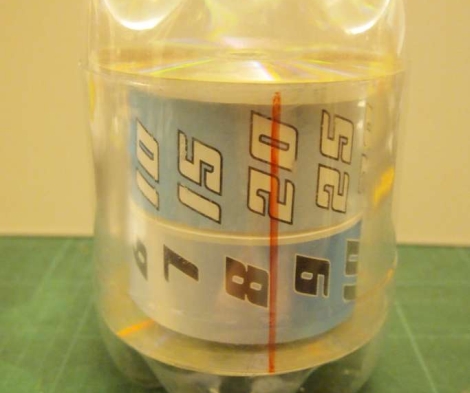
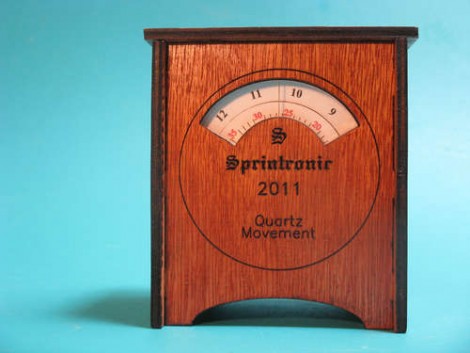
[Doug Paradis] found a simple way to use dials instead of hands on a clock. Actually, that’s pretty much the entire hack… use dials instead of hands. He grabbed a battery-operated clock movement from the hobby store, then printed out one dial for hours, another for minutes, robert’s your mother’s brother, and you’ve got a new clock. The case seen above is laser cut, with a window and index line that helps you read the time precisely.

But instead of building a case, we’d like to try this with some retro equipment. The first thing that pops to mind is to replace the disks on a broken strobotuner, like the big-dialed model that Conn used to make. If you’re not down with the bulky music hardware-turned-clock perhaps there’s an old multi-meter, or a panel gauge that can be repurposed for this. We know [Doug] already has some needle meters sitting around that would be perfect for this.

Bootloader Burning Basics

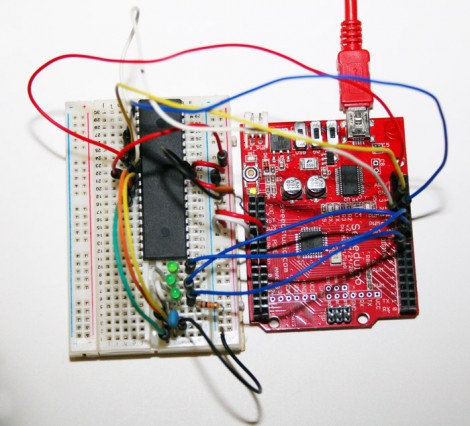
[Charles Gantt] and a few others were having trouble burning the Sanguino bootloader to an ATmega644 chip. With some help from the [Nils Vogil] via the RepRap IRC [Charles] got it worked out and wrote a guide for burning the bootloader using an Arduino as an ISP programmer.

We’re not familiar with the specifics of the Sanguino bootloader, but [Charles] mentioned that he was unable to flash it onto the AVR chip without a resonator. The resonator serves as an external clock source for the chip. We’d bet the programming process changes the fuse settings on the chip to use an external source. Without that source, you won’t be able to communicate with the chip afterwards.

The solution just adds the resonator to the programming circuit. This should be useful when burning any bootloader using an Arduino. But it does make us wonder if there isn’t an alternative method that would let you draw the clock signal from the Arduino itself?

Clocks Built From Old Aircraft Surplus Parts

aircraft_indicator_clocks

A few years ago, Tube Clock forum member[Sine1040] bought a set of four brand new aircraft indicator units that were built some time in the early 70’s. He had no idea what the units were actually used for, but he did know that he could repurpose them into some pretty slick looking clocks.

He disassembled all four boxes and between them, scrounged enough parts to build three clocks. After gutting the clocks and rearranging the digits, he built a timekeeping circuit using an ATMega8 which is clocked by a DS32 oscillator.

While the time is displayed using the large projection-style digit displays, the seconds are ticked off in the left-most analog meter. Minutes are also represented in the clock’s right-most analog window, swinging the needle from top to bottom as each one passes.

[Sine1040] paid special attention to keeping the boxes looking as stock as possible, with the only external modification being a power plug installed in place of an old grounding screw. The clock is definitely a different take on keeping time, and we think it looks great.

Continue reading to see a quick demo video of the clock in action.

[Thanks Brian]

Continue reading “Clocks Built From Old Aircraft Surplus Parts”

Klout Klok Tracks Your Popularity, Time

[Fabien Royer] has been playing around with Netduinos and he just came up with a really awesome project that will display the time and social media popularity. It’s a very nice build, and we’d guess that his social media influence is going to go up very shortly.

Klout is a service that connects to your Facebook or Twitter profile and tells you how much influence you have on a scale of 1 to 100 (possibly 10 to 100. see this). To build the Klout Klock [Fabian] used a Netduino Plus, a good choice because of the integrated ethernet port. The Netduino connects to the Klout API to either satiate vanity or admit prestige. The display is an adafruit TFT screen.

Continue reading “Klout Klok Tracks Your Popularity, Time”

DIY Clock Replica Is Better Than The Real Thing

diy_tix_clock

After seeing the TIX clock for the first time, [Gweedo Steevens] really wanted one, but wasn’t interested in paying the seemingly high asking price over at ThinkGeek. He figured it wouldn’t be too incredibly hard to build his own, so he decided to give it a shot.

The clock relies on 27 LEDs to display the time, which were multiplexed to make the most of his ATMega16 microcontroller’s available IO pins. Once he was happy with how things functioned on breadboard, he migrated the LEDs to a piece of perf board, and etched his own PCB for the controller circuit.

He used an office overhead lighting grate to separate the LEDs, providing nice uniform light segments. He put a piece of clear perspex on the front to cover the LEDs, but later switched it out for a much darker piece, for better daylight viewing.

The finished product is fantastic, and in our opinion looks even better than the retail version – awesome job!

[via HackedGadgets]

Slick 16-segment POV Hard Drive Clock

pov_hdd_clock

Hackaday reader [svofski] sent in a fantastic looking hard drive-based POV clock (Google Translation) created by a maker in the Sichuan province of China. The clock, like the one [svofski] built, relies on LEDs placed behind the spinning platter to create the POV effect.

Quite a few carefully placed cuts have been made to the platter, which make up the segments required to display both numbers and letters of the alphabet. This isn’t a simple 16-segment POV display however. The font uses a lot of sharp edges and odd segment lengths, so we’re guessing that quite a bit of care was taken in the production of this clock.

You can see a demonstration of the clock in the video embedded below, which shows off its ability to display numbers, text, as well as a handful of simple patterns. It looks like there are some details available on the designer’s site, however it is all in Chinese, and Google’s translation is questionable at best. If only we knew someone that could give us a hand with deciphering the inner-workings of this clock…

Continue reading “Slick 16-segment POV Hard Drive Clock”