Building An Electromagnetic Pendulum Clock

electromagnetic_pendulum_clock

[Stephen Hobley] has been experimenting with an electromagnetic pendulum in order to build himself a clock. Through the course of his experiments, he has learned quite a bit about how pendulums function as well as the best way to keep one moving without the need for chains and weights, which are typically associated with these sorts of clocks.

His first experiments involved driving a simple pendulum with a pulse motor. He discovered that the easiest way to keep the pendulum moving was to use a coil to detect when the it reached the equilibrium point, pushing it along by sending a small pulse to that same coil. He noticed that he could keep the pendulum moving at a pretty good tick if he triggered the magnetic coil every third pass, so he implemented an Arduino to keep count of passes and apply the appropriate force when needed.

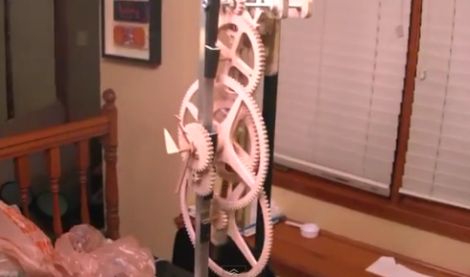
He has been making pretty decent headway since his first experiments and now has nearly all of the clock works assembled. Crafted out of wood, he uses a 15-tooth primary drive ratchet, which powers two 60-tooth gears responsible for keeping track of seconds, as well as a pair of larger gears that track the minutes and hours.

It’s looking good so far, we can’t wait to see it when finished.

Stick around to see a quick video demonstration of the clock with all of its gearing in action.

Continue reading “Building An Electromagnetic Pendulum Clock”

It’s Like… I Can Tell The Time Just By The Color, Man

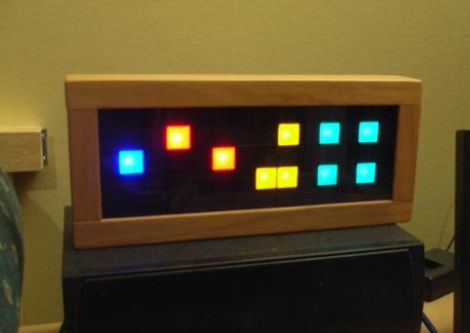
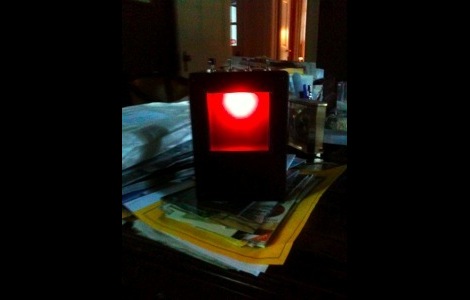
[Alex] has reduced the resolution of his timepiece as a trade-off for speedy-readability. At least that’s what he claims when describing his color-changing clock. It uses a ShiftBrite to slowly alter the hue of the clock based on the current time. The concept is interesting: 12:00 starts off at white and slowly fades to green at 3:00, blue at 6:00, red at 9:00, and back to white by 12:00 to start the process over again. He has gotten to the point where he can get the time within about 15 minutes just with a quick look. But he did need to spend a few days acquiring the skill by having the color clock sit next to a traditional digital clock.

The build is pretty simple and we’d bet you already have what you need to make your own. [Alex] is really just proving a concept by using the ShiftBrite and an mBed, there’s no precision RTC involved here. So grab your microcontroller of choice, and an RGB LED of your own and see if you can’t recreate his build.

Of course you could always choose to build a color-based timepiece that’s even harder to read.

DIY Sunrise Alarm Clock

sunrise_alarm_clock

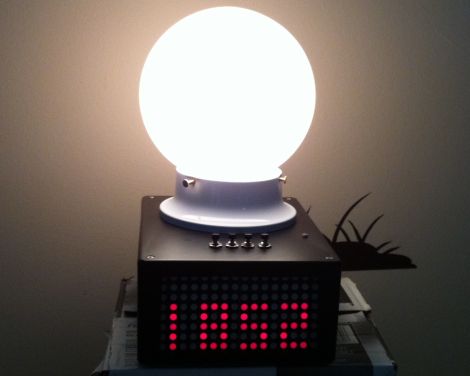
As a project for an embedded systems class, [Alan] recently built himself a sunrise-simulating alarm clock. You are probably familiar with these sorts of timepieces – they gradually light up the room to awaken the sleeping individual rather than jarring them awake with a buzzer or the radio. Since many commercial units with this feature are sold for $70 and up, his goal was to replicate the functionality at a fraction of the cost, using only open source components.

An Arm Cortex M3 processor runs the show, displaying the time via a pair of 8×8 LED matrix panels on the front of the device. The clock is programmed to gently wake up its user by simulating a sunrise over a period of 5, 15, 30, 45, or 60 minutes. If the user has not woken up before the sunrise simulation is complete, the clock resorts to a traditional piezo alarm to rouse the heavy sleeper.

The project is nicely done, and after looking at his bill of materials it seems to be far cheaper than many sunrise alarm clocks you will find in stores.

Watch Hacking, One Day At A Time

watch_a_day

If there is one thing hackers return to time and time again, it is clock/watch hacking. There are always creative ways to tell time, and with several “hackable” wristwatches on the market, there is bound to be no shortage of neat timepiece hacks.

[hudson] from NYC Resistor has decided to take on a fun challenge for the next month revolving around his programmable inPulse watch. Over the upcoming 30 27 days, he will design, program, and publish a watch face for the timepiece. He already has 3 days behind him, and the results are pretty interesting. The concepts are creative and functional, though due to time constraints they sometimes end up a little less polished than he would like.

All of the code is available on his Bitbucket page if you have an inPulse watch and would like to play along or improve on his work.

We think it’s a pretty cool project, and we are eager to see what he produces each day. Stick around to see a quick video showing off one of his 3D watch faces.

Continue reading “Watch Hacking, One Day At A Time”

flipflop_clock

FlipFlop Clock Uses Mains Frequency To Keep Time

One afternoon, [Sam] was a bit bored and decided he would build a clock. Not wanting to spend any money on the project, he set off to construct his clock using only the components he had on hand – this meant no micro controllers would be used whatsoever.

Built on a set of four breadboards, his clock sports a pretty short parts list. It uses just over a dozen flipflops, a few NAND chips, a 555 timer, and a small handful of other components. What you won’t find on the bill of materials however, is any sort of crystal or real-time clock. Instead of using a separate chip for keeping time, he opted to use the 60hz mains frequency as the basis for his time keeping.

The mains sine wave is passed through a series of frequency dividers to reach a 1/60hz signal, which is used to trigger the clock counters he constructed. The time is displayed on a 4-digit seven segment display, using a pair of multiplexers clocked by a 555 timer.

The clock seems to work nicely, though you have to be pretty well-versed in how the clock was built to set the time. The only means of doing so is to probe into the clock of the digit you are setting while pressing the lone pushbutton mounted on the breadboard.

While we are pretty sure no one will ever mess with his clock’s time, we have to wonder if it blinks on and off like our old VCR when the power goes out.

How Low Can You Go?

That’s exactly what [Kenneth Finnegan] figured out with his original investigation into low powered MSP430-based circuits. He was able to keep a count-up timer running off of 20F worth of capacitors for over 10 weeks. Although quite impressive by its own merit, many people left comments that questioned whether similar results would be seen in a circuit with functionality more advanced than simply incrementing a single digit on an LCD. Well folks, [Kenneth] has stepped it up again with this ultra low power LCD clock.

The biggest challenge in creating this clock was finding an efficient way to drive the 28 LCD segments off of the limited number of pins on his MSP430G2231 chip while still having open pins for button inputs as well. An ICM7211 LCD driver is definitely up for the task (with a few clever modifications to drive the auxiliary characters such as the center colon), but requires 8 pins to drive it. A standard 74HC595 latching shift register brings this number down to a more manageable number of 3 total pins.

Once completed the total current consumption was found to be around 12μA – low enough for a claimed run-time of approximately two and a half years from the 3V 200mAh CR2032 coin cell used. If true, a set of standard AA alkaline cells in series as found in many clocks would run this little circuit for decades.

Stick around for a short video after the break and make sure to check out the original blog entry for schematics and the complete source code!

Continue reading “How Low Can You Go?”

15-digit Nixie Clock Contains Mostly Non-useful Information

[Jarek Lupinski] is at it again, this time building a clock using 15 Nixie tubes. Just look at the time…. wait, how do you read this now? It’s not seconds since the epoch, but an homage to a very expensive New York City art piece. [Jarek] took his inspiration from the Metronome art installation in Union Square.

We hadn’t heard of it before and were shocked to learn that this art was commissioned at $4.2 million. It belches steam and confuses passersby with its cryptic fifteen digits. It seems that the eight digits on the left mark the current time – two digits for hours, two for minutes, two for seconds, and the final digit for hundreths of a second. The seven remaining digits count down the time left in the day. So when you watch it, you see the significant digits of the display increasing, and the insignificant half decreasing.

The Nixie version rests snuggly on a 15″x4″ PCB. We’re sure it doesn’t number in the millions, but that couldn’t have been cheap to have manufactured. Each tube has its own driver chip, removing the need for multiplexing. An ATmega168 controls the clock (along with some shift registers to expand the I/O count), reading time from a DS1307 RTC chip. It looks fancy, but where’s the belching smoke on this version?